• Fri frakt över 249 kr
  • •
  • Snabba leveranser
  • •
  • Billiga böcker
Kundservice

Du är på sajten för privatpersoner.

Företag, bibliotek eller offentlig verksamhet?

Du handlar på classic.bokus.com, där alla dina funktioner finns intakta.
Till classic.bokus.com
Bokus logotyp. Gå till startsidan.
  • Erbjudanden
  • Nyheter
  • Student
  • Topplistor
  • Barn & ungdom
  • Bokus Play
  • E-böcker
  • Pocketböcker
  • Spel & pussel

10% rabatt på allt med kod: NYSTART10 →

Sidfot

Mina sidor

    Hjälp

    • Kundservice
    • Vanliga frågor och svar
    • Frakt och leverans
    • Retur vid ångerrätt
    • Reklamera vara
    • Betalning
    • Köpvillkor
    • Allmänna villkor
    • Information om webbplatsens tillgänglighet

    Om Bokus

    • Om oss
    • Pressrum
    • För studenter
    • För företag
    • För bibliotek och offentlig verksamhet
    • För leverantörer
    • Hållbarhet

    Populärt

    • Aktuella erbjudanden
    • Presentkort
    • Studentlitteratur
    • Nya böcker
    • Topplistor
    • Signerade böcker
    • Engelska böcker

    Inspiration

    • Boktips
    • BookTok
    • Populära bokserier
    • Barnbokskaraktärer
    • Populära författare
    Logotyp för Bokus
    Följ oss på Facebook (extern länk)Följ oss på Instagram (extern länk)Följ oss på YouTube (extern länk)Följ oss på TikTok (extern länk)
    bokus @ CookiesAnpassa cookiesIntegritetspolicyKöpvillkor
    Till Citymail hemsida (extern länk)Till Budbee hemsida (extern länk)Till Postnord hemsida (extern länk)Till Schenker hemsida (extern länk)Till Early Bird hemsida (extern länk)Till Walleys hemsida (extern länk)
    1. Psykologi och pedagogik
    2. Psykologi
    3. Barnpsykologi och utvecklingspsykologi

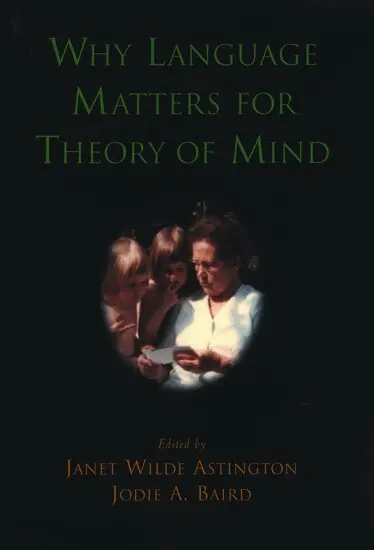
    Why Language Matters for Theory of Mind

    AvJanet Wilde Astington,Jodie A. Baird

    Inbunden, Engelska, 2005

    1 601 kr

    Beställningsvara. Skickas inom 5-8 vardagar. Fri frakt över 249 kr.

    Beskrivning

    "Theory of mind" is the phrase researchers use to refer to children's understanding of people as mental beings, who have beliefs, desires, emotions, and intentions, and whose actions and interactions can be interpreted and explained by taking account of these mental states. The gradual development of children's theory of mind, particularly during the early years, is by now well described in the research literature. What is lacking, however, is a decisive explanation of how children acquire this understanding. Recent research has shown strong relations between children's linguistic abilities and their theory of mind. Yet exactly what role these abilities play is controversial and uncertain. The purpose of this book is to provide a forum for the leading scholars in the field to explore thoroughly the role of language in the development of the theory of mind. This volume will appeal to students and researchers in developmental and cognitive psychology.

    Produktinformation

    • Utgivningsdatum:2005-04-21
    • Mått:166 x 242 x 22 mm
    • Vikt:644 g
    • Format:Inbunden
    • Språk:Engelska
    • Antal sidor:368
    • Förlag:OUP USA
    • ISBN:9780195159912

    Utforska kategorier

    • Barnpsykologi och utvecklingspsykologi inom Psykologi och pedagogik
    • Kognitiv psykologi inom Psykologi och pedagogik

    Recensioner i media

    Why language matters for theory of mind offers all the inspiration and a good deal of the background necessary for child language researchers to start contributing to ToM-language debate.

    Innehållsförteckning

    • 1. Introduction: Why Language Matters ; 2. Language pathways into the community of minds ; 3. Communication, relationships, and individual differences in children's understanding of mind ; 4. Conversation, pretence and theory of mind ; 5. Talking about "new" information: the given/new distinction and children's developing theory of mind ; 6. The developmental origins of meaning for mental terms ; 7. Language promotes structural alignment in the acquisition of mentalistic concepts ; 8. Language and the development of cognitive flexibility: Implications for theory of mind ; 9. Representational development and false-belief understanding ; 10. Can language acquisition give children a point of view? ; 11. What does "that" have to do with point of view? Conflicting desires and "want" in German ; 12. Linguistic communication and social understanding ; 13. The role of language in theory-of-mind development: What deaf children tell us ; 14. How language facilitates the acquisition of false-belief understanding in children with autism ; 15. Genetic and environmental influences on individual differences in language and theory of mind: Common or distinct?