• Fri frakt över 249 kr
  • •
  • Snabba leveranser
  • •
  • Billiga böcker
Kundservice

Du är på sajten för privatpersoner.

Företag, bibliotek eller offentlig verksamhet?

Du handlar på classic.bokus.com, där alla dina funktioner finns intakta.
Till classic.bokus.com
Bokus logotyp. Gå till startsidan.
  • Erbjudanden
  • Nyheter
  • Student
  • Topplistor
  • Barn & ungdom
  • Bokus Play
  • E-böcker
  • Pocketböcker
  • Spel & pussel

10% rabatt på allt med kod NYSTART10 →

Sidfot

Mina sidor

    Hjälp

    • Kundservice
    • Vanliga frågor och svar
    • Frakt och leverans
    • Retur vid ångerrätt
    • Reklamera vara
    • Betalning
    • Köpvillkor
    • Allmänna villkor
    • Information om webbplatsens tillgänglighet

    Om Bokus

    • Om oss
    • Pressrum
    • För studenter
    • För företag
    • För bibliotek och offentlig verksamhet
    • För leverantörer
    • Hållbarhet

    Populärt

    • Aktuella erbjudanden
    • Presentkort
    • Studentlitteratur
    • Nya böcker
    • Topplistor
    • Signerade böcker
    • Engelska böcker

    Inspiration

    • Boktips
    • BookTok
    • Populära bokserier
    • Barnbokskaraktärer
    • Populära författare
    Logotyp för Bokus
    Följ oss på Facebook (extern länk)Följ oss på Instagram (extern länk)Följ oss på YouTube (extern länk)Följ oss på TikTok (extern länk)
    bokus @ CookiesAnpassa cookiesIntegritetspolicyKöpvillkor
    Till Citymail hemsida (extern länk)Till Budbee hemsida (extern länk)Till Postnord hemsida (extern länk)Till Schenker hemsida (extern länk)Till Early Bird hemsida (extern länk)Till Walleys hemsida (extern länk)
    1. Psykologi och pedagogik
    2. Psykologi
    3. Kognitiv psykologi

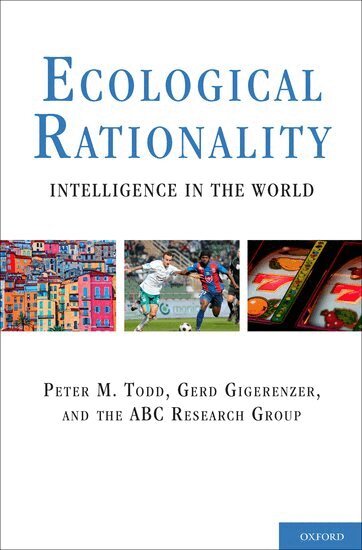
    Ecological Rationality

    Intelligence in the World

    AvPeter M. Todd,Gerd Gigerenzer

    Inbunden, Engelska, 2012

    2 189 kr

    Beställningsvara. Skickas inom 5-8 vardagar. Fri frakt över 249 kr.

    Beskrivning

    "More information is always better, and full information is best. More computation is always better, and optimization is best." More-is-better ideals such as these have long shaped our vision of rationality. Yet humans and other animals typically rely on simple heuristics to solve adaptive problems, focusing on one or a few important cues and ignoring the rest, and shortcutting computation rather than striving for as much as possible. In this book, we argue that in an uncertain world, more information and computation are not always better, and we ask when, and why, less can be more. The answers to these questions constitute the idea of ecological rationality: how we are able to achieve intelligence in the world by using simple heuristics matched to the environments we face, exploiting the structures inherent in our physical, biological, social, and cultural surroundings.

    Produktinformation

    • Utgivningsdatum:2012-05-03
    • Mått:241 x 155 x 30 mm
    • Vikt:907 g
    • Format:Inbunden
    • Språk:Engelska
    • Antal sidor:608
    • Förlag:OUP USA
    • ISBN:9780195315448

    Utforska kategorier

    • Kognitiv psykologi inom Psykologi och pedagogik
    • Psykologiska teorier och skolor inom Psykologi och pedagogik
    • Biovetenskap inom Naturvetenskap och teknik

    Mer om författaren

    Peter M. Todd is Professor of Cognitive Science, Informatics, and Psychology at Indiana University.Gerd Gigerenzer is the Director of the Max Planck Institute for Human Development and Center for Adaptive Behavior and Cognition.

    Innehållsförteckning

    • Part I. The Research Agenda ; 1. What Is Ecological Rationality? ; Peter M. Todd and Gerd Gigerenzer ; Part II. Uncertainty in the World ; 2. How Heuristics Handle Uncertainty ; Henry Brighton and Gerd Gigerenzer ; 3. When Simple Is Hard to Accept ; Robin M. Hogarth ; 4. Rethinking Cognitive Biases as Environmental Consequences ; Gerd Gigerenzer, Klaus Fiedler, and Henrik Olsson ; Part III. Correlations Between Recognition and the World ; 5. When is the Recognition Heuristic an Adaptive Tool? ; Thorsten Pachur, Peter M. Todd, Gerd Gigerenzer, Lael J. Schooler, and Daniel G. Goldstein ; 6. How Smart Forgetting Helps Heuristic Inference ; Lael J. Schooler, Ralph Hertwig, and Stefan M. Herzog ; 7. How Groups Use Partial Ignorance to Make Good Decisions ; Konstantinos V. Katsikopoulos and Torsten Reimer ; Part IV. Redundancy and Variability in the World ; 8. Redundancy: Environment Structure That Simple Heuristics Can Exploit ; Jorg Rieskamp and Anja Dieckmann ; 9. The Quest for Take-The-Best: Insights and Outlooks from Experimental Research Arndt Broder ; 10. Efficient Cognition Through Limited Search ; Gerd Gigerenzer, Anja Dieckmann, and Wolfgang Gaissmaier ; 11. Simple Rules for Ordering Cues in One-Reason Decision Making ; Anja Dieckmann and Peter M. Todd ; Part V. Rarity and Skewness in the World ; 12. Why Rare Things Are Precious: How Rarity Benefits Inference ; Craig R. M. McKenzie and Valerie M. Chase ; 13. Ecological Rationality for Teams and Committees: Heuristics in Group Decision Making ; Torsten Reimer and Ulrich Hoffrage ; 14. Naive, Fast, and, Frugal Trees for Classification ; Laura F. Martignon, Konstantinos V. Katsikopoulos, and Jan K. Woike ; 15. How Estimation Can Benefit From an Imbalanced World ; Ralph Hertwig, Ulrich Hoffrage, and Rudiger Sparr ; Part VI. Designing the World ; 16. Designed to Fit Minds: Institutions and Ecological Rationality ; Will M. Bennis, Konstantinos V. Katsikopoulos, Daniel G. Goldstein, Anja Dieckmann, and Nathan Berg ; 17. Designing Risk Communication in Health ; Stephanie Kurzenhauser and Ulrich Hoffrage ; 18. Car Parking as a Game Between Simple Heuristics ; John M. C. Hutchinson, Carola Fanselow, and Peter M. Todd ; Part VII. Afterword ; 19. Ecological Rationality: The Normative Study of Heuristics ; Gerd Gigerenzer and Peter M. Todd