• Fri frakt över 249 kr
  • •
  • Snabba leveranser
  • •
  • Billiga böcker
Kundservice

Du är på sajten för privatpersoner.

Företag, bibliotek eller offentlig verksamhet?

Du handlar på classic.bokus.com, där alla dina funktioner finns intakta.
Till classic.bokus.com
Bokus logotyp. Gå till startsidan.
  • Erbjudanden
  • Nyheter
  • Student
  • Topplistor
  • Barn & ungdom
  • Bokus Play
  • E-böcker
  • Pocketböcker
  • Spel & pussel

10% rabatt på allt med kod: NYSTART10 →

Sidfot

Mina sidor

    Hjälp

    • Kundservice
    • Vanliga frågor och svar
    • Frakt och leverans
    • Retur vid ångerrätt
    • Reklamera vara
    • Betalning
    • Köpvillkor
    • Allmänna villkor
    • Information om webbplatsens tillgänglighet

    Om Bokus

    • Om oss
    • Pressrum
    • För studenter
    • För företag
    • För bibliotek och offentlig verksamhet
    • För leverantörer
    • Hållbarhet

    Populärt

    • Aktuella erbjudanden
    • Presentkort
    • Studentlitteratur
    • Nya böcker
    • Topplistor
    • Signerade böcker
    • Engelska böcker

    Inspiration

    • Boktips
    • BookTok
    • Populära bokserier
    • Barnbokskaraktärer
    • Populära författare
    Logotyp för Bokus
    Följ oss på Facebook (extern länk)Följ oss på Instagram (extern länk)Följ oss på YouTube (extern länk)Följ oss på TikTok (extern länk)
    bokus @ CookiesAnpassa cookiesIntegritetspolicyKöpvillkor
    Till Citymail hemsida (extern länk)Till Budbee hemsida (extern länk)Till Postnord hemsida (extern länk)Till Schenker hemsida (extern länk)Till Early Bird hemsida (extern länk)Till Walleys hemsida (extern länk)
    1. Djur och Natur
    2. Naturböcker
    3. Växtböcker

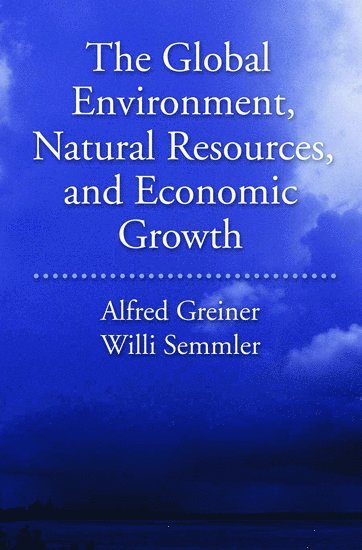
    The Global Environment, Natural Resources, and Economic Growth

    AvAlfred Greiner,Willi Semmler

    Inbunden, Engelska, 2008

    932 kr

    Beställningsvara. Skickas inom 7-10 vardagar. Fri frakt över 249 kr.

    Beskrivning

    Recently, the public attention has turned toward the intricate interrelation between economic growth and global warming. This book focuses on this nexus but broadens the framework to study the issue. Growth is seen as global growth, which affects the global environment and climate change. Global growth, in particular high economic growth rates, imply a fast depletion of renewable and non-renewable resources. Thus this book deals with the impact of the environment and the effect of the exhaustive use of natural resources on economic growth and welfare of market economies as well as the reverse linkage. It is arranged in three parts: Part I of the book discusses the environment and growth. There, Greiner and Semmler incorporate the role of environmental pollution into modern endogenous growth models and use recently developed dynamic methods and techniques to derive appropriate abatement activities that policymakers can institute. Part II looks at global climate change using these same growth models. Here, too, the authors provide direct and transparent policy implications. More specifically, the authors favour tax measures, such as a carbon tax, over emission trading as instruments of mitigation policies. Part III evaluates the use and overuse of renewable and non-renewable resources in the context of a variety of dynamic models. They, in particular, consider the cases when resources interact as an ecological system and analyze issues of ownership of resources as well as policy measures to avoid the overuse of resources. In addition, not only intertemporal resource allocation but also the eminent issues relating to intertemporal inequities, as well as policy measures to overcome them, are discussed in each part of the book.

    Produktinformation

    • Utgivningsdatum:2008-08-14
    • Mått:236 x 160 x 25 mm
    • Vikt:508 g
    • Format:Inbunden
    • Språk:Engelska
    • Antal sidor:220
    • Förlag:OUP USA
    • ISBN:9780195328233

    Utforska kategorier

    • Växtböcker inom Djur och Natur
    • Botanik inom Naturvetenskap och teknik
    • Miljöekonomi inom Ekonomi och Ledarskap

    Mer om författaren

    Alfred Greiner is professor of Economics at Bielefeld University. His research interests are in dynamic macroeconomics with special emphasis on topics in economic growth and fiscal policy. He has published numerous articles and was invited to author the survey article "Models of Economic Growth" for the UNESCO Encyclopedia of Life Support Systems. Willi Semmler is Chair and Professor of Economics at New School University, co-director of the Center for Empirical Macroeconomics, Bielefeld University and Research Fellow at the Bernard Schwartz Center for Economic Policy Analysis. He is the author of numerous articles and several books including Stochastic Dynamic Macroeconomics (OUP, 2006).

    Recensioner i media

    Issues concerning the global environment, natural resources and economic growth are at the heart of a great deal of current political and social debate. Greiner and Semmler in this book address these issues within the framework of modern economic theory, in particular applying the techniques of intertemporal optimal growth theory. They develop an integrated framework for the study of environmental and climate issues as well as those concerning renewable and non-renewable resources. As a result they present a range of simple models that give policy insights and policy recommendations. This book should be of interest to applied economists, climate change modellers and environmental policy makers.

    Innehållsförteckning

    • PART I The Environment and Economic Growth 1: Introduction and Overview 2: The Basic Economic Model 3: Growth and Welfare Effects of Fiscal Policy 4: The Dynamics of the Model with Standard Preferences 5: Pollution as a Stock 6 PART II Global Warming and Economic Growth 7: Introduction and Overview 8: Facts on GHG Emissions and the Change in Average Global Surface Temperature 9: A Descriptive Model of Endogenous Growth 10: The AK Endogenous Growth Model 11: A Model with Optimizing Agents 12: Concluding Remarks PART III Depletion of Resources and Economic Growth 13: Introduction and Overview 14: Non-Renewable Resources 15: Renewable Resources 16: Regulation of Resources 17: Conclusion