• Fri frakt över 249 kr
  • •
  • Snabba leveranser
  • •
  • Billiga böcker
Kundservice

Du är på sajten för privatpersoner.

Företag, bibliotek eller offentlig verksamhet?

Du handlar på classic.bokus.com, där alla dina funktioner finns intakta.
Till classic.bokus.com
Bokus logotyp. Gå till startsidan.
  • Erbjudanden
  • Nyheter
  • Student
  • Topplistor
  • Barn & ungdom
  • Bokus Play
  • E-böcker
  • Pocketböcker
  • Spel & pussel

10% rabatt på allt med kod: NYSTART10 →

Sidfot

Mina sidor

    Hjälp

    • Kundservice
    • Vanliga frågor och svar
    • Frakt och leverans
    • Retur vid ångerrätt
    • Reklamera vara
    • Betalning
    • Köpvillkor
    • Allmänna villkor
    • Information om webbplatsens tillgänglighet

    Om Bokus

    • Om oss
    • Pressrum
    • För studenter
    • För företag
    • För bibliotek och offentlig verksamhet
    • För leverantörer
    • Hållbarhet

    Populärt

    • Aktuella erbjudanden
    • Presentkort
    • Studentlitteratur
    • Nya böcker
    • Topplistor
    • Signerade böcker
    • Engelska böcker

    Inspiration

    • Boktips
    • BookTok
    • Populära bokserier
    • Barnbokskaraktärer
    • Populära författare
    Logotyp för Bokus
    Följ oss på Facebook (extern länk)Följ oss på Instagram (extern länk)Följ oss på YouTube (extern länk)Följ oss på TikTok (extern länk)
    bokus @ CookiesAnpassa cookiesIntegritetspolicyKöpvillkor
    Till Citymail hemsida (extern länk)Till Budbee hemsida (extern länk)Till Postnord hemsida (extern länk)Till Schenker hemsida (extern länk)Till Early Bird hemsida (extern länk)Till Walleys hemsida (extern länk)
    1. Psykologi och pedagogik
    2. Psykologi
    3. Kognitiv psykologi

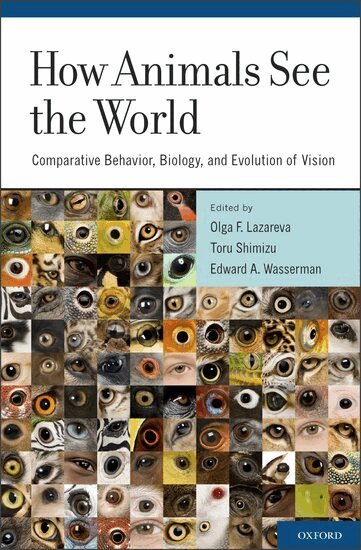
    How Animals See the World

    Comparative Behavior, Biology, and Evolution of Vision

    AvOlga F. Lazareva,Toru Shimizu

    Inbunden, Engelska, 2012

    3 939 kr

    Beställningsvara. Skickas inom 5-8 vardagar. Fri frakt över 249 kr.

    Beskrivning

    The visual world of animals is highly diverse and often very different from the world that we humans take for granted. This book provides an extensive review of the latest behavioral and neurobiological research on animal vision, highlighting fascinating species similarities and differences in visual processing. It contains 26 chapters written by world-leading experts about a variety of species including: honeybees, spiders, fish, birds, and primates. The chapters are divided into six sections: Perceptual grouping and segmentation, Object perception and object recognition, Motion perception, Visual attention, Different dimensions of visual perception, and Evolution of the visual system. An exhaustive work in range and depth, How Animals See the World will be a valuable resource for advanced students and researchers in areas of cognitive psychology, perception and cognitive neuroscience, as well as researchers in the visual sciences.

    Produktinformation

    • Utgivningsdatum:2012-04-19
    • Mått:185 x 259 x 38 mm
    • Vikt:1 157 g
    • Format:Inbunden
    • Språk:Engelska
    • Antal sidor:560
    • Förlag:OUP USA
    • ISBN:9780195334654

    Utforska kategorier

    • Kognitiv psykologi inom Psykologi och pedagogik

    Mer om författaren

    Olga F. Lazareva is Assistant Professor of Psychology at Drake University. Her research concentrates on behavioral and neurobiological aspects of visual perception and relational learning in humans and nonhuman animals.Toru Shimizu is Professor of Psychology at the University of South Florida. His areas of research include the neural basis of vision and cognition in animals.Edward A. Wasserman is Dewey B. and Velma P. Stuit Professor of Experimental Psychology at the University of Iowa and coeditor with Thomas Zentall of Comparative Cognition: Experimental Explorations of Animal Intelligence (Oxford University Press, 2006). He is a member of the Delta Center at the University of Iowa, dedicated to the investigation of learning, development, and change. Wasserman's research has centered on learning, memory, cognition, and perception in humans and nonhuman animals.

    Recensioner i media

    The book is fascinating reading for the specialist in perception and the cognitive neuroscientist.

    Innehållsförteckning

    • Introduction ; Part I. Perceptual grouping and segmentation ; Chapter1: What birds see and what they don't ; William Hodos ; Part II. Luminance, contrast, and spatial and temporal resolution ; Chapter 2: Color vision in fish and other vertebrates ; Christa Neumeyer ; Chapter 3: Grouping and early visual processing in avian vision ; Robert Cook and Carl Erick Hagmann ; Chapter 4: Figure-ground segregation and object-based attention in birds ; Olga Lazareva and Edward Wasserman ; Chapter 5: Neurobiological foundations of figure-ground segregation in primates ; Hans Super ; Chapter 6: Illusory perception in animals: Observations and interpretations ; Edward Wasserman ; Chapter 7: Amodal completion and illusory perception in birds and primates ; Kazuo Fujita, Noriyuki Nakamura, Ayumi Sakai, Sota Watanabe, & Tomokazu Ushitani ; Chapter 8: Neurobiology of perception of illusory contours in animals ; Andreas Nieder ; Part III. Object perception and object recognition ; Chapter 9: How jumping spiders see the world ; Duane P Harland, Daiqin Li and Robert R Jackson ; Chapter 10: Visual discrimination by the honeybee (Apis mellifera) ; Adrian Horridge ; Chapter 11: Recognition by components: A birds' eye view ; Edward A. Wasserman and Irving Biederman ; Chapter 12: Birds' perception of depth and objects in pictures ; Marcia L. Spetch and Ronald G. Weisman ; Chapter 13: The recognition of rotated objects in animals ; Jessie J. Peissig and Tamara Goode ; Chapter 14: Neural mechanisms of object recognition in non-human primates ; Rufin Vogels ; Part IV. Motion perception ; Chapter 15: Avian visual processing of motion and objects ; Robert G. Cook and Matthew S. Murphy ; Chapter 16: Neural mechanisms underlying visual motion detection in birds ; Douglas R.W. Wylie and Andrew N. Iwaniuk ; Chapter 17: Primate motion perception ; Bart Krekelberg ; Part V. Visual attention ; Chapter 18: Primate visual attention: How studies of monkeys have shaped theories of selective visual processing ; Pierre Pouget, Jason Arita and Geoffrey F. Woodman ; Chapter 19: Selective and divided attention in pigeons ; Tom Zentall ; Chapter 20: Visual cognition in baboons: Attention to the global and local stimulus properties ; Joel Fagot ; Part VI. Different dimensions of visual perception ; Chapter 21: Circadian visual system of mammals ; awrence P. Morin ; Part VII. Evolution of visual system ; Chapter 22: Evolution of the brain in vertebrates: Overview ; Ann B. Butler ; Chapter 23: Evolution of the vertebrate eye ; James K Bowmaker ; Chapter 24: The avian visual system: Overview ; Toru Shimizu and Shigeru Watanabe ; Chapter 25: Development of the visual system in birds and mammals ; Hans-Joachim Bischof ; Chapter 26: Brain asymmetry in vertebrates ; Onur Gunturkun ; Postscript: Shaun Vecera ; Index