• Fri frakt över 249 kr
  • •
  • Snabba leveranser
  • •
  • Billiga böcker
Kundservice

Du är på sajten för privatpersoner.

Företag, bibliotek eller offentlig verksamhet?

Du handlar på classic.bokus.com, där alla dina funktioner finns intakta.
Till classic.bokus.com
Bokus logotyp. Gå till startsidan.
  • Erbjudanden
  • Nyheter
  • Student
  • Topplistor
  • Barn & ungdom
  • Bokus Play
  • E-böcker
  • Pocketböcker
  • Spel & pussel

10% studentrabatt med kod TERM26

Sidfot

Mina sidor

    Hjälp

    • Kundservice
    • Vanliga frågor och svar
    • Frakt och leverans
    • Retur vid ångerrätt
    • Reklamera vara
    • Betalning
    • Köpvillkor
    • Allmänna villkor
    • Information om webbplatsens tillgänglighet

    Om Bokus

    • Om oss
    • Pressrum
    • För studenter
    • För företag
    • För bibliotek och offentlig verksamhet
    • För leverantörer
    • Hållbarhet

    Populärt

    • Aktuella erbjudanden
    • Presentkort
    • Studentlitteratur
    • Nya böcker
    • Topplistor
    • Signerade böcker
    • Engelska böcker

    Inspiration

    • Boktips
    • BookTok
    • Populära bokserier
    • Barnbokskaraktärer
    • Populära författare
    Logotyp för Bokus
    Följ oss på Facebook (extern länk)Följ oss på Instagram (extern länk)Följ oss på YouTube (extern länk)Följ oss på TikTok (extern länk)
    bokus @ CookiesAnpassa cookiesIntegritetspolicyKöpvillkor
    Till Citymail hemsida (extern länk)Till Budbee hemsida (extern länk)Till Postnord hemsida (extern länk)Till Schenker hemsida (extern länk)Till Early Bird hemsida (extern länk)Till Walleys hemsida (extern länk)
    1. Medicin
    2. Medicin: icke kliniska discipliner
    3. Fysiologi

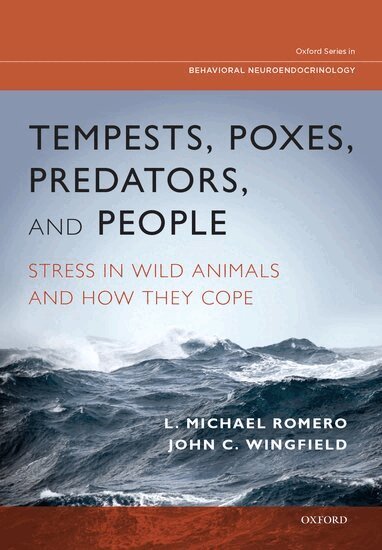
    Tempests, Poxes, Predators, and People

    Stress in Wild Animals and How They Cope

    AvL.Michael Romero,John C. Wingfield

    Inbunden, Engelska, 2015

    Del i serien Oxford Series in Behavioral Neuroendocrinology

    3 168 kr

    Beställningsvara. Skickas inom 5-8 vardagar. Fri frakt över 249 kr.

    Beskrivning

    Although scientists have discovered many fundamental physiological and behavioral mechanisms that comprise the stress response, most of current knowledge is based on laboratory experiments using domesticated or captive animals. Scientists are only beginning, however, to understand how stress impacts wild animals - by studying the nature of the stressful stimuli that animals in their natural environments have adapted to for survival, and what the mechanisms that allow that survival might be. This book summarizes, for the first time, several decades of work on understanding stress in natural contexts. The aim is two-fold. The first goal of this work is to place modern stress research into an evolutionary context. The stress response clearly did not evolve to cause disease, so that studying how animals use the stress response to survive in the wild should provide insight into why mechanisms evolved the way that they did. The second goal is to provide predictions on how wild animals might cope with the Anthropocene, the current period of Earth's history characterized by the massive human remodeling of habitats on a global scale. Conservation of species will rely upon how wild animals use their stress response to successfully cope with human-created stressors.

    Produktinformation

    • Utgivningsdatum:2015-12-10
    • Mått:175 x 257 x 35 mm
    • Vikt:1 247 g
    • Format:Inbunden
    • Språk:Engelska
    • Serie:Oxford Series in Behavioral Neuroendocrinology
    • Antal sidor:624
    • Förlag:OUP USA
    • ISBN:9780195366693

    Utforska kategorier

    • Fysiologi inom Medicin
    • Biovetenskap inom Naturvetenskap och teknik
    • Zoologi inom Naturvetenskap och teknik

    Mer om författaren

    L. Michael Romero is Professor of Biology at Tufts University.John C. Wingfield is Distinguished Professor of Neurobiology, Physiology, and Behavior and Endowed Chair in Physiology at the University of California, Davis.Professors Romero and Wingfield have spent their careers studying the endocrinology of wild animals in their natural habitats. A major focus has been on how animals cope with stressors in the environment. Between the two of them, they have studied over 100 different species covering all of the major vertebrate taxa (mammals, birds, fish, reptiles, and amphibians).

    Recensioner i media

    "This is a superb manuscript by an outstanding pair of scholars that provides valuable insights into the 'natural world' and a good integration of information from many domains of physiology, neuroscience, behavioral neurobiology and animal behavior. "-Bruce McEwen, Alfred E. Mirsky Professor and Head of the Harold and Margaret Milliken Hatch Laboratory of Neuroendocrinology, The Rockefeller University

    Innehållsförteckning

    • PART I. Biology of Stress Chapter 1: Environment and the Earth: A Stressful PlanetChapter 2: Mediators of StressChapter 3: Models of StressChapter 4: Classic Stress ResponseChapter 5: Impacts on Physiological and Behavioral Systems PART II. Coping with a Capricious Environment Chapter 6: Field TechniquesChapter 7: Responses to Natural Perturbations: Variation in Available EnergyChapter 8: Responses to Natural Perturbations: Tempests-Weather and Climate EventsChapter 9: Responses to Natural Perturbations: Poxes, Predators, and PersonalitiesChapter 10. Modulation of the Adrenocortical Response to StressChapter 11: Development, Environmental, and Maternal EffectsChapter 12: Global Change: Consequences of Human DisturbanceChapter 13: Global Change: Conservation Implications and the Role of Stress PhysiologyChapter 14: Conclusions and the Future Index