• Fri frakt över 249 kr
  • •
  • Snabba leveranser
  • •
  • Billiga böcker
Kundservice

Du är på sajten för privatpersoner.

Företag, bibliotek eller offentlig verksamhet?

Du handlar på classic.bokus.com, där alla dina funktioner finns intakta.
Till classic.bokus.com
Bokus logotyp. Gå till startsidan.
  • Erbjudanden
  • Nyheter
  • Student
  • Topplistor
  • Barn & ungdom
  • Bokus Play
  • E-böcker
  • Pocketböcker
  • Spel & pussel

10% rabatt på allt med kod: NYSTART10 →

Sidfot

Mina sidor

    Hjälp

    • Kundservice
    • Vanliga frågor och svar
    • Frakt och leverans
    • Retur vid ångerrätt
    • Reklamera vara
    • Betalning
    • Köpvillkor
    • Allmänna villkor
    • Information om webbplatsens tillgänglighet

    Om Bokus

    • Om oss
    • Pressrum
    • För studenter
    • För företag
    • För bibliotek och offentlig verksamhet
    • För leverantörer
    • Hållbarhet

    Populärt

    • Aktuella erbjudanden
    • Presentkort
    • Studentlitteratur
    • Nya böcker
    • Topplistor
    • Signerade böcker
    • Engelska böcker

    Inspiration

    • Boktips
    • BookTok
    • Populära bokserier
    • Barnbokskaraktärer
    • Populära författare
    Logotyp för Bokus
    Följ oss på Facebook (extern länk)Följ oss på Instagram (extern länk)Följ oss på YouTube (extern länk)Följ oss på TikTok (extern länk)
    bokus @ CookiesAnpassa cookiesIntegritetspolicyKöpvillkor
    Till Citymail hemsida (extern länk)Till Budbee hemsida (extern länk)Till Postnord hemsida (extern länk)Till Schenker hemsida (extern länk)Till Early Bird hemsida (extern länk)Till Walleys hemsida (extern länk)
    1. Naturvetenskap och teknik
    2. Matematik och naturvetenskap
    3. Fysik

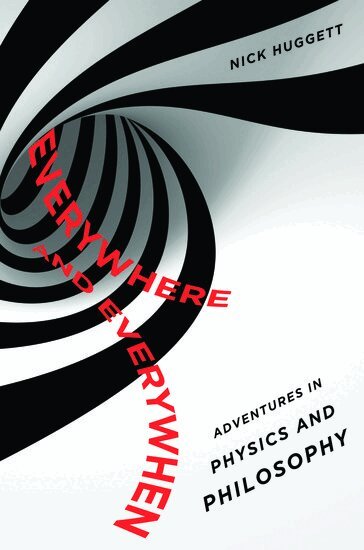
    Everywhere and Everywhen

    Adventures in Physics and Philosophy

    AvNick Huggett

    Häftad, Engelska, 2010

    630 kr

    Beställningsvara. Skickas inom 5-8 vardagar. Fri frakt över 249 kr.

    Fler format och utgåvor

    Inbunden

    1 133 kr

    E-bok

    426 kr

    Beskrivning

    Why does time pass and space does not? Are there just three dimensions? What is a quantum particle? Nick Huggett shows that philosophy - armed with a power to analyze fundamental concepts and their relationship to the human experience -- has much to say about these profound questions about the universe. In Everywhere and Everywhen, Huggett charts a journey that peers into some of the oldest questions about the world, through some of the newest, such as: What shape is space? Does it have an edge? What is the difference between past and future? What is time in relativity? Is time travel possible? Are there other universes? Huggett shows that answers to these profound questions are not just reserved for physics, and that philosophy can not only address but help advance our view of our deepest questions about the universe, space, and time, and their implications for humanity. His lively, accessible introduction to these topics is suitable for a general reader with no previous exposure to these profound and exciting questions.

    Produktinformation

    • Utgivningsdatum:2010-02-11
    • Mått:152 x 229 x 17 mm
    • Vikt:340 g
    • Format:Häftad
    • Språk:Engelska
    • Antal sidor:234
    • Förlag:OUP USA
    • ISBN:9780195379501

    Utforska kategorier

    • Fysik inom Naturvetenskap och teknik
    • Filosofiska discipliner inom Filosofi och religion
    • Naturvetenskapens filosofi inom Naturvetenskap och teknik

    Mer om författaren

    Nick Huggett is Associate Professor of Philosophy at the University of Illinois Chicago.

    Recensioner i media

    Huggett's writing style is clear and accessible, the examples are plentiful and helpful, and the overall narrative structure of the book is successful, with each chapter leading to the next.

    Innehållsförteckning

    • 1. A Longish Introduction: The Problem of Change ; 1.1 Melissus's Paradox ; 1.2 What is Change? ; 1.3 Laws ; 1.4 Spacetime Today ; 2. Zeno's Paradoxes: 2.1 The Dichotomy Paradox ; 2.2 'Supertasks' ; 3. Zeno's Arrow Paradox: 3.1 The Paradox ; 3.2 What Philosophy Can Teach Physics ; 4. The Shape of Space I-Topology ; 4.1 An End to Space? ; 4.2 Neither Bounded Nor Infinite ; 4.3 What Physics Can Teach Philosophy ; 5. Beyond the Third Dimension? ; 5.1 Multi-Dimensional Life ; 5.2 More Than Three Dimensions? ; 6. Why Three Dimensions? ; 6.1 The Force of Gravity and the Dimensions of Space ; 6.2 Does Intelligent Life Take Three Dimensions? ; 6.3 Is the Universe Made for Humans? ; 6.4 The Megaverse ; 6.5 Philosophy in Physics ; 7. The Shape of Space II-Curved Space? ; 7.1 Mathematical Certainty ; 7.2 Life in Non-Euclidean Geometry;7.3 What Kind of Knowledge is Geometry? ; 8. Looking For Geometry ; 8.1 Measuring the Geometry of Space? ; 8.2 The 'Geometry' of Poincare's Space ; 8.3 How to Disprove a Definition ; 8.4 Experiencing Space: 8.5 Where is Geometry? ; 9. What is Space? ; 9.1 Space=Matter ; 9.2 Relational Space ; 9.3 Absolute Space ; 9.4 Relational Space Redux ; 9.5 What Physics and Philosophy Can Teach Each Other ; 10. Time ; 10.1 Time vs. Space ; 10.2 Nowism ; 10.3 A Moving Now? ; 10.4 McTaggart's Argument ; 10.5 Passing Time in a Block Universe ; 11. Time and Tralfamadore ; 11.1 The Mind's Worldline ; 11.2 Experience of Space vs. Time ; 11.3 Another Arrow ; 11.4 Physics and the Philosophy of Perception ; 12. Time Travel ; 12.1 What is Time Travel? ; 12.2 Is Time Travel Possible? ; 12.3 The Problem with Time Travel ; 12.4 Possible and Impossible Time Travel ; 12.5 The Philosophy and Physics of Time Travel ; 13. Why Can't I Stop my Younger Self from Time Traveling? ; 13.1 Physics Might Stop Me ; 13.2 ... and If Not, Logic Will ; 13.3 My Precise Physical State Stops Me ; 13.4 Living in a Physical Universe ; 14. Spacetime and the Theory of Relativity ; 14.1 Photons and Bullets ; 14.2 Convention ; 14.3 Relativity-When is Now? ; 14.4 Relativistic Spacetime ; 14.5 Relativity of Length ; 14.6 Relativity of Time ; 15. Time in Relativity ; 15.1 The Twins ; 15.2 General Relativity ; 15.3 Time vs. Space Yet Again ; 16. Hands and Mirrors ; 16.1 Is Handedness Intrinsic or Extrinsic? ; 16.2 The 'Fitting' Account ; 16.3 Kant's Argument against the Fitting Account ; 16.4 Looking Left and Right ; 16.5 Mirrors ; 16.6 Orientability ; 17. Identity ; 17.1 Particle Statistics ; 17.2 Schr:odinger's Counting Games ; 18. Quarticles ; 18.1 New Counting Games ; 18.2 Hookon Identity ; 18.3 Indistinguishable Quarticles? ; 18.4 Quanta as Quarticles ; 19. Where Next?