• Fri frakt över 249 kr
  • •
  • Snabba leveranser
  • •
  • Billiga böcker
Kundservice

Du är på sajten för privatpersoner.

Företag, bibliotek eller offentlig verksamhet?

Du handlar på classic.bokus.com, där alla dina funktioner finns intakta.
Till classic.bokus.com
Bokus logotyp. Gå till startsidan.
  • Erbjudanden
  • Nyheter
  • Student
  • Topplistor
  • Barn & ungdom
  • Bokus Play
  • E-böcker
  • Pocketböcker
  • Spel & pussel

10% rabatt på allt med kod: NYSTART10 →

Sidfot

Mina sidor

    Hjälp

    • Kundservice
    • Vanliga frågor och svar
    • Frakt och leverans
    • Retur vid ångerrätt
    • Reklamera vara
    • Betalning
    • Köpvillkor
    • Allmänna villkor
    • Information om webbplatsens tillgänglighet

    Om Bokus

    • Om oss
    • Pressrum
    • För studenter
    • För företag
    • För bibliotek och offentlig verksamhet
    • För leverantörer
    • Hållbarhet

    Populärt

    • Aktuella erbjudanden
    • Presentkort
    • Studentlitteratur
    • Nya böcker
    • Topplistor
    • Signerade böcker
    • Engelska böcker

    Inspiration

    • Boktips
    • BookTok
    • Populära bokserier
    • Barnbokskaraktärer
    • Populära författare
    Logotyp för Bokus
    Följ oss på Facebook (extern länk)Följ oss på Instagram (extern länk)Följ oss på YouTube (extern länk)Följ oss på TikTok (extern länk)
    bokus @ CookiesAnpassa cookiesIntegritetspolicyKöpvillkor
    Till Citymail hemsida (extern länk)Till Budbee hemsida (extern länk)Till Postnord hemsida (extern länk)Till Schenker hemsida (extern länk)Till Early Bird hemsida (extern länk)Till Walleys hemsida (extern länk)
    1. Psykologi och pedagogik
    2. Psykologi
    3. Kognitiv psykologi

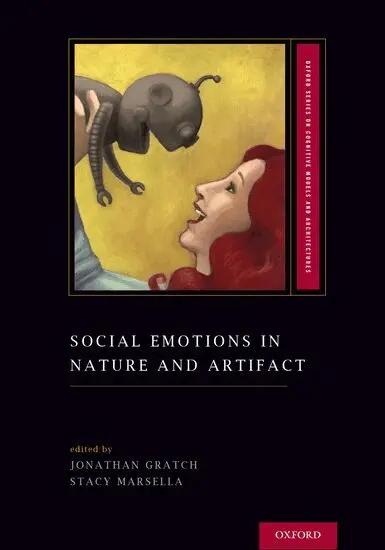
    Social Emotions in Nature and Artifact

    AvGRATCH,Jonathan Gratch

    Inbunden, Engelska, 2014

    Del i serien Oxford Series on Cognitive Models and Architectures

    2 171 kr

    Beställningsvara. Skickas inom 5-8 vardagar. Fri frakt över 249 kr.

    Beskrivning

    Recent years have seen the rise of a remarkable partnership between the social and computational sciences on the phenomena of emotions. Rallying around the term Affective Computing, this research can be seen as revival of the cognitive science revolution, albeit garbed in the cloak of affect, rather than cognition. Traditional cognitive science research, to the extent it considered emotion at all, cases it as at best a heuristic but more commonly a harmful bias to cognition. More recent scholarship in the social sciences has upended this view. Increasingly, emotions are viewed as a form of information processing that serves a functional role in human cognition and social interactions. Emotions shape social motives and communicate important information to social partners. When communicating face-to-face, people can rapidly detect nonverbal affective cues, make inferences about the other party's mental state, and respond in ways that co-construct an emotional trajectory between participants. Recent advances in biometrics and artificial intelligence are allowing computer systems to engage in this nonverbal dance, on the one hand opening a wealth of possibilities for human-machine systems, and on the other, creating powerful new tools for behavioral science research. Social Emotions in Nature and Artifact reports on the state-of-the-art in both social science theory and computational methods, and illustrates how these two fields, together, can both facilitate practical computer/robotic applications and illuminate human social processes.

    Produktinformation

    • Utgivningsdatum:2014-01-09
    • Mått:257 x 180 x 22 mm
    • Vikt:635 g
    • Format:Inbunden
    • Språk:Engelska
    • Serie:Oxford Series on Cognitive Models and Architectures
    • Antal sidor:224
    • Förlag:OUP USA
    • ISBN:9780195387643

    Utforska kategorier

    • Kognitiv psykologi inom Psykologi och pedagogik

    Mer om författaren

    JG: Associate Director for Virtual Humans Research, University of Southern California, Institute for Creative Technologies, Research Associate Professor, Department of Computer Science and co-director, USC Computational Emotion GroupSM: Project Leader, University of Southern California, Information Sciences Institute, Research Associate Professor of Computer Science, University of Southern California

    Recensioner i media

    "This book is a takes a bold and interdisciplinary approach to understanding emotion. Featuring cutting edge theoretical work by the thought leaders in both emotion psychology and computer science, the result is a unique perspective on how emotions shape social interactions." Jeremy Bailenson, Founding Director, Stanford Virtual Human Interaction Lab, Co-author, Infinite Reality: The Hidden Blueprints of Our Virtual Lives

    Innehållsförteckning

    • Contributors ; Introduction ; Jonathan Gratch & Stacy Marsella ; 1 ; On the Sociality of Emotion-Eliciting Appraisals: Two Aspects ; Craig A. Smith & Leslie D. Kirby ; 2 ; Processes of Emotional Meaning and Response Coordination ; Brian Parkinson ; 3 ; Challenge, Threat and Social Influence in Digital Immersive Virtual Environments ; Jim Blascovich ; 4 ; Requirements for a process model of appraisal from a social functional perspective ; Stacy Marsella, Jonathan Gratch ; 5 ; Modeling Theory of Mind and Cognitive Appraisal with Decision-Theoretic Agents ; David V. Pynadath, Mei Si, & Stacy C. Marsella ; 6 ; Automatic Facial Expression Recognition ; Jacob Whitehill, Marian Stewart Bartlett, & Javier R. Movellan ; 7 ; Toward effective automatic recognition systems of emotion in speech ; Carlos Busso, Murtaza Bulut, & Shrikanth Narayanan ; 8 ; The Role of Context in Affective Behavior Understanding ; Louis-Philippe Morency ; 9 ; Computational Models of Expressive Behaviors for a Virtual Agent ; Rados?aw Niewiadomski, Sylwia Julia Hyniewska, & Catherine Pelachaud ; 10 ; Early Emotional Communication: Novel Approaches to Interaction ; Daniel S. Messinger, Mohammad H.Mahoor, Sy-Miin Chow, J. D. Haltigan, StevenCadavid, & Jeffrey F. Cohn ; 11 ; Using social agents to explore theories of rapport and emotional resonance ; Jonathan Gratch, Sin-Hwa Kang, & Ning Wang