• Fri frakt över 249 kr
  • •
  • Snabba leveranser
  • •
  • Billiga böcker
Kundservice

Du är på sajten för privatpersoner.

Företag, bibliotek eller offentlig verksamhet?

Du handlar på classic.bokus.com, där alla dina funktioner finns intakta.
Till classic.bokus.com
Bokus logotyp. Gå till startsidan.
  • Erbjudanden
  • Nyheter
  • Student
  • Topplistor
  • Barn & ungdom
  • Bokus Play
  • E-böcker
  • Pocketböcker
  • Spel & pussel

10% rabatt på allt med kod: NYSTART10 →

Sidfot

Mina sidor

    Hjälp

    • Kundservice
    • Vanliga frågor och svar
    • Frakt och leverans
    • Retur vid ångerrätt
    • Reklamera vara
    • Betalning
    • Köpvillkor
    • Allmänna villkor
    • Information om webbplatsens tillgänglighet

    Om Bokus

    • Om oss
    • Pressrum
    • För studenter
    • För företag
    • För bibliotek och offentlig verksamhet
    • För leverantörer
    • Hållbarhet

    Populärt

    • Aktuella erbjudanden
    • Presentkort
    • Studentlitteratur
    • Nya böcker
    • Topplistor
    • Signerade böcker
    • Engelska böcker

    Inspiration

    • Boktips
    • BookTok
    • Populära bokserier
    • Barnbokskaraktärer
    • Populära författare
    Logotyp för Bokus
    Följ oss på Facebook (extern länk)Följ oss på Instagram (extern länk)Följ oss på YouTube (extern länk)Följ oss på TikTok (extern länk)
    bokus @ CookiesAnpassa cookiesIntegritetspolicyKöpvillkor
    Till Citymail hemsida (extern länk)Till Budbee hemsida (extern länk)Till Postnord hemsida (extern länk)Till Schenker hemsida (extern länk)Till Early Bird hemsida (extern länk)Till Walleys hemsida (extern länk)
    1. Historia och arkeologi
    2. Historia
    3. Historia: särskilda händelser och ämnen
    4. Socialhistoria och kulturhistoria

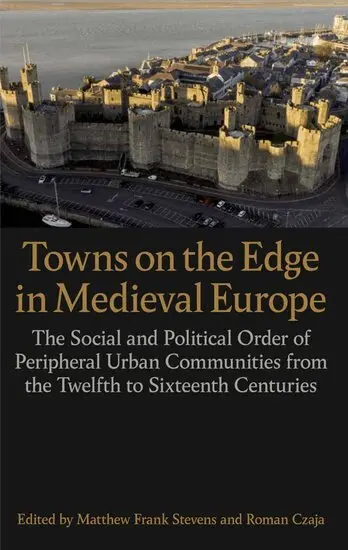
    Towns on the Edge in Medieval Europe

    The Social and Political Order of Peripheral Urban Communities from the Twelfth to Sixteenth Centuries

    AvMatthew Frank, Stevens,Matthew Frank Stevens

    Inbunden, Engelska, 2022

    Del 244 i serien Proceedings of the British Academy

    1 221 kr

    Beställningsvara. Skickas inom 5-8 vardagar. Fri frakt över 249 kr.

    Beskrivning

    In the later Middle Ages a European 'core' of culturally and administratively sophisticated societies with rapidly growing populations, on an axis from England to Italy, colonised the European 'periphery'. In northern Europe this periphery included Wales and Ireland, as colonised by the English, and Prussia and Livonia, as colonised (mainly) by Germanic and Nordic peoples. A key tool of colonisation was the chartered town, giving citizens distinguishing legal privileges and a degree of self-regulation. Towns on the Edge in Medieval Europe contends that while the chartered town, as a legal and social-political concept, was transferred to peripheral areas by colonisers, its implementation and adaptation in peripheral areas resulted in unique societies, not simply the replication of core urban forms and communities. In so doing, it compares the development of social and political institutions in the chartered towns of medieval Ireland, Wales, Prussia, and Livonia. Research themes include community formation, normalisation/social disciplining, and peace making/keeping.

    Produktinformation

    • Utgivningsdatum:2022-03-10
    • Mått:241 x 163 x 23 mm
    • Vikt:586 g
    • Format:Inbunden
    • Språk:Engelska
    • Serie:Proceedings of the British Academy
    • Antal sidor:288
    • Förlag:OUP OXFORD
    • ISBN:9780197267301

    Utforska kategorier

    • Socialhistoria och kulturhistoria inom Historia och arkeologi
    • Medeltiden inom Historia och arkeologi

    Mer om författaren

    Matthew Frank Stevens studied at Pennsylvania State University and the University of Wales, Aberystwyth, completing his PhD in medieval social and economic history in 2005. He is now an Associate Professor of history at Swansea University. He has been an Ulam fellow of the Polish National Agency for Academic Exchange, at Nicolaus Copernicus University, Toru?, an Eileen Power fellow of the Economic History Society, at Oxford University, and a research officer at the Institute of Historical Research, University of London. He is the author of numerous academic articles and two monographs: Urban Assimilation in Post-Conquest Wales: Ethnicity, Gender and Economy in Ruthin, 1282-1348 (2010) and The Economy of Wales, 1067-1536 (2019).Roman Czaja studied history at the Institute of History and Archives Sciences of Nicolaus Copernicus University, Toru?, completing his PhD. in the Department of Arts in 1991. He is now a Professor of history at NCU, holding the Chair of Medieval History and Auxiliary Sciences of History. A fellow of the Alexander von Humboldt Foundation at Humboldt Universität and Freie Universität in Berlin, in 2018 he was honoured by the University of Debrecen with the degree of Doctor Honoris Causa. He is author of over 250 research articles and of five books. In 2008 he published Grupy rz?dz?ce w miastach nadba?tyckich w ?redniowieczu (Ruling Groups in the Cities of the Baltic Zone in the Middle Ages) with Nicolaus Copernicus University Press.

    Recensioner i media

    It is the nature of rich books to raise questions. In this case, this regret does not carry much weight in view of the importance of the heuristic and methodological avenues opened up by this work.

    Innehållsförteckning

    • 1: Introduction2: The place of native populations in the chartered towns of conquered regions: Wales and Prussia as a comparative case study3: 'Irishtowns' and 'Welsh Streets': ethnic enclaves within the towns of colonial Ireland and Wales in a northern-European colonial context4: Women in the small-town economy of medieval Wales and Prussia5: Urban legislation as an instrument for the formation and regulation of socio-economic life in 14th-century Prussian and Irish towns6: The participation of craftsmen in municipal governance in late medieval Malbork and Stockholm7: Shaping the public space of Danzig and Dublin8: Military affairs and community in Prussian, Livonian and Irish towns, 13th-16th centuries9: Quarters and Quartermasters in Franconian and Prussian Towns, 14th-16th Centuries: The Common People and Their Participation in Urban Governance10: Maintaining a 'special relationship'? Petitions to the crown from Irish and Welsh towns, 13th -16th centuries11: Conclusion