• Fri frakt över 249 kr
  • •
  • Snabba leveranser
  • •
  • Billiga böcker
Kundservice

Du är på sajten för privatpersoner.

Företag, bibliotek eller offentlig verksamhet?

Du handlar på classic.bokus.com, där alla dina funktioner finns intakta.
Till classic.bokus.com
Bokus logotyp. Gå till startsidan.
  • Erbjudanden
  • Student
  • Topplistor
  • Barn & ungdom
  • Bokus Play
  • E-böcker
  • Ljudböcker
  • Pocketböcker
  • Spel och pussel

5% studentrabatt – använd koden KURSBOK27 →

Sidfot

Mina sidor

    Hjälp

    • Kundservice
    • Vanliga frågor och svar
    • Frakt och leverans
    • Retur vid ångerrätt
    • Reklamera vara
    • Betalning
    • Köpvillkor
    • Allmänna villkor
    • Information om webbplatsens tillgänglighet

    Om Bokus

    • Om oss
    • Pressrum
    • För studenter
    • För företag
    • För bibliotek och offentlig verksamhet
    • För leverantörer
    • Hållbarhet

    Populärt

    • Aktuella erbjudanden
    • Presentkort
    • Studentlitteratur
    • Nya böcker
    • Topplistor
    • Signerade böcker
    • Engelska böcker

    Inspiration

    • Boktips
    • BookTok
    • Barnbokskaraktärer
    • Populära författare
    Logotyp för Bokus
    Följ oss på Facebook (extern länk)Följ oss på Instagram (extern länk)Följ oss på YouTube (extern länk)Följ oss på TikTok (extern länk)
    bokus @ CookiesAnpassa cookiesIntegritetspolicyKöpvillkor
    Till Citymail hemsida (extern länk)Till Budbee hemsida (extern länk)Till Postnord hemsida (extern länk)Till Schenker hemsida (extern länk)Till Early Bird hemsida (extern länk)Till Walleys hemsida (extern länk)
    1. Samhälle och politik
    2. Politik och statsskick
    3. Statsvetenskap och politisk teori

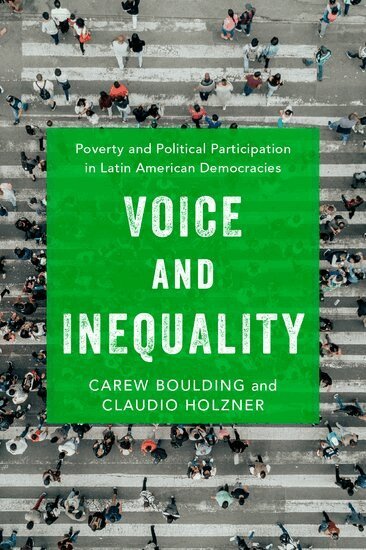
    Voice and Inequality

    Poverty and Political Participation in Latin American Democracies

    AvCarew Boulding,Claudio A. Holzner

    Inbunden, Engelska, 2021

    1 084 kr

    Beställningsvara. Skickas inom 5-8 vardagar. Fri frakt över 249 kr.

    Beskrivning

    The first large-scale study of political participation in eighteen Latin American democracies, focusing on the political participation of the region's poorest citizens.Political regimes in Latin America have a long history of excluding poor people from politics. Today, the region's democracies survive in contexts that are still marked by deep poverty and some of the world's most severe socioeconomic inequalities. Keeping socioeconomic inequality from spilling over into political inequality is one of the core challenges facing these young democracies. In Voice and Inequality, Carew Boulding and Claudio Holzner offer the first large-scale empirical analysis of political participation in Latin America. They find that in recent years, most (but not all) countries in the region have achieved near equality of participation across wealth groups, and in some cases poor people participate more than wealthier individuals. How can this be, given the long history of excluding poor people from the political arena in Latin America?Boulding and Holzner argue that key institutions of democracy, namely civil society, political parties, and competitive elections, have an enormous impact on whether or not poor people turn out to vote, protest, and contact government officials. Far from being politically inert, under certain conditions the poorest citizens can act and speak for themselves with an intensity that far exceeds their modest socioeconomic resources. When voluntary organizations thrive in poor communities and when political parties focus their mobilization efforts on poor individuals, they respond with high levels of political activism. Poor people's activism also benefits from strong parties, robust electoral competition and well-functioning democratic institutions. Where electoral competition is robust and where the power of incumbents is constrained, the authors find higher levels of participation by poor individuals and more political equality. Precisely because the individual resource constraints that poor people face are daunting obstacles to political activism, Voice and Inequality focuses on the features of democratic politics that create opportunities for participation that have the strongest impact on poor people's political behavior. Ultimately, Voice and Inequality provides important insights about how the elusive goal of political equality can be achieved even in contexts of elevated poverty and inequality.

    Produktinformation

    • Utgivningsdatum:2021-09-07
    • Mått:241 x 163 x 22 mm
    • Vikt:567 g
    • Format:Inbunden
    • Språk:Engelska
    • Antal sidor:264
    • Förlag:OUP USA
    • ISBN:9780197542149

    Utforska kategorier

    • Statsvetenskap och politisk teori inom Samhälle och politik
    • Val och folkomröstningar inom Samhälle och politik
    • Internationella relationer inom Samhälle och politik

    Mer om författaren

    Carew Boulding is Associate Professor of political science at the University of Colorado, Boulder. Her first book, NGOs, Political Protest, and Civil Society, explores how the quality of elections affects the role that NGOs and other organizations in civil society have in shaping how people participate.Claudio A. Holzner is an Associate Professor of Political Science and Director of the Center for Latin American Studies at the University of Utah. His first book, Poverty of Democracy: The Institutional Roots of Political Participation in Mexico, examines poor people's political activism during Mexico's transition to democracy.

    Recensioner i media

    Voice and Inequality makes an exceptionally compelling case for how robust institutions, and not individuals or ideology, are what is critical to reduce gaps in political participation between the rich and the poor. This is a deeply informative book for scholars of Latin American politics. And it makes a significant and original contribution to research on political behavior, inequality, and democracy.

    Innehållsförteckning

    • DedicationAcknowledgments List of Tables and Figures 1. Democracy, Political Participation, and Latin America's Poorest Citizens2. What Shapes Political Participation of the Poorest Citizens?3. Patterns and Puzzles4. Community Organizations and Mobilization from Below5. Political Parties and Electoral Competition6. Inclusion and Exclusion During the Left Turn7. Quality of Democracy8. ConclusionAppendices References