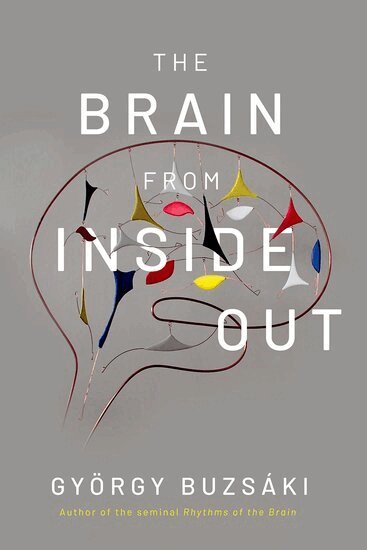
The Brain from Inside Out
486 kr
Beställningsvara. Skickas inom 5-8 vardagar. Fri frakt över 249 kr.
Du är på sajten för privatpersoner.
486 kr
Beställningsvara. Skickas inom 5-8 vardagar. Fri frakt över 249 kr.
György Buzsáki is Biggs Professor of Neuroscience at New York University.Member of the National Academy of Sciences USA, Co-recipient of the 2011 Brain Prize.His main interest is "neural syntax", how segmentation of neural information is organized to support cognitive functions.Book: G. Buzsáki, Rhythms of the Brain, Oxford University Press, 2006
Overall, the book is profound and full of wisdom for both science and culture in general. It challenges the established views about how the brain and the world work together, and it inspires new ideas regarding the psyche and consciousness.
György Buzsáki discusses how higher cognitive functions and consciousness do not arise in an isolated vacuum inside an isolated brain, but in interaction with neurophysiological movements. He discusses alternatives to both inherited systems and tabula rasa - the blank slate models. These aspects in terms of movement and change where all living creatures have a body with a physiological and electrobiological evolutionary development. Buzsáki takes theoretically very cautious steps about the intricate electrophysiology of the brain, which he discusses in detail. For me, this is brilliant, and raises lots of new possible inputs how the biochemical action potential could eventually interact with parallel electromagnetic systems between individual neurons - a neural 69. According to Buzsáki, the brain is a self-organizing system, and its main task is to predict meaningful activities for survival. Although he does not completely dismiss the old reactive learning paradigm (US-CS; etc), but he notes that the brain not primarily is a reactive device, but a predictive one. In self-adjusting algorithmic mechanisms (involving predictive errors) it is a kind of search engine that in a psychologizing context might be called "curiosity" - which is a fundamental survival mechanism. As a psychotherapist, you look when, where and how a patient's positive curiosity is triggered ("motivation"). Buzsáki describes the brain as a predictive device that interacts with the environment to control our decisions ahead. The hypothesis is that our brain is born with a myriad of nonsense patterns, and by synchronizing these nonsense patterns into cognitive or motor activities, they shape for meaningful learnings. Is time perception just an illusion that is relative to our perceived inner and outer movement? Perhaps it is enough to ponder some boring memory to realize this? Or that time perception varies between different ages and different experiences. Buzsáki presents preliminary findings indicating that hippocampal place and grid cells may have multiple sets of modalities that simultaneously can be understood even as "time cells" and thus encode memories as "memory cells" based on three aspects: distance, duration and the "what system". He discuss how the distinction between place cells and time cells is actually irrelevant to the thinking brain, instead it is "how downstream reader mechanisms classify hippocampal messages". He sees the hippocampus as a general-purpose generator that encodes, sequence, and thus structures the available limited amount of ordinal-scale information that heuristically covers the spaces between the various events that need to be ordered to provide a comprehensible context - albeit sometimes entirely contrived: compare how we try to make sense of various optical illusions. The hippocampus in this context is a repetitive apparatus that blindly performs the same thing over and over again to be encoded by frontal mechanisms.
Barry
Du är på sajten för privatpersoner.
486 kr
Beställningsvara. Skickas inom 5-8 vardagar. Fri frakt över 249 kr.
György Buzsáki is Biggs Professor of Neuroscience at New York University.Member of the National Academy of Sciences USA, Co-recipient of the 2011 Brain Prize.His main interest is "neural syntax", how segmentation of neural information is organized to support cognitive functions.Book: G. Buzsáki, Rhythms of the Brain, Oxford University Press, 2006
Overall, the book is profound and full of wisdom for both science and culture in general. It challenges the established views about how the brain and the world work together, and it inspires new ideas regarding the psyche and consciousness.
György Buzsáki discusses how higher cognitive functions and consciousness do not arise in an isolated vacuum inside an isolated brain, but in interaction with neurophysiological movements. He discusses alternatives to both inherited systems and tabula rasa - the blank slate models. These aspects in terms of movement and change where all living creatures have a body with a physiological and electrobiological evolutionary development. Buzsáki takes theoretically very cautious steps about the intricate electrophysiology of the brain, which he discusses in detail. For me, this is brilliant, and raises lots of new possible inputs how the biochemical action potential could eventually interact with parallel electromagnetic systems between individual neurons - a neural 69. According to Buzsáki, the brain is a self-organizing system, and its main task is to predict meaningful activities for survival. Although he does not completely dismiss the old reactive learning paradigm (US-CS; etc), but he notes that the brain not primarily is a reactive device, but a predictive one. In self-adjusting algorithmic mechanisms (involving predictive errors) it is a kind of search engine that in a psychologizing context might be called "curiosity" - which is a fundamental survival mechanism. As a psychotherapist, you look when, where and how a patient's positive curiosity is triggered ("motivation"). Buzsáki describes the brain as a predictive device that interacts with the environment to control our decisions ahead. The hypothesis is that our brain is born with a myriad of nonsense patterns, and by synchronizing these nonsense patterns into cognitive or motor activities, they shape for meaningful learnings. Is time perception just an illusion that is relative to our perceived inner and outer movement? Perhaps it is enough to ponder some boring memory to realize this? Or that time perception varies between different ages and different experiences. Buzsáki presents preliminary findings indicating that hippocampal place and grid cells may have multiple sets of modalities that simultaneously can be understood even as "time cells" and thus encode memories as "memory cells" based on three aspects: distance, duration and the "what system". He discuss how the distinction between place cells and time cells is actually irrelevant to the thinking brain, instead it is "how downstream reader mechanisms classify hippocampal messages". He sees the hippocampus as a general-purpose generator that encodes, sequence, and thus structures the available limited amount of ordinal-scale information that heuristically covers the spaces between the various events that need to be ordered to provide a comprehensible context - albeit sometimes entirely contrived: compare how we try to make sense of various optical illusions. The hippocampus in this context is a repetitive apparatus that blindly performs the same thing over and over again to be encoded by frontal mechanisms.
Barry