• Fri frakt över 249 kr
  • •
  • Snabba leveranser
  • •
  • Billiga böcker
Kundservice

Du är på sajten för privatpersoner.

Företag, bibliotek eller offentlig verksamhet?

Du handlar på classic.bokus.com, där alla dina funktioner finns intakta.
Till classic.bokus.com
Bokus logotyp. Gå till startsidan.
  • Erbjudanden
  • Nyheter
  • Student
  • Topplistor
  • Barn & ungdom
  • Bokus Play
  • E-böcker
  • Pocketböcker
  • Spel & pussel

10% rabatt på allt med kod: NYSTART10 →

Sidfot

Mina sidor

    Hjälp

    • Kundservice
    • Vanliga frågor och svar
    • Frakt och leverans
    • Retur vid ångerrätt
    • Reklamera vara
    • Betalning
    • Köpvillkor
    • Allmänna villkor
    • Information om webbplatsens tillgänglighet

    Om Bokus

    • Om oss
    • Pressrum
    • För studenter
    • För företag
    • För bibliotek och offentlig verksamhet
    • För leverantörer
    • Hållbarhet

    Populärt

    • Aktuella erbjudanden
    • Presentkort
    • Studentlitteratur
    • Nya böcker
    • Topplistor
    • Signerade böcker
    • Engelska böcker

    Inspiration

    • Boktips
    • BookTok
    • Populära bokserier
    • Barnbokskaraktärer
    • Populära författare
    Logotyp för Bokus
    Följ oss på Facebook (extern länk)Följ oss på Instagram (extern länk)Följ oss på YouTube (extern länk)Följ oss på TikTok (extern länk)
    bokus @ CookiesAnpassa cookiesIntegritetspolicyKöpvillkor
    Till Citymail hemsida (extern länk)Till Budbee hemsida (extern länk)Till Postnord hemsida (extern länk)Till Schenker hemsida (extern länk)Till Early Bird hemsida (extern länk)Till Walleys hemsida (extern länk)
    1. Psykologi och pedagogik
    2. Pedagogik
    3. Utbildningsstrategier och utbildningspolitik

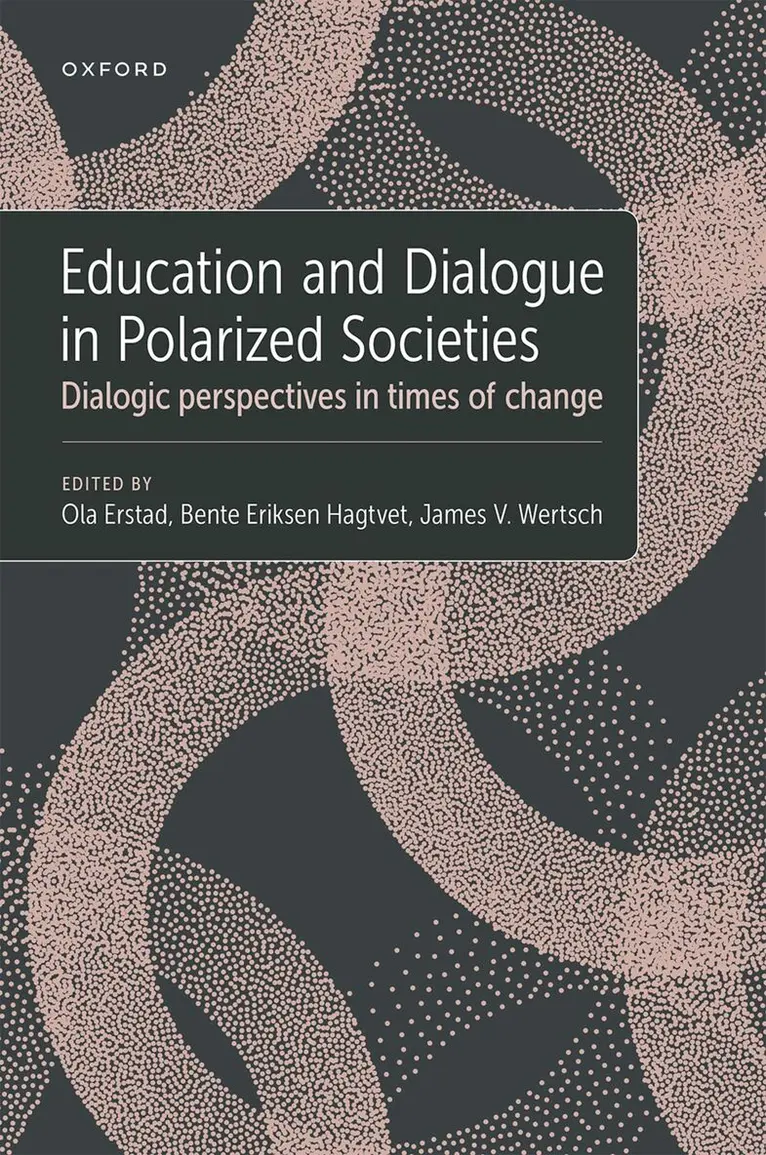
    Education and Dialogue in Polarized Societies

    Dialogic perspectives in times of change

    AvOla Erstad,Bente E. Hagtvet

    Inbunden, Engelska, 2024

    785 kr

    Beställningsvara. Skickas inom 5-8 vardagar. Fri frakt över 249 kr.

    Beskrivning

    A number of scholars within the social sciences and the humanities have elaborated on the cultural and psychological dimensions of living through social, economic and political crises. Still, developments during the last decade have created an awareness that something fundamental of the human condition is at stake, especially for the young generation growing up today, with a devastating environmental crisis, globalization, large scale migration, the impact of digitalization and so forth. The consequence has been increased polarization between nations, communities, and people, where the dialogue for human understanding seems to vanish. The basic rationale underlying this book is that education is a key social system where learning to take different perspectives, to stimulate dialogue and intersubjectivity are fundamental for social and cultural development. We bring together scholars from North-America and Europe, but with relevance on a global scale. The four sections in the book cover theoretical explorations referring to the power and generativity of the writings of the Norwegian scholar Ragnar Rommetveit (section 1), diverse chapters and examples on the societal conditions for dialogue and the role of education (section 2), empirical illustration on the role of digital technologies (section 3), and micro-analytical studies of learning dialogues at home, in kindergarten and school (section 4).

    Produktinformation

    • Utgivningsdatum:2024-08-29
    • Mått:236 x 165 x 29 mm
    • Vikt:567 g
    • Format:Inbunden
    • Språk:Engelska
    • Antal sidor:320
    • Förlag:OUP USA
    • ISBN:9780197605424

    Utforska kategorier

    • Utbildningsstrategier och utbildningspolitik inom Psykologi och pedagogik

    Mer om författaren

    Professor Erstad is an internationally leading researcher with a focus on digital literacy, but firmly rooted in the wider social and cultural context of learning beyond the technological aspects. His areas of expertise are learning, technology and education, children and youth in modern society. Erstad has been leading several large-scale research projects and research networks funded by the Norwegian Research Council, Nordforsk and the EU, and is part of several international networks and committees. He has been elected as Chair for the Scientific Advisory Committee for Science Europe (2016-2018), and Vice-Chair for the COST Action of 'The digital literacy and multimodal practices of young children' (2015-2018). He has been visiting scholar/professor at the University of Southern-Denmark, University of Hong Kong, UC San Diego. Bente E. Hagtvet is a researcher of the learning and teaching of language and thinking with particular interests in in developmental and didactic perspectives on thetransition from preschool to school and children's meeting with the written language, when in typical and untypical deveopment. She graduated from the University of Oslo, has taught at Universities in Sweden, Denmark and Finland and been a guest professor at the University of Oxford (1996-1996), Berkely University (the fall of 2007), University of Tromsø (2008-2010), At the University of Oslo she was Dean of Faculty (2002-2007) and has been leading a fair number of research projects over the years.James V. Wertsch is a scholar of language, thought, and culture, with a special focus on national memory and and narratives. After finishing his Ph.D. at the University of Chicago, Wertsch was a postdoctoral fellow at the USSR Academy of Sciences and Moscow State University, where he studied with the neuropsychologist A.R. Luria. Wertsch has held faculty positions at Northwestern University, the University of California, San Diego, Clark University, and Washington University in St. Louis, where hehas also been Vice Chancellor for International Affairs. He is a fellow of the American Academy of Arts and Sciences and the Russian Academy of Education, and he holds honorary degrees from Linköping University and the University of Oslo. Wertsch has also served as a guest professor at the University of Oslo, the University of Bristol, the University of Seville, Tsinghua University in Beijing, and Fudan University in Shanghai.

    Innehållsförteckning

    • Chapter 1 The Importance of Dialogue 1.1 Introduction 1.2 The importance of dialogue 1.3 The current dominance of monologic approaches 1.4 The dialogical rationale of this book: Key theoretical positions. 1.5 Dialogue and learning 1.6 The structure of the book SECTION 1: THE LEGACY OF ROMMETVEIT Chapter 2 The Role of Narratives in Dialogue and Intersubjectivity 2.1 Introduction 2.2 The influence of Rommetveit 2.3 Narrative as a Symbolic Tool 2.4 American National Narratives as Co-authors 2.5 Competing Narrative Templates 2.6 Dialogism, Intersubjectivity, and Narratives Chapter 3 Ragnar Rommetveit on Contextures and Partially Shared Understandings 3.1 Introduction 3.2 Ragnar Rommetveit 3.3 On Rommetveit´s early attempts to describe contexts of languaging 3.4 Authentic situations I: Threatening phone calls 3.5 Authentic situations II: Situations suggesting sexual abuse of children 3.6 Authentic situations III: Hannah Arendt about Adolf Eichmann in Jerusalem 3.7 Authentic example IV: Putin´s on the war in Ukraine3.8 On remote contexts and lost opportunities 3.9 Context atrophy in formal linguistics and in myopic interaction analysis 3.10 Coda: A note on macro-level phenomena Chapter 4 Layered Attunement: Internal dialogues of intersubjectivity 4.1 Introduction 4.2 Dialogical negotiation beyond consciousness 4.3 The Polysemic Multivoiced Self (PMS) 4.4 Relations between voices: tensions and their negotiation 4.5 General Discussion: Learning with Rommetveit SECTION 2: SOCIETAL CONDITONS FOR DIALOGUE AND THE ROLE OF EDUCATION Chapter 5 The Limits and Potential of Dialogue to counter Polarization in Educative settings 5.1 Introduction: is dialogue disabled in polarized settings? 5.2 Dialogue as a remedy of polarization - the UNION project 5.3 What can dialogue do in situations of polarization according to the theory? 5.3.1 Can we design inclusive dialogical spaces for communities that are diverse? 5.3.2 (How) can dialogue function between parties with rival or incommensurable worldviews? 5.3.3 What can we learn from the very nature of intersubjectivty and its ability to bridge opposing worlds? 5.4 Implications for designing dialogical interventions 5.4.1 Design principles for dialogical interventions 5.5 Concluding thoughts: the need to go back to the rough ground Chapter 6 Active citizenship and participation through <"Dialogues in the Square> "6.1 Introduction 6.2 Theoretical framework 6.3 <"Dialogues in the Square> ": The origins of the project 6.4 Participants and Partners 6.5 The Development of dialogues: Towards Action in a Public Space 6.6 Experiencing Different Types of Dialogues 6.7 A Snapshot from the Field: Triggering Cross-Generation Dialogue 6.8 Constraints and Opportunities Chapter 7 A dialogic theory of educational technology 7.1 Introduction: definitions and scope 7.1.1 What is 'technology'? 7.1.2 Theory and practice as dialogues in different timescales 7.1.3 What is 'education'? 7.2 Dialogism 7.2.1 The dialogic gap is constitutive for meaning 7.2.2 Dialogic space 7.2.3 The inside:outside/outside:inside nature of dialogic relations 7.2.4 We learn as a response to a call 7.2.5 Dialogic double-voicedness 7.2.6 Learning as the expansion of dialogue 7.3 The theory of educational technology 7.4 Conversation Theory 7.4.1 Commentary on Conversation Theory 7.4.2 Connectivism or learning as networking7.4.3 Commentary on Connectivism7.5 A dialogic theory of educational technology7.5.1 Education technology for connection7.5.2 Education technology for participation7.5.3 Education technology for the expansion of time7.6 Discussion and conclusionSECTION 3: THE ROLE OF DIGITAL TECHNOLOGIESChapter 8 Using microblogging to create a space for attending and attuning to others8.1 Introduction8.2 Socioscientific reasoning (SSI), intersubjectivity and technology mediated dialogue8.3 Microblogging in classroom interactions8.4 Vignettes of classroom attunement and intersubjectivity8.4.1 Who is to blame if the car crashes?8.4.2 'The computer could go crazy'8.4.3 'I think you should do that one'8.5 Attunement and intersubjectivity in technology-mediated learningChapter 9 Engaging in dialogic activities in an online community: Expanding the notion of double dialogicality9.1 Introduction9.2 Dialogism and co-authorship of meaning9.3 Digital technology and the expansion of double dialogicality9.4 Engaging in dialogic activities in an online community - Space2cre8 as an illustrative case9.5 Concluding remarksChapter 10 Intersubjectivity and Dialogue in Video Games10.1 Introduction10.2 Online Gaming and Notions of Intersubjectivity10.3 Contextual Background10.4 Elements of the Communicative Medium and Their Influence on Toxicity10.5 Enculturation10.6 Data and Analysis10.7 Disagreement and Intersubjectivity - Online and Offline10.8 ConclusionSECTION 4: LEARNING DIALOGUES AT HOME AND IN SCHOOLChapter 11 Opportunities to learn and intersubjectivity11.1 Introduction11.2 Classroom/supports for active learning11.2.1 Engaging in debate and discussion11.2.2 Using worked examples to promote reflection11.3 Collaborative learning with authentic tasks11.3.1 Summary of classroom methods11.3.2 Piercing the Autonomous learner shield in professional development11.3.3 Engaging in hybrid debate and discussion11.3.4 Using worked examples to promote reflection11.3.5 Collaborative Learning with Authentic Tasks11.3.6 From practices to principlesChapter 12 Code-switching during Shared Reading in Bilingual Families12.1 Introduction12.2 A dialogic perspective on parent-child code-switching in the context of shared reading12.3 The present study12.4 Methods12.4.1 Participants12.4.2 Procedure and data collection12.4.3 Coding and analysis12.5 Results12.5.1 Code-switching patterns over time in the seven dyads12.5.2 Code-switching as a tool in scaffolded dialogues12.5.3 Child-initiated code-switching and parental confirmation12.5.5 Child-initiated code-switching and parental extension12.5.6 Parent-initiated code-switching to support the child's understanding12.6 Discussion12.7 Conclusion Chapter 13 The Importance of Intersubjectivity in Teacher-Child Joint Story Construction 13.1 Introduction13.2 Teaching and learning as communicative acts, based on intersubjectivity13.3 Intersubjectivity and learning dialogues13.4 Intersubjectivity in a developmental perspective13.5 The current study13.6 Method13.7 Results13.7 Teacher-child-interactions with wavering intersubjectivity13.8 Summary and Conclusions13.9 ImplicationsSECTION 5: COMMENTARIESChapter 14 Dialogue, Polarization, and Change: Reflections - a CommentaryChapter 15 Not just change: Dialogue in times of crisis - a Commentary15.1 A perennial theme of acute contemporary relevance15.2 Crisis, not just change15.3 The implications of considering crisis15.4 The significance of dialogical perspectives in a time of planetary crisis15.5 A brief illustration Chapter 16 Legacies and Prospects of Dialogue - Editor's Final Note16.1 A final note16.2 With inspiration from Ragnar Rommetveit