• Fri frakt över 249 kr
  • •
  • Snabba leveranser
  • •
  • Billiga böcker
Kundservice

Du är på sajten för privatpersoner.

Företag, bibliotek eller offentlig verksamhet?

Du handlar på classic.bokus.com, där alla dina funktioner finns intakta.
Till classic.bokus.com
Bokus logotyp. Gå till startsidan.
  • Erbjudanden
  • Nyheter
  • Student
  • Topplistor
  • Barn & ungdom
  • Bokus Play
  • E-böcker
  • Pocketböcker
  • Spel & pussel

10% rabatt på allt med kod: NYSTART10 →

Sidfot

Mina sidor

    Hjälp

    • Kundservice
    • Vanliga frågor och svar
    • Frakt och leverans
    • Retur vid ångerrätt
    • Reklamera vara
    • Betalning
    • Köpvillkor
    • Allmänna villkor
    • Information om webbplatsens tillgänglighet

    Om Bokus

    • Om oss
    • Pressrum
    • För studenter
    • För företag
    • För bibliotek och offentlig verksamhet
    • För leverantörer
    • Hållbarhet

    Populärt

    • Aktuella erbjudanden
    • Presentkort
    • Studentlitteratur
    • Nya böcker
    • Topplistor
    • Signerade böcker
    • Engelska böcker

    Inspiration

    • Boktips
    • BookTok
    • Populära bokserier
    • Barnbokskaraktärer
    • Populära författare
    Logotyp för Bokus
    Följ oss på Facebook (extern länk)Följ oss på Instagram (extern länk)Följ oss på YouTube (extern länk)Följ oss på TikTok (extern länk)
    bokus @ CookiesAnpassa cookiesIntegritetspolicyKöpvillkor
    Till Citymail hemsida (extern länk)Till Budbee hemsida (extern länk)Till Postnord hemsida (extern länk)Till Schenker hemsida (extern länk)Till Early Bird hemsida (extern länk)Till Walleys hemsida (extern länk)
    1. Medicin
    2. Andra medicinska specialiteter
    3. Klinisk psykologi

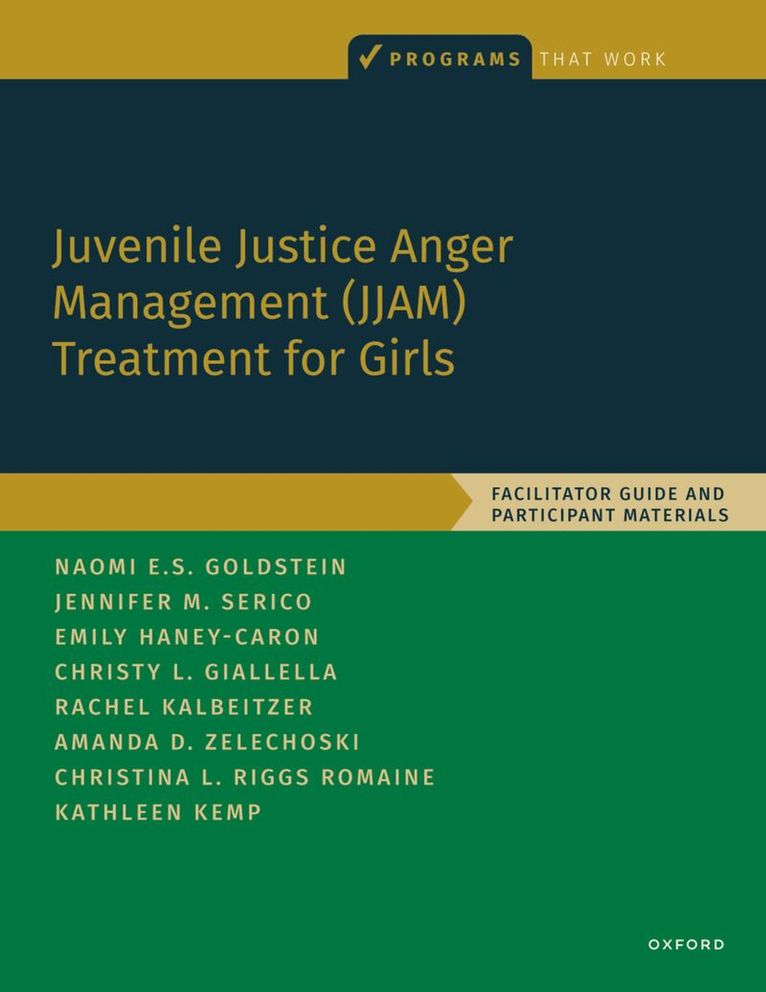
    Juvenile Justice Anger Management (JJAM) Treatment for Girls

    Facilitator Guide and Participant Materials

    AvNaomi E. Goldstein,Jennifer Serico

    Häftad, Engelska, 2023

    Del i serien PROGRAMS THAT WORK

    1 287 kr

    Beställningsvara. Skickas inom 5-8 vardagar. Fri frakt över 249 kr.

    Beskrivning

    The Juvenile Justice Anger Management (JJAM) Treatment for Girls is a manualized anger management and aggression reduction treatment designed for adolescent girls and young women placed in residential juvenile justice facilities. This gender-specific treatment is an 8-week, cognitive-behavioral group intervention that consists of 16 90-minute sessions. The JJAM Facilitator Manual includes a user-friendly, session-by-session guide, along with the accompanying workbook materials for youth participants.JJAM addresses the unique gender- and developmental-needs of girls and young women in juvenile justice system, such as the link between relational and physical aggression, the importance of strengthening and repairing damaged relationships, and the need to transfer skills learned in a facility to day-to-day life in the community following discharge. Session activities elicit real-life examples from participants so that activities and content can be tailored to the characteristics, needs, and interests of the specific girls and young women in each group.JJAM was developed through a rigorous research process and is identified as an empirically based program and empirically supported treatment. Studies have shown that JJAM significantly reduced anger and aggression among girls in residential juvenile justice facilities, making it an essential resource for any clinician working on anger management treatment.

    Produktinformation

    • Utgivningsdatum:2023-07-27
    • Mått:280 x 216 x 36 mm
    • Vikt:1 352 g
    • Format:Häftad
    • Språk:Engelska
    • Serie:PROGRAMS THAT WORK
    • Antal sidor:632
    • Förlag:OUP USA
    • ISBN:9780197609286

    Utforska kategorier

    • Klinisk psykologi inom Medicin
    • Sociala grupper och identitet inom Samhälle och politik
    • Arbetspsykologi inom Psykologi och pedagogik

    Mer om författaren

    Naomi E. S. Goldstein, Ph.D., is Professor of Psychology, Co-Director of the JD/PhD Program in Law and Psychology, and Director of the Juvenile Justice Research and Reform Lab at Drexel University. For more than 20 years, Dr. Goldstein has collaborated with community stakeholders to use social science research to improve juvenile justice policy and practice. She uses research to guide large-scale system change, leads implementation projects to promote high-quality dissemination of juvenile justice reforms, and evaluates the effects of new programs and policies on youth and communities. She also provides training and technical assistance to juvenile justice practitioners to help agencies develop and implement new policies and practices to improve outcomes for youth and communities.Jennifer M. Serico, Ph.D., is a clinical psychologist specializing child and adolescent trauma. Dr. Serico completed her doctoral degree in clinical psychology at Drexel University. Following her graduate work with justice-involved youth, she sought training opportunities in trauma-focused prevention and intervention. She has been implementing evidence-based treatments (e.g., PCIT, TF-CBT and DBT) for families who have experienced trauma at the Center for Child and Family Traumatic Stress at Kennedy Krieger Institute since 2013. Dr. Serico currently provides education, training, and supervision, and conducts research focused on complex trauma and emotional dysregulation in her role at KKI and Johns Hopkins.Emily Haney-Caron, J.D., Ph.D., is an Assistant Professor of Psychology and Director of the Youth Law & Psychology Lab at John Jay College of Criminal Justice. She holds a law degree and a doctorate in Clinical Psychology from Drexel University, and she completed a pre-doctoral clinical internship at Brown University Warren Alpert Medical School. Her research, scholarship, policy work, and teaching are all focused on the juvenile legal system, with a primary goal of contributing to system reform to increase racial justice and improve the system's developmental appropriateness. Dr. Haney-Caron is a licensed attorney in Pennsylvania and a licensed psychologist in New York.Christy Giallella, Ph.D., is Clinical Forensic Manager with the Philadelphia Department of Behavioral Health and Intellectual Disability Services. Dr. Giallella manages programs for justice-involved individuals with behavioral health challenges, including initiatives with the jail, state hospital, state prisons, and probation and parole. Dr. Giallella earned her doctorate in Clinical Psychology from Drexel University and BA in Psychology from Georgetown University. She is a licensed clinical psychologist with a specialization in forensic psychology. Dr. Giallella has worked in numerous community-based and correctional settings with justice-involved adolescents and adults. Her research background includes juvenile justice, forensic mental health assessment, and public policy.Rachel Kalbeitzer, Ph.D., is a licensed clinical and forensic psychologist specializing in the assessment of juveniles and adults involved in the criminal justice system. She earned a doctoral degree in Clinical Psychology with a Forensic Concentration from Drexel University. She completed a postdoctoral fellowship in Forensic Psychology through the University of Massachusetts Law and Psychiatry Program. She has provided forensic evaluation services in juvenile and adult court clinics, prisons, and psychiatric hospitals. She currently works for the Department of Defense and has a private forensic practice conducting criminal forensic evaluations. Her research interests focus on juvenile justice issues and adjudicative competence.Amanda Zelechoski, J.D., Ph.D., is a licensed clinical and forensic psychologist and attorney, specializing in trauma. She is board certified in Clinical Child and Adolescent Psychology and has worked clinically with adults, children, and families. She is a Professor of Psychology and Director of Clinical Training at Purdue University Northwest. Dr. Zelechoski's research examines the intersection between psychology, law, and trauma, particularly for underserved and vulnerable populations.Kathleen Kemp, Ph.D., is an Assistant Professor (Research) at the Brown University Warren Alpert Medical School and Director of the Rhode Island Family Court Mental Health Clinic, where she specializes in forensic mental health evaluations with adolescents. She earned her doctoral degree at Drexel University and completed her forensic psychology fellowship at the University of Virginia's Institute of Law, Psychiatry, and Public Policy and Western State Hospital. Her NIMH-funded clinical research focuses on suicide prevention as well as the dissemination and implementation of evidence-based practice with juvenile justice involved-youth.Christina L. Riggs Romaine, Ph.D., received her doctorate in Clinical Psychology with a concentration in Forensic Psychology at Drexel University and completed a post-doctoral fellowship in Forensic Psychology at the University of Massachusetts Medical School in collaboration with the Department of Youth Services. She has worked as an evaluator and service provider in pre- and post-adjudication facilities, and as a forensic evaluator in the MA Juvenile Court Clinics. She is now an Associate Professor of Psychology at Wheaton College where she conducts research on juvenile adjudicative competence, risk, and developmental maturity.

    Recensioner i media

    This book is excellent because it is so practical. The anger management sessions are described in depth so facilitators will have no difficulty implementing them with clients. The book is a complete package that has shown to be effective with girls living in juvenile residential facilities. Readers will not be disappointed in this book.

    Innehållsförteckning

    • Part 1- Facilitator guide and materialsINTRODUCTION FOR FACILITATORS 1.1 Facilitator GuideSESSION 1: IS ANGER NORMAL?SESSION 2: CONSEQUENCES OF ANGER AND THE IMPORTANCE OF SETTING GOALSSESSION 3: INTRODUCTION TO SOCIAL AGGRESSIONSESSION 4: DOES EVERYONE SEE THE SAME THING?SESSION 5: RECOGNITION OF ANGERSESSION 6: TRIGGERS OF ANGERSESSION 7: SELF-CONTROLSESSION 8: HOW DO I KEEP MYSELF CALM? SESSION 9: HOW DO I STOP MYSELF WHEN I'M ANGRY?SESSION 10: COMMUNICATIONSESSION 11: INTRODUCTION TO PROBLEM SOLVINGSESSION 12: IDENTIFYING OPTIONS AND CONSEQUENCESSESSION 13: REPAIRING DAMAGED RELATIONSHIPSSESSION 14: PREPARING FOR OUR FUTURESSESSION 15: CAN I BE A STAR?SESSION 16: DRESS REHEARSAL AND PLAY 1.2 Facilitator MaterialsFACILITATOR MATERIALS FOR ALL SESSIONSSESSION 1 FACILITATOR MATERIALS: IS ANGER NORMAL?SESSION 2 FACILITATOR MATERIALS: CONSEQUENCES OF ANGER AND THE IMPORTANCE OF SETTING GOALSSESSION 3 FACILITATOR MATERIALS: INTRODUCTION TO SOCIAL AGGRESSIONSESSION 4 FACILITATOR MATERIALS: DOES EVERYONE SEE THE SAME THING?SESSION 5 FACILITATOR MATERIALS: RECOGNITION OF ANGERSESSION 6 FACILITATOR MATERIALS: TRIGGERS OF ANGERSESSION 7 FACILITATOR MATERIALS: SELF-CONTROLSESSION 8 FACILITATOR MATERIALS: HOW DO I KEEP MYSELF CALM? SESSION 9: FACILITATOR MATERIALS HOW DO I STOP MYSELF WHEN I'M ANGRY?SESSION 10 FACILITATOR MATERIALS: COMMUNICATIONSESSION 11 FACILITATOR MATERIALS: INTRODUCTION TO PROBLEM SOLVINGSESSION 12 FACILITATOR MATERIALS: IDENTIFYING OPTIONS AND CONSEQUENCESSESSION 13 FACILITATOR MATERIALS: REPAIRING DAMAGED RELATIONSHIPSSESSION 14 FACILITATOR MATERIALS: PREPARING FOR OUR FUTURESSESSION 15 FACILITATOR MATERIALS: CAN I BE A STAR? Part 2- Participant Materials SESSION 1 PARTICIPANT MATERIALS: IS ANGER NORMAL?SESSION 2 PARTICIPANT MATERIALS: CONSEQUENCES OF ANGER AND THE IMPORTANCE OF SETTING GOALSSESSION 3 PARTICIPANT MATERIALS: INTRODUCTION TO SOCIAL AGGRESSIONSESSION 4 PARTICIPANT MATERIALS: DOES EVERYONE SEE THE SAME THING?SESSION 5 PARTICIPANT MATERIALS: RECOGNITION OF ANGERSESSION 6: PARTICIPANT MATERIALS TRIGGERS OF ANGERSESSION 7 PARTICIPANT MATERIALS: SELF-CONTROLSESSION 8 PARTICIPANT MATERIALS: HOW DO I KEEP MYSELF CALM? SESSION 9 PARTICIPANT MATERIALS: HOW DO I STOP MYSELF WHEN I'M ANGRY?SESSION 10 PARTICIPANT MATERIALS: COMMUNICATIONSESSION 11 PARTICIPANT MATERIALS: INTRODUCTION TO PROBLEM SOLVINGSESSION 12 PARTICIPANT MATERIALS: IDENTIFYING OPTIONS AND CONSEQUENCESSESSION 13 PARTICIPANT MATERIALS: REPAIRING DAMAGED RELATIONSHIPSSESSION 14: PARTICIPANT MATERIALS PREPARING FOR OUR FUTURESSESSION 15 PARTICIPANT MATERIALS: CAN I BE A STAR?SESSION 16 PARTICIPANT MATERIALS: DRESS REHEARSAL AND PLAY