• Fri frakt över 249 kr
  • •
  • Snabba leveranser
  • •
  • Billiga böcker
Kundservice

Du är på sajten för privatpersoner.

Företag, bibliotek eller offentlig verksamhet?

Du handlar på classic.bokus.com, där alla dina funktioner finns intakta.
Till classic.bokus.com
Bokus logotyp. Gå till startsidan.
  • Erbjudanden
  • Nyheter
  • Student
  • Topplistor
  • Barn & ungdom
  • Bokus Play
  • E-böcker
  • Pocketböcker
  • Spel & pussel

10% rabatt på allt med kod: NYSTART10 →

Sidfot

Mina sidor

    Hjälp

    • Kundservice
    • Vanliga frågor och svar
    • Frakt och leverans
    • Retur vid ångerrätt
    • Reklamera vara
    • Betalning
    • Köpvillkor
    • Allmänna villkor
    • Information om webbplatsens tillgänglighet

    Om Bokus

    • Om oss
    • Pressrum
    • För studenter
    • För företag
    • För bibliotek och offentlig verksamhet
    • För leverantörer
    • Hållbarhet

    Populärt

    • Aktuella erbjudanden
    • Presentkort
    • Studentlitteratur
    • Nya böcker
    • Topplistor
    • Signerade böcker
    • Engelska böcker

    Inspiration

    • Boktips
    • BookTok
    • Populära bokserier
    • Barnbokskaraktärer
    • Populära författare
    Logotyp för Bokus
    Följ oss på Facebook (extern länk)Följ oss på Instagram (extern länk)Följ oss på YouTube (extern länk)Följ oss på TikTok (extern länk)
    bokus @ CookiesAnpassa cookiesIntegritetspolicyKöpvillkor
    Till Citymail hemsida (extern länk)Till Budbee hemsida (extern länk)Till Postnord hemsida (extern länk)Till Schenker hemsida (extern länk)Till Early Bird hemsida (extern länk)Till Walleys hemsida (extern länk)
    1. Språk och ordböcker
    2. Språkvetenskap och lingvistik
    • Nyhet

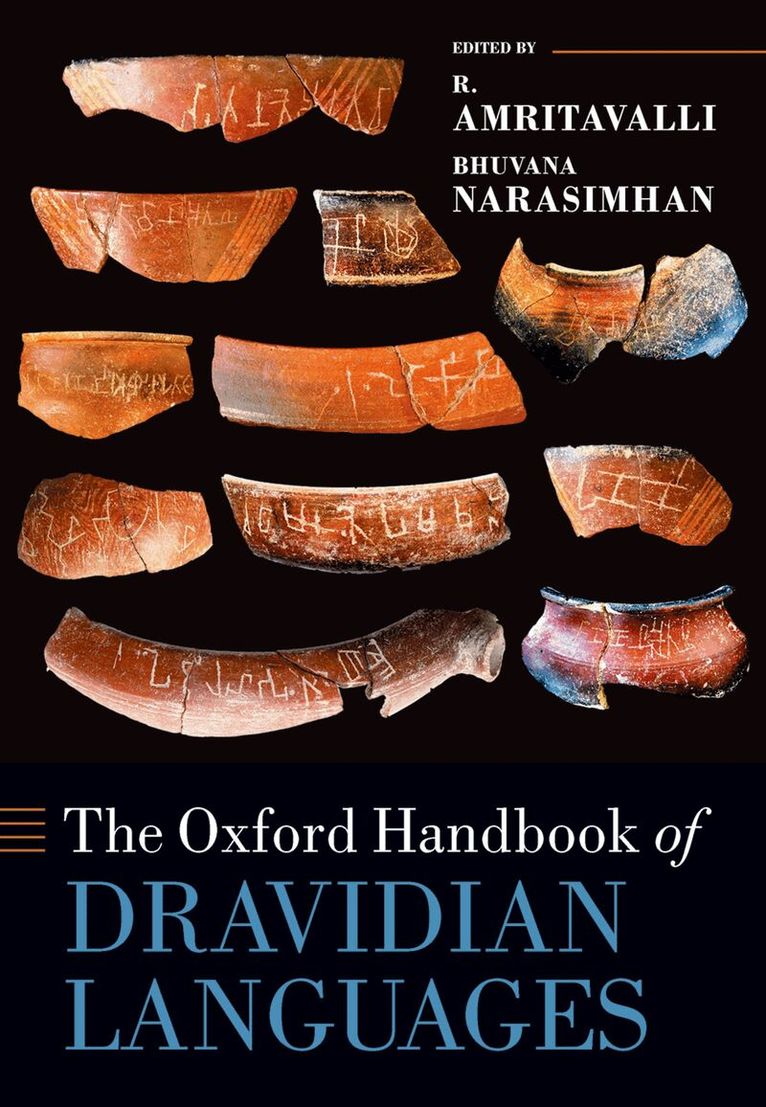
    The Oxford Handbook of Dravidian Languages

    AvR. Amritavalli,Bhuvana Narasimhan

    Inbunden, Engelska, 2026

    Del i serien Oxford Handbooks

    2 201 kr

    Beställningsvara. Skickas inom 5-8 vardagar. Fri frakt över 249 kr.

    Beskrivning

    The Dravidian languages of south India, spoken by approximately 222 million speakers across South Asia, form one of the largest language families in the world. First recognized as a distinct group in the early-to-mid 19th century, the pioneering scholarship on Dravidian languages emerged in the 1970s within the Generative Linguistics paradigm. Half a century later, the body of scholarship on Dravidian languages, employing varied analytical frameworks, serves to deepen our understanding of this unique linguistic family.The Oxford Handbook of Dravidian Languages offers an accessible introduction to Dravidian languages and linguistics from a broad interdisciplinary perspective. The text examines the languages through studies that highlight their long histories, vast literatures, and current robust presence in communication. Beyond formal linguistics, the chapters cover diverse areas of inquiry such as cognition and conceptual representation, comparative philology, language and politics, lexicology, literature and literary history, and multilingualism. This Handbook compiles current, trend-setting scholarship in Dravidian studies, exploring the origins of the Dravidian peoples, their languages, and the history of script in the Indian subcontinent.

    Produktinformation

    • Utgivningsdatum:2026-07-09
    • Mått:182 x 248 x 44 mm
    • Vikt:1 270 g
    • Format:Inbunden
    • Språk:Engelska
    • Serie:Oxford Handbooks
    • Antal sidor:656
    • Förlag:OUP USA
    • ISBN:9780197610411

    Utforska kategorier

    • Språkvetenskap och lingvistik inom Språk och ordböcker

    Mer om författaren

    R. Amritavalli (M.A., Bangalore, M.A., Ph.D., Simon Fraser) retired in 2015 from The English & Foreign Languages University, where she held professorships in the schools of Language Education and Linguistics, and administrative positions including that of Vice Chancellor. Her linguistic research centres on syntactic categories and argument- and clause-structure in Kannada and Hindi. Her work on the acquisition of first and second languages in natural and instructional settings has contributed to the policy and practice of English Language Teaching in India. She is author of English in Deprived Circumstances: Maximising Learner Autonomy (2007), and co-author or Dravidian Syntax and Universal Grammar. Bhuvana Narasimhan is Professor of Linguistics at the University of Colorado, Boulder. She conducts corpus-based and experimental research in language acquisition, linguistics, and the language-cognition interface. Her topics of research include word meaning, argument structure,case-marking, and information structure from a crosslinguistic and developmental perspective with a focus on Hindi and Tamil.

    Innehållsförteckning

    • 1. Introduction to The Oxford Handbook of Dravidian LanguagesR. Amritavalli and Bhuvana Narasimhan 2. The Dravidian Languages: An OverviewSuresh Kolichala Section I. Formal Analyses 3. Dravidian Word Order and the Clausal PeripheriesK. A. Jayaseelan 4. Perspectival Anaphora: a Case Study From TamilSandhya Sundaresan 5. Allocutive Agreement in DravidianThomas McFadden 6. Fine-tuning the Dravidian Left Periphery: The Three "Complementisers" in TeluguRahul Balusu 7. Genericity, Quantification, and Modality in Malayalam: The Many Faces of -Um and -UnnuHany Babu M. T. 8. Gradability and Comparison in KannadaSindhu Herur and R. Amritavalli Section II. Traditional And Contemporary Language Studies 9. Correlative Structures in DravidianSanford Steever 10. Asyndetic Conditional Clauses in BrahuiMasato Kobayashi and Liaquat Ali 11. Verb base alternations in Betta KurumbaGail Coelho 12. Agreement in Malto Conjunctive ParticiplesMasato Kobayashi Section III. Language Processing, Acquisition, And Impairment 13. Psycholinguistic studies in Dravidian languagesBhuvana Narasimhan and Annu Kurian-Mathew 14. Electrophysiological Investigations of Sentence Processing in TamilR. Muralikrishnan 15. The Acquisition of Differential Object-Marking in TamilAnnu Kurian-Mathew and Bhuvana Narasimhan 16. Dravidian Contributions to the Theory of Language AcquisitionJeffrey Lidz 17. The Acquisition of Negation and Finiteness in TamilR. Amritavalli 18. Possible Morphosyntactic Markers of Specific Language Impairment in KannadaShivani Tiwari, Pratibha Karanth and R. Amritavalli 19. Inflections in Home and School LanguagesMadhavi Gayathri Raman 20. Malayalam and Core Dravidian Phonology: A View from Early Language AcquisitionGayathri G. Krishnan, Arathi Raghunathan, and Vaijayanthi M. Sarma Section IV. Literary Creativity and Languages in Contact 21. The World of the Tamil Sangam PoetryManu V. Devadevan 22. The Trajectory of Tamil in CinemaSwarnavel Eswaran 23. The Tamil Response to Cosmopolitan Languages in ContactE. Annamalai and T. Sriraman 24. Syntactic Maintenance of Tamil Relative Clauses in Multilingual Adolescents Usha Lakshmanan 25. Multilingualism in the Evolution of Dravidian LanguagesS. N. Sridhar Section V. Literacy and Lexicography 26. From Brahmi to Early Kannada: Script, Scribes, and their SocietyS. Settar 27. Literacy and its Acquisition in KannadaSonali Nag 28. Currents in Tamil LexicographyGregory James and V. Jayadevan 29. The Legacy of Kannada DictionariesS. L. Srinivasa Murthy Index