• Fri frakt över 249 kr
  • •
  • Snabba leveranser
  • •
  • Billiga böcker
Kundservice

Du är på sajten för privatpersoner.

Företag, bibliotek eller offentlig verksamhet?

Du handlar på classic.bokus.com, där alla dina funktioner finns intakta.
Till classic.bokus.com
Bokus logotyp. Gå till startsidan.
  • Erbjudanden
  • Student
  • Topplistor
  • Barn & ungdom
  • Bokus Play
  • E-böcker
  • Ljudböcker
  • Pocketböcker
  • Spel & pussel

10% rabatt på allt med kod NYSTART10 →

Sidfot

Mina sidor

    Hjälp

    • Kundservice
    • Vanliga frågor och svar
    • Frakt och leverans
    • Retur vid ångerrätt
    • Reklamera vara
    • Betalning
    • Köpvillkor
    • Allmänna villkor
    • Information om webbplatsens tillgänglighet

    Om Bokus

    • Om oss
    • Pressrum
    • För studenter
    • För företag
    • För bibliotek och offentlig verksamhet
    • För leverantörer
    • Hållbarhet

    Populärt

    • Aktuella erbjudanden
    • Presentkort
    • Studentlitteratur
    • Nya böcker
    • Topplistor
    • Signerade böcker
    • Engelska böcker

    Inspiration

    • Boktips
    • BookTok
    • Populära bokserier
    • Barnbokskaraktärer
    • Populära författare
    Logotyp för Bokus
    Följ oss på Facebook (extern länk)Följ oss på Instagram (extern länk)Följ oss på YouTube (extern länk)Följ oss på TikTok (extern länk)
    bokus @ CookiesAnpassa cookiesIntegritetspolicyKöpvillkor
    Till Citymail hemsida (extern länk)Till Budbee hemsida (extern länk)Till Postnord hemsida (extern länk)Till Schenker hemsida (extern länk)Till Early Bird hemsida (extern länk)Till Walleys hemsida (extern länk)
    1. Samhälle och politik
    2. Krig och försvar
    3. Vapen och utrustning

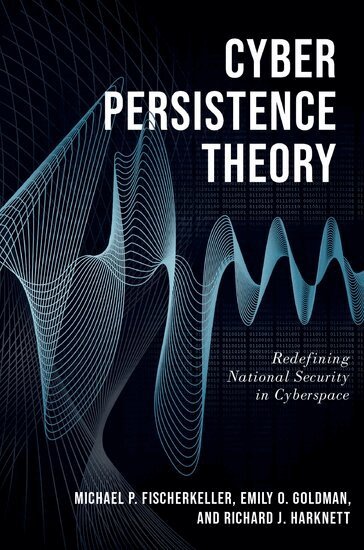
    Cyber Persistence Theory

    Redefining National Security in Cyberspace

    AvMichael P. Fischerkeller,Emily O. Goldman

    Inbunden, Engelska, 2023

    Del i serien Bridging the Gap

    1 236 kr

    Beställningsvara. Skickas inom 7-10 vardagar. Fri frakt över 249 kr.

    Fler format och utgåvor

    Häftad

    406 kr

    Beskrivning

    A bold re-conceptualization of the fundamentals driving behavior and dynamics in cyberspace.Most cyber operations and campaigns fall short of activities that states would regard as armed conflict. In Cyber Persistence Theory, Michael P. Fischerkeller, Emily O. Goldman, and Richard J. Harknett argue that a failure to understand this strategic competitive space has led many states to misapply the logic and strategies of coercion and conflict to this environment and, thus, suffer strategic loss as a result. The authors show how the paradigm of deterrence theory can neither explain nor manage the preponderance of state cyber activity. They present a new theory that illuminates the exploitive, rather than coercive, dynamics of cyber competition and an analytical framework that can serve as the basis for new strategies of persistence. Drawing on their policy experience, they offer a new set of prescriptions to guide policymakers toward a more stable, secure cyberspace.

    Produktinformation

    • Utgivningsdatum:2023-03-27
    • Mått:241 x 159 x 18 mm
    • Vikt:463 g
    • Format:Inbunden
    • Språk:Engelska
    • Serie:Bridging the Gap
    • Antal sidor:266
    • Förlag:OUP USA
    • Medarbetare:PaulM. Nakasone
    • ISBN:9780197638255

    Utforska kategorier

    • Vapen och utrustning inom Samhälle och politik
    • IT-säkerhet inom Data och IT
    • Internationella relationer inom Samhälle och politik

    Mer om författaren

    Michael Fischerkeller is a research staff member in the Information, Technology and Systems Division at the Institute for Defense Analyses, a Federally Funded Research and Development Center. Michael has spent his entire professional career supporting the Office of the Secretary of Defense, Joint Chiefs of Staff, Combatant and Multi-National Force commanders, and the Intelligence Community. His areas of expertise are cyber strategy, strategic / operational concept development, and analysis / assessment. Emily O. Goldman serves as a strategist at US Cyber Command and a thought leader on cyber policy. She was cyber advisor to the Director of Policy Planning at the Department of State, 2018-19. From 2014 to 2018, she directed the US Cyber Command / National Security Agency Combined Action Group, reporting to a four-star commander and leading a team that wrote the 2018 US Cyber Command vision, Achieve and Maintain Cyberspace Superiority. She has also worked as a strategic communicationsadvisor for US Central Command and for the Coordinator for Counterterrorism at the State Department. She holds a doctorate in Political Science from Stanford University and was a Professor of Political Science at the University of California, Davis, for two decades. Dr. Goldman has published and lectured widely on strategy, cybersecurity, arms control, military history and innovation, and organizational change.Richard J. Harknett is Professor and Director of the School of Public and International Affairs at the University of Cincinnati. He also co-directs the Ohio Cyber Range Institute, a state-wide organization supporting education, workforce, economic, and research development in cybersecurity. He served as Scholar-in-Residence at US Cyber Command and National Security Agency and has held two Fulbright Professor positions.

    Recensioner i media

    Cyber Persistence Theory is an important addition to our collective understanding of the dynamics of cyberspace and its implications for national security. It provides sound insight and excellent analysis on how we can meet the challenges of cyber in the hyper-connected, digitally driven world we find ourselves in today. Excellent work on a topic of increasing importance to all!

    Innehållsförteckning

    • AcknowledgmentsForeword by General Paul NakasoneChapter 1: The Misapplied Nexus of Theory and PolicyChapter 2: The Structure of Strategic EnvironmentsChapter 3: Cyber Behavior and DynamicsChapter 4: Theory and the Empirical RecordChapter 5: Cyber StabilityChapter 6: The Cyber Aligned Nexus of Theory and PolicyChapter 7: United States Case StudyBibliography Index