• Fri frakt över 249 kr
  • •
  • Snabba leveranser
  • •
  • Billiga böcker
Kundservice

Du är på sajten för privatpersoner.

Företag, bibliotek eller offentlig verksamhet?

Du handlar på classic.bokus.com, där alla dina funktioner finns intakta.
Till classic.bokus.com
Bokus logotyp. Gå till startsidan.
  • Erbjudanden
  • Nyheter
  • Student
  • Topplistor
  • Barn & ungdom
  • Bokus Play
  • E-böcker
  • Pocketböcker
  • Spel & pussel

10% rabatt på allt med kod: NYSTART10 →

Sidfot

Mina sidor

    Hjälp

    • Kundservice
    • Vanliga frågor och svar
    • Frakt och leverans
    • Retur vid ångerrätt
    • Reklamera vara
    • Betalning
    • Köpvillkor
    • Allmänna villkor
    • Information om webbplatsens tillgänglighet

    Om Bokus

    • Om oss
    • Pressrum
    • För studenter
    • För företag
    • För bibliotek och offentlig verksamhet
    • För leverantörer
    • Hållbarhet

    Populärt

    • Aktuella erbjudanden
    • Presentkort
    • Studentlitteratur
    • Nya böcker
    • Topplistor
    • Signerade böcker
    • Engelska böcker

    Inspiration

    • Boktips
    • BookTok
    • Populära bokserier
    • Barnbokskaraktärer
    • Populära författare
    Logotyp för Bokus
    Följ oss på Facebook (extern länk)Följ oss på Instagram (extern länk)Följ oss på YouTube (extern länk)Följ oss på TikTok (extern länk)
    bokus @ CookiesAnpassa cookiesIntegritetspolicyKöpvillkor
    Till Citymail hemsida (extern länk)Till Budbee hemsida (extern länk)Till Postnord hemsida (extern länk)Till Schenker hemsida (extern länk)Till Early Bird hemsida (extern länk)Till Walleys hemsida (extern länk)
    1. Filosofi och religion
    2. Filosofi
    3. Filosofiska discipliner

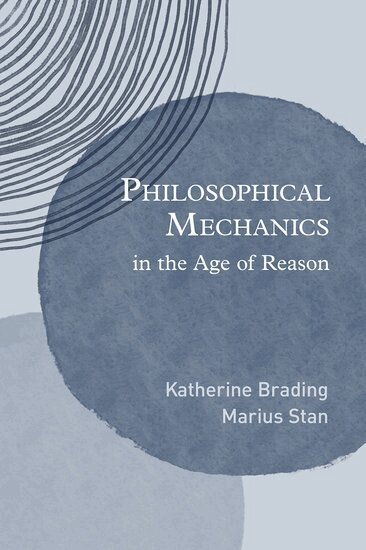
    Philosophical Mechanics in the Age of Reason

    AvKatherine Brading,Marius Stan

    Inbunden, Engelska, 2024

    1 098 kr

    Beställningsvara. Skickas inom 5-8 vardagar. Fri frakt över 249 kr.

    Beskrivning

    From pebbles to planets, tigers to tables, pine trees to people; animate and inanimate, natural and artificial; bodies are everywhere. Bodies populate the world, acting and interacting with one another, and they are the subject-matter of Newton's laws of motion. But what is a body? And how can we know how they behave? In Philosophical Mechanics in the Age of Reason, Katherine Brading and Marius Stan examine the struggle for a theory of bodies.At the beginning of the 18th century, physics was the branch of philosophy that studied bodies in general. Its primary task was to provide a qualitative account of the nature of bodies, including their essential properties, causal powers, and generic behaviors. Pursued by a variety of figures both canonical (from Leibniz to Kant) and less familiar (from Du Châtelet and Euler to d'Alembert and Lagrange), this proved a difficult task. At stake were the appropriate epistemologies and methods for theorizing about the natural world. Solutions demanded the combined resources of philosophy, physics, and mechanics: what Brading and Stan call a “philosophical mechanics.” Brading and Stan analyze a century of widespread, concerted efforts to solve “the problem of bodies,” they examine the consequences of the many failures, both for the problem itself and for philosophy more generally. They reveal relationships among disparate themes of 18th century physics and philosophy, from the nature of matter to the motion of a vibrating string; causation to the principle of least action; and the role of subtle matter in collision theory to analytic mechanics. All of these, Brading and Stan argue, are related to the eventual emergence of physics as an independent discipline, autonomous from philosophy, more than a century after Newton's Principia. This book provides a new framing of natural philosophy and its transformations in the Enlightenment; and it proposes an account of how physics and philosophy evolved into distinct fields of inquiry.

    Produktinformation

    • Utgivningsdatum:2024-06-19
    • Mått:224 x 157 x 50 mm
    • Vikt:771 g
    • Format:Inbunden
    • Språk:Engelska
    • Antal sidor:448
    • Förlag:OUP USA
    • ISBN:9780197678954

    Utforska kategorier

    • Filosofiska discipliner inom Filosofi och religion
    • Naturvetenskapens filosofi inom Naturvetenskap och teknik

    Mer om författaren

    Katherine Brading is Professor of Philosophy at Duke University. She is co-editor of Symmetries in Physics: Philosophical Reflections (with Elena Castellani) and author of Emilie Du Châtelet and the Foundations of Physical Science. Marius Stan is Associate Professor of Philosophy at Boston College. He is author of Kant's Natural Philosophy.

    Recensioner i media

    The writing is engaging but technical and aimed at specialists. Brading and Stan characterize the book's intended audience as philosophers of physics, science, and metaphysics and those interested in the history of modern philosophy. A strong, nuanced, technical work with a limited audience.

    Innehållsförteckning

    • 1. A Golden Age 1.1. Introduction 1.2. The Problem of Bodies 1.3. Philosophical mechanics 1.4. Constructive and principle approaches 1.5. The Unity of Physical Theory 1.6. Collisions and constraints: PCOL and PCON 1.7. Methods 1.8. Audience 1.9. Overview 1.10. Conclusions 2. Malebranche and French collision theory 2.1. Introduction 2.2. Correcting Descartes: Malebranche's early theory of collisions 2.3. Leibniz's objections to Malebranche's early collision theory 2.4. Malebranche's mature theory of collisions 2.5. After Malebranche: hard bodies in the competition of 1724 and beyond 2.6. After Malebranche: elastic rebound and the prize competition of 1726 2.7. Open questions, hidden problems 2.8. Conclusions 3. Beyond Newton and Leibniz: bodies in collision 3.1. Introduction 3.2. Newtonian collisions 3.3. Leibniz on collisions 3.4. Leibnizian collisions in Hermann and Wolff 3.5. The Problem of Collisions (PCOL) 4. The Problem of Bodies 4.1. Introduction 4.2. The scope and remit of physics 4.3. The Problem of Bodies: Nature and Action 4.4. The Problem of Bodies: Evidence and Principle 4.5. The methods of Newtonian physics 4.6. Substance and causation 4.7. The goal: a philosophical mechanics 5. Body and force in the physics of collisions: Du Châtelet and Euler 5.1. Introduction 5.2. Nature: extension as a property of bodies 5.3. Action5.4. Du Châtelet and Action 5.5. Euler and Action 5.6. Conclusions 6. Searching for a new physics: Kant and Boscovich 6.1. Introduction 6.2. The physics of bodies in Kant and Boscovich 6.3. Kant's philosophical mechanics 6.4. Boscovich's philosophical mechanics 6.5. Conclusions 7. Shifting sands in philosophical mechanics 7.1. Introduction 7.2. Methodology 7.3. Elusive mass 7.4. Contact action 7.5. A general theory of bodies in motion 7.6. Shifting sands 7.7. From rational to philosophical mechanics 7.8. Rational mechanics ascendant 7.9. Conclusions 8. Early work in the rational mechanics of constrained motion 8.1. Introduction 8.2. Personnel and work sites 8.3. New territory: oscillating systems 8.4. The compound pendulum 8.5. From special problems to general principles 8.6. Implications for philosophical mechanics 8.7. Conclusions 9. Constructive and principle approaches in d'Alembert's Treatise 9.1. Introduction 9.2. Constructive and principle approaches 9.3. D'Alembert's Treatise on Dynamics: its structure and contents 9.4. The Treatise as rational mechanics 9.5. The Treatise as philosophical mechanics: a constructive reading 9.6. The Treatise as philosophical mechanics: a principle reading 9.7. The unity of philosophical mechanics: ontic and nomic 9.8. Nature, Action, Evidence, and Principle 9.9. Conclusions 10. Building bodies: Euler and impressed force mechanics 10.1. Introduction 10.2. Solving MCON 10.3. Newton's Lex Secunda, Euler's principles, Cauchy's laws of motion 10.4. Solving MCON1 10.5. Assessment 10.6. Conclusions 11. External obstacles: Lagrange and the mechanics of constraints 11.1. Introduction 11.2. The Principle of Virtual Velocities and Lagrange's Principle 11.3. Constraints: equations of condition 11.4. Lagrange's Relaxation Postulate: the kinematics and dynamics of constraints 11.5. Philosophical mechanics and Lagrange's Mechanique 11.6. Action 11.7. Evidence 11.8. Assessment 11.9. Conclusions 12. Philosophical mechanics in the Late Enlightenment 12.1. Introduction 12.2. Makers and spaces 12.3. Lagrangian nomic unification 12.4. Molecular ontic unification 12.5. The Cauchy package 12.6. Disunity 12.7. Conclusions: A Golden Age