• Fri frakt över 249 kr
  • •
  • Snabba leveranser
  • •
  • Billiga böcker
Kundservice

Du är på sajten för privatpersoner.

Företag, bibliotek eller offentlig verksamhet?

Du handlar på classic.bokus.com, där alla dina funktioner finns intakta.
Till classic.bokus.com
Bokus logotyp. Gå till startsidan.
  • Erbjudanden
  • Nyheter
  • Student
  • Topplistor
  • Barn & ungdom
  • Bokus Play
  • E-böcker
  • Pocketböcker
  • Spel & pussel

10% rabatt på allt med kod NYSTART10 →

Sidfot

Mina sidor

    Hjälp

    • Kundservice
    • Vanliga frågor och svar
    • Frakt och leverans
    • Retur vid ångerrätt
    • Reklamera vara
    • Betalning
    • Köpvillkor
    • Allmänna villkor
    • Information om webbplatsens tillgänglighet

    Om Bokus

    • Om oss
    • Pressrum
    • För studenter
    • För företag
    • För bibliotek och offentlig verksamhet
    • För leverantörer
    • Hållbarhet

    Populärt

    • Aktuella erbjudanden
    • Presentkort
    • Studentlitteratur
    • Nya böcker
    • Topplistor
    • Signerade böcker
    • Engelska böcker

    Inspiration

    • Boktips
    • BookTok
    • Populära bokserier
    • Barnbokskaraktärer
    • Populära författare
    Logotyp för Bokus
    Följ oss på Facebook (extern länk)Följ oss på Instagram (extern länk)Följ oss på YouTube (extern länk)Följ oss på TikTok (extern länk)
    bokus @ CookiesAnpassa cookiesIntegritetspolicyKöpvillkor
    Till Citymail hemsida (extern länk)Till Budbee hemsida (extern länk)Till Postnord hemsida (extern länk)Till Schenker hemsida (extern länk)Till Early Bird hemsida (extern länk)Till Walleys hemsida (extern länk)
    1. Samhälle och politik
    2. Politik och statsskick
    3. Statsskick och politiska processer

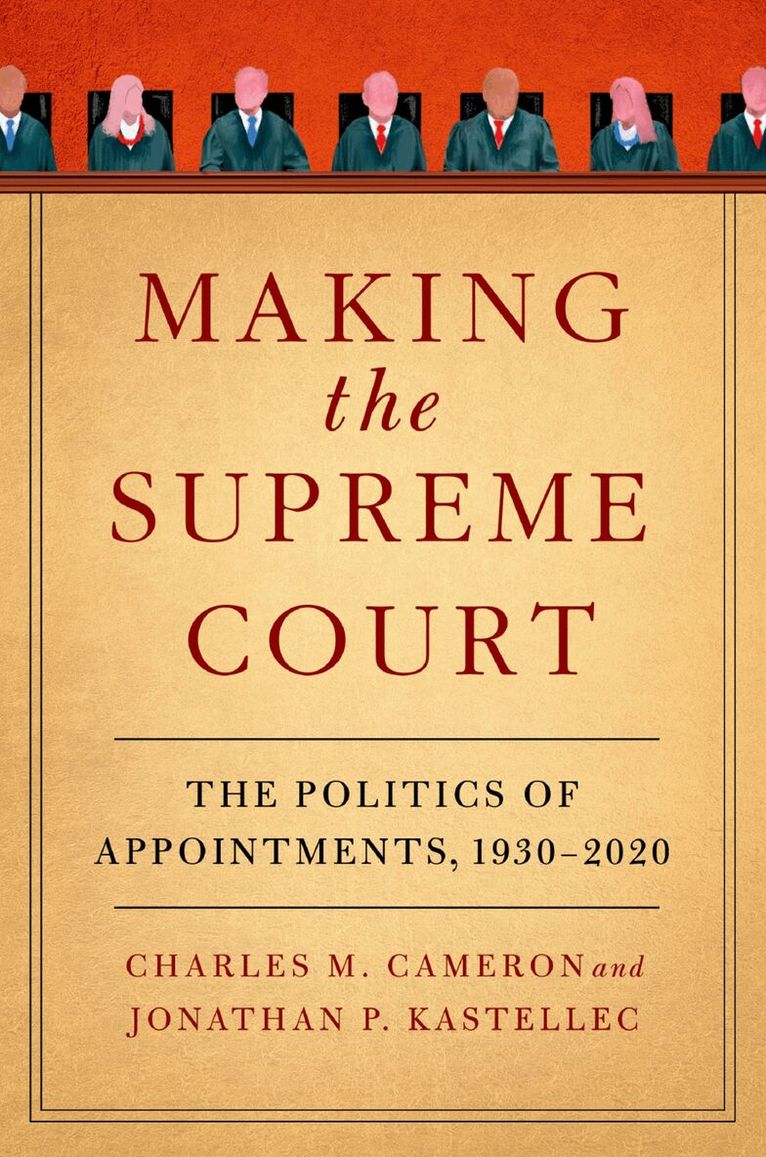
    Making the Supreme Court

    The Politics of Appointments, 1930-2020

    AvCharles M. Cameron,Jonathan P. Kastellec

    Häftad, Engelska, 2023

    367 kr

    Beställningsvara. Skickas inom 5-8 vardagar. Fri frakt över 249 kr.

    Fler format och utgåvor

    Inbunden

    1 263 kr

    Beskrivning

    Appointments to the United States Supreme Court are now central events in American political life. Every vacancy unleashes a bitter struggle between Republicans and Democrats over nominees; and once the seat is filled, new justices typically vote in predictable ways. However, this has not always been the case. As late as the middle of the twentieth century, presidents invested little time and effort in finding and vetting nominees, often selecting personal cronies, who senators briskly confirmed. Media coverage was desultory, public opinion was largely non-existent, and the justices often voted independently and erratically. In Making the Supreme Court, Charles M. Cameron and Jonathan P. Kastellec examine 90 years of American political history to show how the growth of federal judicial power from the 1930s onward inspired a multitude of groups struggling to shape judicial policy. Over time, some groups moved beyond lobbying the Court to changing who sits on it. Other groups formed expressly to influence appointments. These activists and organized groups penetrated the national party system so that after about 1980, presidential candidates increasingly pledged to select and confirm nominees who conformed to specific policy and ideological litmus tests. Once in office, these presidents re-shaped the executive selection system to deliver on their promises. Moreover, the selection process for justices turned into media events, often fueled by controversy. As Cameron and Kastellec argue, the result is a new politics aimed squarely at selecting and placing judicial ideologues on the Court. They make the case that this new model gradually transformed how the Court itself operates, turning it into an ideologically driven and polarized branch. Based on rich data and qualitative evidence, Making the Supreme Court provides a sharp lens on the social and political transformations that created a new American politics.

    Produktinformation

    • Utgivningsdatum:2023-10-26
    • Mått:157 x 234 x 18 mm
    • Vikt:644 g
    • Format:Häftad
    • Språk:Engelska
    • Antal sidor:504
    • Förlag:OUP USA
    • ISBN:9780197680544
    • Utmärkelser:Winner, Richard E. Neustadt Award, American Political Science Association

    Utforska kategorier

    • Statsskick och politiska processer inom Samhälle och politik
    • Statsvetenskap och politisk teori inom Samhälle och politik

    Mer om författaren

    Charles M. Cameron is Professor of Politics and Public Affairs at Princeton University. He specializes in the analysis of political institutions, particularly courts and law, the American presidency, and legislatures. The author of numerous articles in leading journals of political science, he is also the author of Veto Bargaining: Presidents and the Politics of Negative Power, which won the American Political Science Association's Richard F. Fenno Jr. Prize and the William H. Riker Award. He was inducted in the American Academy of Arts and Sciences in 2014.Jonathan P. Kastellec is Professor of Politics at Princeton University. His research and teaching interests are in American political institutions, with a particular focus on judicial politics and the politics of Supreme Court nominations and confirmations. His research has been published in the American Political Science Review; American Journal of Political Science; Journal of Politics; Journal of Law, Economics & Organization; Journal of Empirical Legal Studies; and Political Research Quarterly.

    Recensioner i media

    Making the Supreme Court uses judicial nominees to investigate larger changes in American politics over the last century, enduring questions about the administrative state, political parties, citizens, interest groups, and lobbying-not to mention nettlesome debates about voter rationality, the downstream effects of partisan polarization, and plenty more besides. Keenly perceptive and abundantly inquisitive, Cameron and Kastellec have delivered a tour de force that is sure to have a major impact on our understanding of all of American politics.

    Innehållsförteckning

    • I. What Happened Then and Now The Party Demands: Party Agendas for the Supreme Court Selecting How to Select: Presidents and Organizational Design The Candidates for the Court and the Nominees Interest Groups The Media, co-authored with Leeann Bass and Julian Dean Public Opinion Decision in the Senate II. Why it Happened The Logic of Presidential Selection, co-authored with Lauren Mattioli What the Public Wanted Voting in the Shadow of Accountability: Senators' Confirmation Decisions III. How It Matters, and What the Future Holds New Politics, New Justices, New Policies: The Courts That Politics Made The Future: The Courts that Politics May Make What Future Do We Want? Evaluating Judicial Independence Conclusion