• Fri frakt över 249 kr
  • •
  • Snabba leveranser
  • •
  • Billiga böcker
Kundservice

Du är på sajten för privatpersoner.

Företag, bibliotek eller offentlig verksamhet?

Du handlar på classic.bokus.com, där alla dina funktioner finns intakta.
Till classic.bokus.com
Bokus logotyp. Gå till startsidan.
  • Erbjudanden
  • Nyheter
  • Student
  • Topplistor
  • Barn & ungdom
  • Bokus Play
  • E-böcker
  • Pocketböcker
  • Spel & pussel

10% rabatt på allt med kod: NYSTART10 →

Sidfot

Mina sidor

    Hjälp

    • Kundservice
    • Vanliga frågor och svar
    • Frakt och leverans
    • Retur vid ångerrätt
    • Reklamera vara
    • Betalning
    • Köpvillkor
    • Allmänna villkor
    • Information om webbplatsens tillgänglighet

    Om Bokus

    • Om oss
    • Pressrum
    • För studenter
    • För företag
    • För bibliotek och offentlig verksamhet
    • För leverantörer
    • Hållbarhet

    Populärt

    • Aktuella erbjudanden
    • Presentkort
    • Studentlitteratur
    • Nya böcker
    • Topplistor
    • Signerade böcker
    • Engelska böcker

    Inspiration

    • Boktips
    • BookTok
    • Populära bokserier
    • Barnbokskaraktärer
    • Populära författare
    Logotyp för Bokus
    Följ oss på Facebook (extern länk)Följ oss på Instagram (extern länk)Följ oss på YouTube (extern länk)Följ oss på TikTok (extern länk)
    bokus @ CookiesAnpassa cookiesIntegritetspolicyKöpvillkor
    Till Citymail hemsida (extern länk)Till Budbee hemsida (extern länk)Till Postnord hemsida (extern länk)Till Schenker hemsida (extern länk)Till Early Bird hemsida (extern länk)Till Walleys hemsida (extern länk)
    1. Medicin
    2. Medicin: allmänt
    3. Den medicinska professionen

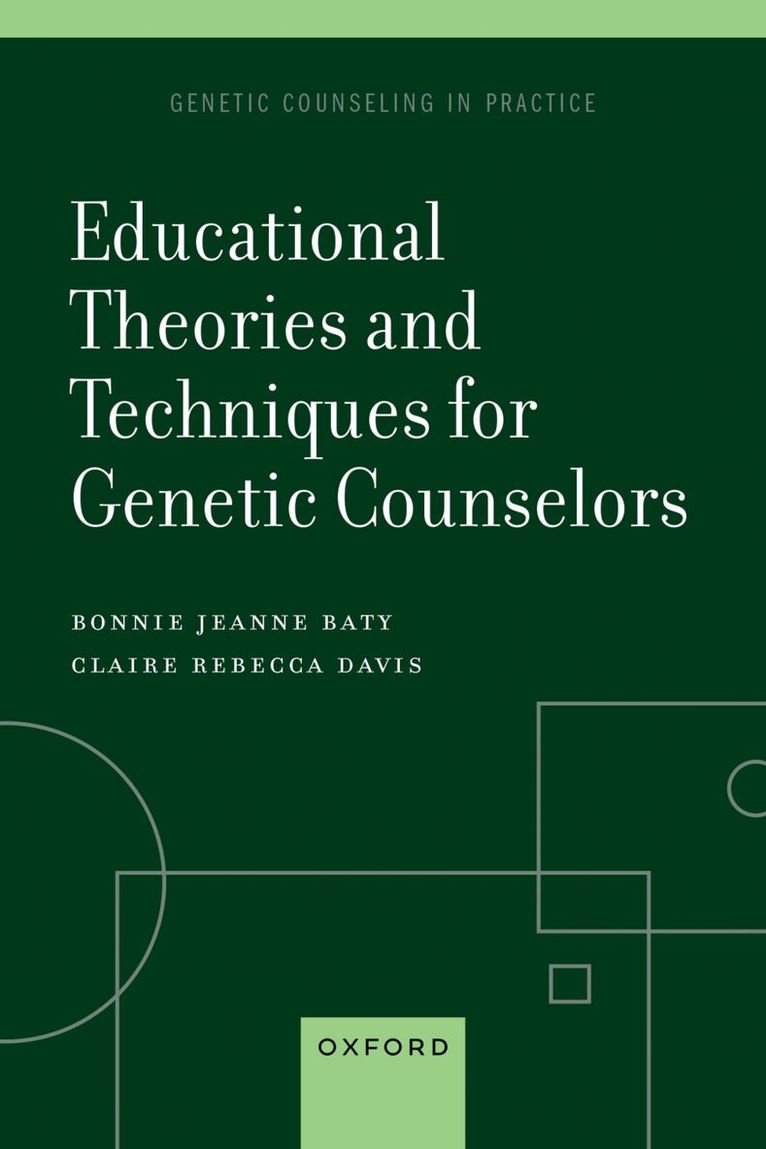
    Educational Theories and Techniques for Genetic Counselors

    AvBonnie Jeanne Baty,Claire Davis

    Häftad, Engelska, 2025

    Del i serien Genetic Counseling in Practice

    641 kr

    Beställningsvara. Skickas inom 5-8 vardagar. Fri frakt över 249 kr.

    Beskrivning

    Educational Theories and Techniques for Genetic Counselors provides an overview of central aspects of effective education by and for genetic counselors, beginning with insights from the general and genetic counseling education literature and moving through a survey of the structure and function of genetic counselor education in North America. In the opening two sections, Bonnie Baty and Claire Davis take a critical look at genetic counseling graduate programs, the contextual factors that shape the way education is offered, recruitment, admissions, and student support practices, the instructional framework and its components and teaching techniques, as well as intentional efforts to integrate these, the evaluative procedures for student learning, and processes of ongoing program evolution. The third section covers the continuous and increasingly self-directed learning that genetic counselors employ throughout their careers to sustain and expand their competence. The book concludes by considering genetic counselors' roles as educators of others, including their colleagues, clients, and communities, because education is an essential competency in all genetic counseling settings. Throughout the book, educational theories are coupled with practical techniques for designing and delivering education programs, and readers are invited to apply the book's content to their own educational experiences through a series of thought-provoking reflective questions and 76 practice-based examples from contributors across North America.

    Produktinformation

    • Utgivningsdatum:2025-11-28
    • Mått:135 x 198 x 25 mm
    • Vikt:567 g
    • Format:Häftad
    • Språk:Engelska
    • Serie:Genetic Counseling in Practice
    • Antal sidor:536
    • Förlag:OUP USA
    • ISBN:9780197749258

    Utforska kategorier

    • Den medicinska professionen inom Medicin
    • Medicin: icke kliniska discipliner inom Medicin

    Mer om författaren

    Bonnie Jeanne Baty is Professor Emerita in Pediatrics, Program Director Emerita for the Graduate Program in Genetic Counseling, and has provided clinical genetic counseling at the University of Utah for over 35 years. She served on the American Board of Genetic Counseling and has authored numerous peer-reviewed journal articles and book chapters. She was awarded the National Society of Genetic Counselors Natalie Weissberger Paul National Achievement Award and the University of Utah Distinguished Teaching Award. She currently teaches genetic counseling students, conducts research in genetic counseling education and professional development, and is a series editor for Oxford University Press.Claire Davis is a genetic counselor educator who has contributed to the learning, growth, and development of genetic counselors for 15 years. She has served as a graduate program director, course director, clinical supervisor, thesis advisor, simulation facilitator, student mentor, committee volunteer, andpeer learning participant. She is particularly fond of teaching, as reflected in her zeal for designing courses in GC skill development, evidence-based practice, and health humanities. She also enjoys building varied learning processes that encourage genetic counselors, educators, and allied healthcare practitioners to reflect on and further their own learning and work.

    Innehållsförteckning

    • Introduction to Genetic Counselor EducationA | Educational Literature A.1 | General educational theories and modelsA.1.1 | Program planningA.1.2 | Adult learning theoriesA.1.3 | Competency-based education A.1.4 | Staged self-directed learning modelA.1.5 | Student partnership theory A.2| Educational methods in genetic counseling A.2.1 | Previous genetic counselor educational literature A.2.2 | Genetic counselor educational study: Commonalities and contrasts: North American program directors' perspectives B | Genetic Counselor Master's Programs B.1 | Planning and Developing a Genetic Counselor Master's ProgramB.1.1 | Capitalizing on local strengthsB.1.2 | Actualizing program goalsB.1.3 | Diversity, equity, inclusion - philosophical framework and program planning B.1.4 | Administrative structure B.1.5 | Sequencing of program elements B.1.6 | Curriculum mapping B.1.7 | Distance educationB.1.8 | Regulatory structure and its effect on training genetic counselors B.2 | Recruitment, Admissions, and Student SupportB.2.1 | Fostering growth and diversity: Alignment of admissions standards and goalsB.2.2 | RecruitmentB.2.3 | AdmissionsB2.4 | Supporting students B.3 | Instructional Framework B.3.1 | Components: Courses B.3.2 | Components: Fieldwork B.3.3 | Components: Research B.3.4 | Components: Additional activities B.3.5 | Teaching techniques: Discussion B.3.6 | Teaching techniques: Role plays B.3.7 | Teaching techniques: Simulation B.4 | Integration across the Curriculum B.4.1 | Structural integration of program components B.4.2 | Integration of ethical orientations B.4.3 | Integrative developmental processes B.4.4 | Integrating theories and practice B.5 | Student EvaluationB.5.1 | General evaluation considerationsB.5.2 | Fieldwork evaluationB.5.3 | Evaluation by examinationB.5.4 | Assignments and projectsB.5.5 | RemediationB.5.6 | Assessing overall competence B.6 | Continuous Program EvolutionB.6.1 | General philosophyB.6.2 | Student feedbackB.6.3 | Evolving curricular conceptsB.6.4 | Faculty developmentB.6.5 | Program administrationB.6.6 | Program evaluationB.6.7 | Negotiating change C | Continuing Professional Learning C.1 | Lifelong learning C.2 | Maintaining and expanding competence across a career C.3 | Model of advanced training for Certified Genetic Counselors C.4 | Reflective practice C.5 | Communities of practice C.6 | Authentic professional learning C.7 | Learning through contributionC.7.1 | Publication of research and practice strategiesC.7.2 | Teaching and supervisionC.7.3 | Learning through collaborationC.7.4 | Examples of collaborations and partnerships D | Education Provided by Genetic Counselors D.1 | Why and how do genetic counselors learn to provide education? D.2 | General teaching strategies D.3 | Teaching health practitioners D.4 | Teaching clients D.5 | Teaching for the public Epilogue: Arriving