• Fri frakt över 249 kr
  • •
  • Snabba leveranser
  • •
  • Billiga böcker
Kundservice

Du är på sajten för privatpersoner.

Företag, bibliotek eller offentlig verksamhet?

Du handlar på classic.bokus.com, där alla dina funktioner finns intakta.
Till classic.bokus.com
Bokus logotyp. Gå till startsidan.
  • Erbjudanden
  • Nyheter
  • Student
  • Topplistor
  • Barn & ungdom
  • Bokus Play
  • E-böcker
  • Pocketböcker
  • Spel & pussel

10% rabatt på allt med kod NYSTART10 →

Sidfot

Mina sidor

    Hjälp

    • Kundservice
    • Vanliga frågor och svar
    • Frakt och leverans
    • Retur vid ångerrätt
    • Reklamera vara
    • Betalning
    • Köpvillkor
    • Allmänna villkor
    • Information om webbplatsens tillgänglighet

    Om Bokus

    • Om oss
    • Pressrum
    • För studenter
    • För företag
    • För bibliotek och offentlig verksamhet
    • För leverantörer
    • Hållbarhet

    Populärt

    • Aktuella erbjudanden
    • Presentkort
    • Studentlitteratur
    • Nya böcker
    • Topplistor
    • Signerade böcker
    • Engelska böcker

    Inspiration

    • Boktips
    • BookTok
    • Populära bokserier
    • Barnbokskaraktärer
    • Populära författare
    Logotyp för Bokus
    Följ oss på Facebook (extern länk)Följ oss på Instagram (extern länk)Följ oss på YouTube (extern länk)Följ oss på TikTok (extern länk)
    bokus @ CookiesAnpassa cookiesIntegritetspolicyKöpvillkor
    Till Citymail hemsida (extern länk)Till Budbee hemsida (extern länk)Till Postnord hemsida (extern länk)Till Schenker hemsida (extern länk)Till Early Bird hemsida (extern länk)Till Walleys hemsida (extern länk)
    1. Språk och ordböcker
    2. Språkvetenskap och lingvistik
    • Nyhet

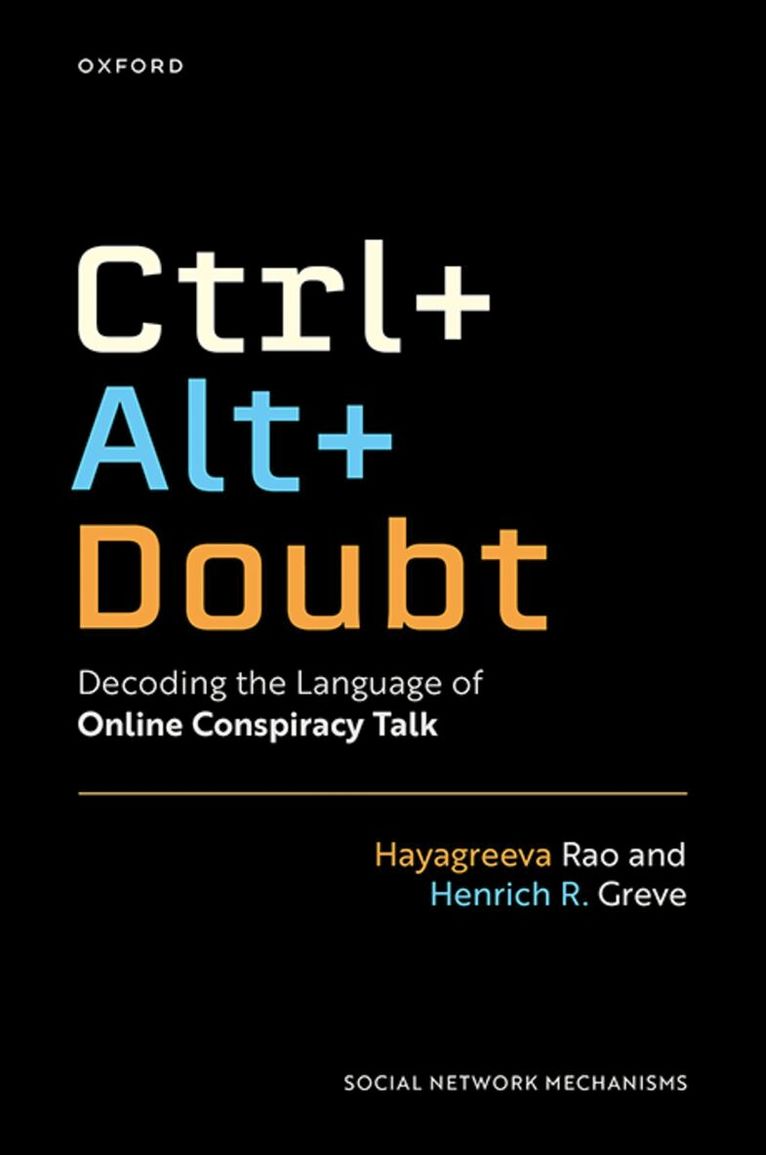
    Ctrl+Alt+Doubt

    Decoding the Language of Online Conspiracy Talk

    AvHayagreeva Rao,Henrich R. Greve

    Häftad, Engelska, 2026

    Del i serien Social Network Mechanisms

    283 kr

    Beställningsvara. Skickas inom 5-8 vardagar. Fri frakt över 249 kr.

    Fler format och utgåvor

    Inbunden

    1 546 kr

    Beskrivning

    Conspiracy theories are as old as society^—^but never have they spread so fast or so visibly. In an age of social media, moments of crisis and conflict ignite waves of conspiratorial storytelling that reshape how people interpret events, assign blame, and mobilize action.Ctrl+Alt+Doubt offers a new way to understand why conspiracy theories grow and persist. Rather than treating them as cognitive errors, psychological pathologies, or products of echo chambers, Rao and Greve analyze conspiracy theories as linguistic constructions^—^stories built from recognizable semantic patterns. Using tools from distributional semantics, they map the semantic space of conspiracy talk and show how meanings are assembled, recombined, and diffused online.Drawing on cases from COVID-19 and the Black Lives Matter protests, Rao and Greve show that conspiracy theorizing is a form of bricolage: people tinker with cultural fragments to craft explanations that reduce uncertainty and threat. New conspiracy beliefs are most likely to take hold when they are linguistically close to beliefs people already hold. The book traces how conspiracy theories spread through superspreaders, fear-laden language, bots, and shared hashtags^—^revealing conspiracy theorizing as a form of proto-coordination that generates community, amplifies outrage, and enables collective sensemaking among opponents of social movements.By foregrounding language and interaction, Ctrl+Alt+Doubt bridges cultural sociology, computational linguistics, and diffusion theory^—^offering a powerful framework for understanding how conspiracy theories spread and how interventions might be designed to blunt their social harm.

    Produktinformation

    • Utgivningsdatum:2026-08-27
    • Mått:159 x 234 x 10 mm
    • Vikt:268 g
    • Format:Häftad
    • Språk:Engelska
    • Serie:Social Network Mechanisms
    • Antal sidor:176
    • Förlag:OUP USA
    • ISBN:9780197772294

    Utforska kategorier

    • Språkvetenskap och lingvistik inom Språk och ordböcker
    • Sociala och etiska frågor inom Samhälle och politik
    • Sociologi inom Samhälle och politik

    Mer om författaren

    Hayagreeva Rao is the Atholl McBean Professor of Organizational Behavior and Human Resources at the Stanford Graduate School of Business. He studies cultural and organizational change, with a focus on how language and narratives shape beliefs and institutions. A former editor of Administrative Science Quarterly, Rao is the author of Market Rebels, Scaling Up Excellence (with Robert I. Sutton), and The Friction Project, a Financial Times Best Business Book of 2024. He is a Fellow of the Academy of Management and the Sociological Research Association.Henrich R. Greve has a Ph.D. in Business from Graduate School of Business at Stanford University and has spent much of his career doing research on how and why organizations make changes. He has also examined how communities differ from each other and change over time, and how this affects the foundation and growth of organizations. Soon after completing research on the societal effects on the Spanish Flu of 1918 onward, COVID-19happened. A seemingly similar disease except that it was not just a human and societal disaster, but also an outbreak of conspiracy theories and political turmoil.

    Recensioner i media

    CTRL+ALT+DOUBT delves into the digital age of doubt we're living through, tracing how conspiracy theories flourish not among the fringe, but across everyday online conversations. Sparked by the global upheaval of COVID-19, this sociological study investigates how distributed skepticism-fueled by uncertainty and shared online-shapes meaning-making on the margins. This is a wonderful examination of how we got to this place, and why conspiracy theories have such enduring appeal. It's essential reading for students, scholars, and anyone seeking to understand how truth, trust, and collective reasoning evolve in our hyperconnected world. Charles Duhigg, author of Supercommunicators and The Power of Habit

    Innehållsförteckning

    • 1: Linguistic Patterns in Online Conspiracy Theory Part I Sociological Foundations 2: Why Do Online Conspiracy Theories Matter? 3: Fake News, Rumors, Folk Theories: A Neglect of Language 4: From Mindsets and Algorithms to a Cultural Toolkit Part II The Linguistic Landscape of Conspiracy Theory 5: Cultural Toolkit: Conspiracy Theorists as Echolocators 6: Online Conspiracy Rabbit Hole as a Semantic Cascade 7: Linguistic Signature of Superspreaders 8: Online Conspiracy Theorizing as Conversational Coordination Part III What To Do 9: Resilience: Muting and Resisting Conspiracy Theories 10: Opportunities for Future Research Analytical Tools Appendix 1: Topic Modeling and Word Embedding Appendix 2: How We Studied Conspiracy Theories