• Fri frakt över 249 kr
  • •
  • Snabba leveranser
  • •
  • Billiga böcker
Kundservice

Du är på sajten för privatpersoner.

Företag, bibliotek eller offentlig verksamhet?

Du handlar på classic.bokus.com, där alla dina funktioner finns intakta.
Till classic.bokus.com
Bokus logotyp. Gå till startsidan.
  • Erbjudanden
  • Nyheter
  • Student
  • Topplistor
  • Barn & ungdom
  • Bokus Play
  • E-böcker
  • Pocketböcker
  • Spel & pussel

10% rabatt på allt med kod: NYSTART10 →

Sidfot

Mina sidor

    Hjälp

    • Kundservice
    • Vanliga frågor och svar
    • Frakt och leverans
    • Retur vid ångerrätt
    • Reklamera vara
    • Betalning
    • Köpvillkor
    • Allmänna villkor
    • Information om webbplatsens tillgänglighet

    Om Bokus

    • Om oss
    • Pressrum
    • För studenter
    • För företag
    • För bibliotek och offentlig verksamhet
    • För leverantörer
    • Hållbarhet

    Populärt

    • Aktuella erbjudanden
    • Presentkort
    • Studentlitteratur
    • Nya böcker
    • Topplistor
    • Signerade böcker
    • Engelska böcker

    Inspiration

    • Boktips
    • BookTok
    • Populära bokserier
    • Barnbokskaraktärer
    • Populära författare
    Logotyp för Bokus
    Följ oss på Facebook (extern länk)Följ oss på Instagram (extern länk)Följ oss på YouTube (extern länk)Följ oss på TikTok (extern länk)
    bokus @ CookiesAnpassa cookiesIntegritetspolicyKöpvillkor
    Till Citymail hemsida (extern länk)Till Budbee hemsida (extern länk)Till Postnord hemsida (extern länk)Till Schenker hemsida (extern länk)Till Early Bird hemsida (extern länk)Till Walleys hemsida (extern länk)
    1. Juridik
    2. Rättsvetenskap
    3. Juridik: metod och teori
    4. Rättssystem

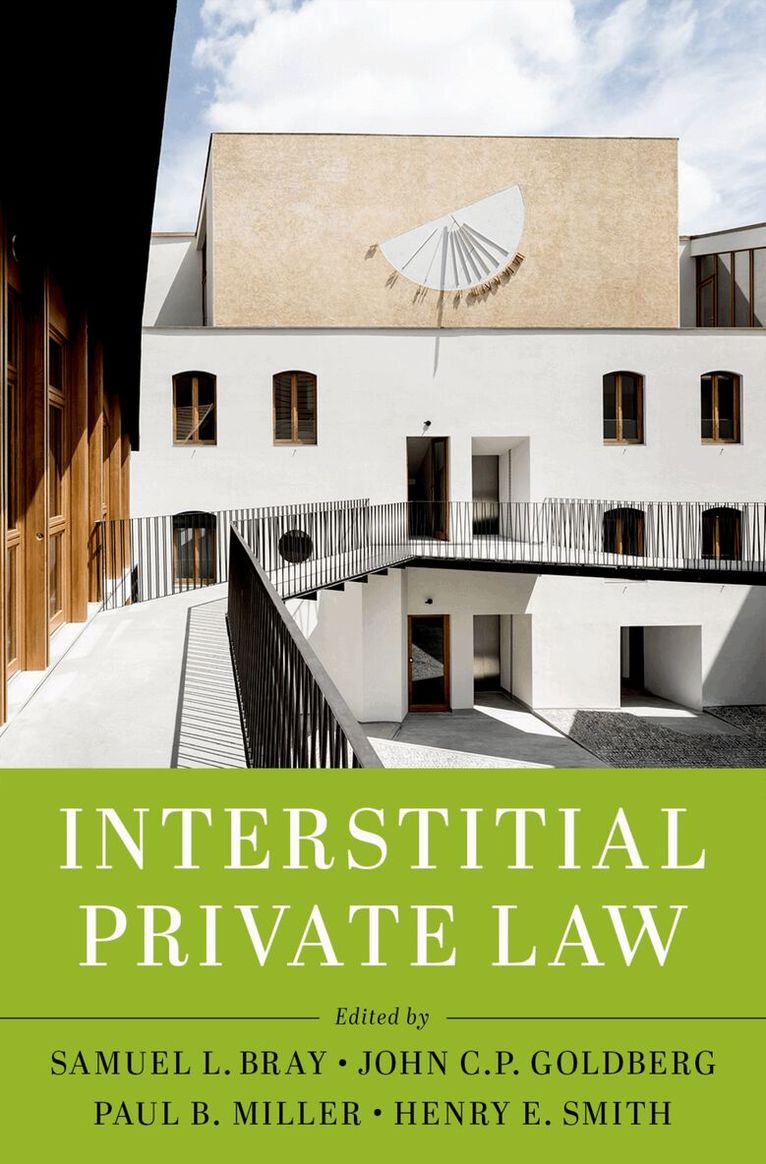
    Interstitial Private Law

    AvSamuel L. Bray,John C.P. Goldberg

    Inbunden, Engelska, 2025

    959 kr

    Beställningsvara. Skickas inom 5-8 vardagar. Fri frakt över 249 kr.

    Beskrivning

    Long regarded by US legal scholars as uninteresting, private law theory has received renewed attention in the United States and around the world. Yet, even amid this scholarly revival, private law is still too often reduced to the more traditional concepts found within tort, property, and contract law. These basic categories alone cannot provide sufficient basis for informed doctrinal analysis - lawyers who hope to apply private law theory must also understand the rules and concepts that operate independently of, across, or within the interstices of these fields.The essays collected in Interstitial Private Law encourage the next generation of private law theorists to engage with the 'connective tissue' of private law. Internationally prominent scholars introduce and analyze these crucially important interstitial aspects, including legal personhood, agency and other attribution rules, consent, estoppel, equity, remedies, and restitution. Contributions explain what interstitial concepts are and explore the ways they operate, contributing to the systematicity and functional coherence of private law systems. In doing so, Interstitial Private Law broadens and deepens the scholarly agenda for private law theory in the United States and worldwide.

    Produktinformation

    • Utgivningsdatum:2025-02-03
    • Mått:157 x 226 x 27 mm
    • Vikt:567 g
    • Format:Inbunden
    • Språk:Engelska
    • Antal sidor:296
    • Förlag:OUP USA
    • ISBN:9780197783627

    Utforska kategorier

    • Rättssystem inom Juridik
    • Skada, kränkningar och kompensation inom Juridik
    • Avtalsrätt inom Juridik

    Mer om författaren

    Samuel L. Bray is the John N. Matthews Professor of Law at Notre Dame Law School. His primary areas of expertise are remedies, equity, and constitutional law. He was previously a faculty member at UCLA School of Law, as well as a Harrington Faculty Fellow at the University of Texas. He is a McDonald Senior Distinguished Fellow at the Center for the Study of Law and Religion at Emory University, and he serves as an advisor to the Restatement (Third) of Torts: Remedies. John C.P. Goldberg, the Carter Professor of General Jurisprudence at Harvard Law School, is an expert in tort law, tort theory, and political philosophy. He joined the Law School faculty in 2008 and served as a Deputy Dean from 2017 to 2022. Previously, he was a faculty member of Vanderbilt Law School, where he was Associate Dean for Research (2006-08). An Associate Reporter for the American Law Institute's Fourth Restatement of Property, he also serves as an advisor to the Third Restatement of Torts. In addition, he is a memberof the editorial boards of the Journal of Tort Law and Legal Theory, and in 2009 was Chair of the Torts and Compensation Systems Section of the Association of American Law Schools.Paul B. Miller is the Robert and Marion Short Professor of Law and Associate Dean for International and Graduate Programs at Notre Dame Law School, where he also serves as Director of the Notre Dame Program on Private Law. Miller taught previously at McGill University in Montréal and has held visiting appointments at Bucerius Law School, the University of Melbourne, Université Paris-Panthéon-Assas, and Tel Aviv University. He has been a member of the Global Faculty of Peking University Law School since 2018.Henry E. Smith is the Fessenden Professor of Law at Harvard Law School, where he directs the Project on the Foundations of Private Law. Previously, Smith taught at the Northwestern University School of Law and was the Fred A. Johnston Professor of Property and Environmental Law at Yale Law School. He hasserved as the President of the Society for Institutional and Organizational Economics and is the Reporter for the American Law Institute's Fourth Restatement of Property.

    Innehållsförteckning

    • IntroductionHenry E. Smith 1. Equity Will Not. . .Samuel L. Bray 2. Duties Owed to the PublicNicolas Cornell 3. This Is a Chapter About DeceptionCourtney M. Cox 4. On the Form and Justification of Some Private Law Rights, Liberties, and PowersChristopher Essert 5. Consent Across Private LawMark P. Gergen 6. Private Law's Choice of Private LawAndrew S. Gold 7. Recklessness in Tort: Interstitial Law as Doctrinal Fine-TuningJohn C.P. Goldberg and Benjamin C. Zipursky 8. Equitable Estoppel and Restitution as Interstitial Causes of ActionBen McFarlane 9. The Concept of Personality in Private LawPaul B. Miller 10. Understanding the Rules of Attribution in Private LawJames Penner 11. General Customs and Legal Institutions: The Short, Sad Example of Racially Restrictive Covenants in the United StatesCarol M. Rose 12. The Threat and Promise of Collateral Benefits for Private Law's CoherenceZoë Sinel