• Fri frakt över 249 kr
  • •
  • Snabba leveranser
  • •
  • Billiga böcker
Kundservice

Du är på sajten för privatpersoner.

Företag, bibliotek eller offentlig verksamhet?

Du handlar på classic.bokus.com, där alla dina funktioner finns intakta.
Till classic.bokus.com
Bokus logotyp. Gå till startsidan.
  • Erbjudanden
  • Nyheter
  • Student
  • Topplistor
  • Barn & ungdom
  • Bokus Play
  • E-böcker
  • Pocketböcker
  • Spel & pussel

10% rabatt på allt med kod: NYSTART10 →

Sidfot

Mina sidor

    Hjälp

    • Kundservice
    • Vanliga frågor och svar
    • Frakt och leverans
    • Retur vid ångerrätt
    • Reklamera vara
    • Betalning
    • Köpvillkor
    • Allmänna villkor
    • Information om webbplatsens tillgänglighet

    Om Bokus

    • Om oss
    • Pressrum
    • För studenter
    • För företag
    • För bibliotek och offentlig verksamhet
    • För leverantörer
    • Hållbarhet

    Populärt

    • Aktuella erbjudanden
    • Presentkort
    • Studentlitteratur
    • Nya böcker
    • Topplistor
    • Signerade böcker
    • Engelska böcker

    Inspiration

    • Boktips
    • BookTok
    • Populära bokserier
    • Barnbokskaraktärer
    • Populära författare
    Logotyp för Bokus
    Följ oss på Facebook (extern länk)Följ oss på Instagram (extern länk)Följ oss på YouTube (extern länk)Följ oss på TikTok (extern länk)
    bokus @ CookiesAnpassa cookiesIntegritetspolicyKöpvillkor
    Till Citymail hemsida (extern länk)Till Budbee hemsida (extern länk)Till Postnord hemsida (extern länk)Till Schenker hemsida (extern länk)Till Early Bird hemsida (extern länk)Till Walleys hemsida (extern länk)
    1. Samhälle och politik
    2. Samhälle och kultur
    3. Kultur och medier
    4. Referensverk och tvärvetenskap

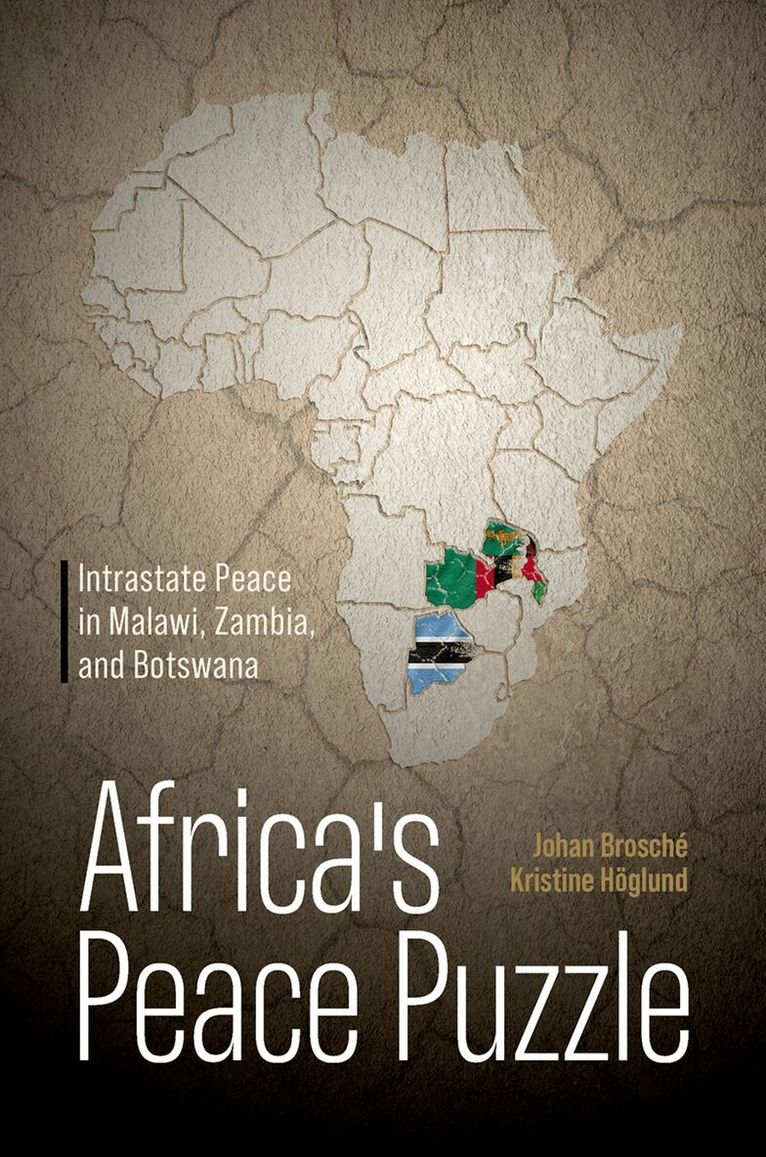
    Africa's Peace Puzzle

    Intrastate Peace in Malawi, Zambia, and Botswana

    AvJohan Brosché,Kristine Höglund

    Häftad, Engelska, 2026

    325 kr

    Kommande

    Fler format och utgåvor

    Inbunden

    Kommande

    Beskrivning

    Africa is often portrayed as a continent marked by violence and war. While conflict has indeed touched much of the continent, a few countries have managed to avoid it altogether. Africa's Peace Puzzle tells the story of three of them^—Malawi, Zambia, and Botswana^—^which together represent almost 90 percent of the population living in African states that have never experienced civil war. This book introduces the Topography of Peace, which highlights how peace endures through a balance between "strains" that threaten stability and "strengths" and "stabilizers" that help societies hold together. The analysis shows that while all three countries have experienced pressures that could have led to civil war, these challenges have played out differently in each context, shaping distinct topographies of peace.Across Malawi, Zambia, and Botswana, five shared features stand out: relatively conciliatory ethnic and communal relations; the absence of deep inequalities between groups; traditions of inclusive and pragmatic governance; the presence of legitimate actors willing to step in to mitigate and resolve conflict; and an underlying pattern of asymmetry and containment that prevents disputes from escalating. Together, these factors offer fresh insight into how peace can endure^—^even in the most fragile of settings.

    Produktinformation

    • Utgivningsdatum:2026-12-24
    • Mått:156 x 235 x undefined mm
    • Format:Häftad
    • Språk:Engelska
    • Antal sidor:304
    • Förlag:OUP USA
    • ISBN:9780197808412

    Utforska kategorier

    • Referensverk och tvärvetenskap inom Samhälle och politik
    • Internationella relationer inom Samhälle och politik
    • Krig och försvar inom Samhälle och politik

    Mer om författaren

    Johan Brosch^é^ is Associate Professor at the Department of Peace and Conflict Research, Uppsala University. His research explores civil war, peace, and political violence. He is the co-author of Violent Conflict and Peacebuilding: The Continuing Crisis in Darfur.Kristine H^ö^glund is Professor of Peace and Conflict Research at Uppsala University in Sweden. She works in the areas of electoral violence, urban insecurity, peacebuilding, and conflict resolution. She is the author of Peace Negotiations in the Shadow of Violence and Troubling Testimonies: Women's Narratives of War.

    Innehållsförteckning

    • Table of Contents AcknowledgementAbbreviations Chapter 1: Africa's Peace Puzzle An Empirical and Theoretical Puzzle Understanding Intrastate Peace What We FindOverview of the Book Chapter 2: Understanding Intrastate Peace Why is Peace Research All about War? Forms of Peace: Concepts and Varieties In Search of the Conditions for Peace A Minimal Definition of Peace The Topography of Peace: Strains, Strengths, and Stabilizers An Abductive Approach What Puts Peace under Pressure and What Keeps It in Place? Economic Dynamics: Resources and Grievances Political Dynamics: Institutions and Elite Interaction Social Dynamics: Group Relations, Conflict-Resolution Mechanisms, and Social Norms Conclusions Chapter 3: From Authoritarian to Unproductive Peace in Malawi Malawi's Political History Explaining Peace: Identifying Strains and Strengths Peaceful Transition: Strategic Restraint in Malawi's Path to Independence Unity, Loyalty, Obedience, and Discipline: Authoritarian Peace under Banda The Life President's Rule: Kamuzuism, Car Accidents, and Meat for Crocodiles The Cabinet Crisis and Chipembere Rebellion Consequences of Banda's Authoritarian Rule: Fear and Submissiveness Lack of Outside Support Surprisingly Smooth: The Path to Multiparty Elections "Under Siege from Above and Below, from Home and Abroad" Operation Bwezani and the Military's Defense of Democracy Land Inequality as a Structural Strain Land Dependency and Inequality Mitigating Land Conflict in Malawi Contained Ethnic Tensions Regional Grievance Balancing Interethnic Marriages and Religious Tolerance History Matters Shallow Democracy and Economically Unproductive Peace The Political Game in the Multiparty Era Hastings Banda's Legacy: Bwana, Submissiveness, and Economic VulnerabilityElite Dynamics: Democracy of Chameleons and Don't Rock the Boat Two Stabilizing Institutions: The Judiciary and Civil Society Organizations From Tipp-Ex Election to Country of the Year, to a New Opposition Win Malawi's Peace: Bringing It All Together Chapter 4: Balancing a Turbulent Peace in Zambia From Independence and into the New Millennium Explaining Peace: Identifying Strains and StrengthsThe Inclusive Struggle for Independence The Barotseland Challenge A Country of Copper: Resource Rich but Economically VulnerableBeyond the Resource Curse: Land Disputes and the Lunda-Luvale Conflict Unequal Land Distribution and Mitigation of Land Disputes The Lunda-Luvale Conflict UNIP's Political Powerhouse: Keeping Power and Averting Threats Challenges to UNIP during the First and Second Republic Inclusive Governance as a Co-optation Strategy Food Riots and Union-led Demonstrations Walking a Diplomatic Tightrope: Zambia during the Cold War Kaunda's Balancing Act: Supporting and Restricting Liberation Movements Kaunda's Pragmatism in Foreign Relations The Response: Fluctuating Retaliation The Mushala Rebellion Averted Coup Attempts Softening Identity-based Strains: Interethnic Marriages and Civil Servant Rotation Interethnic Marriages Civil Servant Rotation The End of Kaunda's Rule: A Peaceful Transition Chiluba in Power: Corruption and Third-Term Bid The Patriotic Front and a Decade of Autocratization The Patriotic Front's Path to Power Amplified Autocratization and Increased Tensions Polarized Churches: Pentecostals, Catholics, and Mainline Protestants Democracy Strikes Back The Opposition's Landslide Victory Conflict Management Institutions and the Ousting of Lungu Zambia's Peace: Bringing It All Together Chapter 5: Stable but Unequal Peace in Botswana From Poorest of the Poor to an African Success Story Explaining Peace: Identifying Strains and Strengths Independence Without Throwing a Stone Limited Colonial Intrusion A Peaceful Divorce Pragmatic Leadership, Democracy, and Diamonds Balancing Democracy and Customary Authority The Discovery of Diamonds Kagiso and the Kgotla System-Living Peacefully Together Turbulent Times: Escaping Violent Conflicts in the Region Pretoria- and Salisbury-Orchestrated Intrusions Geographically Encircled, Economically Dependent Botswana-The Land of the Tswana? The Ethnic Homogeneity Myth Tswanadom and Assimilation StrategiesThe Price of Assimilation: Unequal Land Access and Cultural Marginalization Multicultural Resistance: Contesting Assimilation and Hegemony Severe Grievances, Nonviolent Responses The San Community: Abandoned and Impoverished The Kalanga-Tswana Relationship In the Shadow of Diamonds, Poverty Persists Enduring Inequality and "The Kgosi Should Have Most of Everything" Limited Popular Resistance Extraordinary Presidential Power and BDP Dominance The President as King: Unrestricted Executive Authority Inclusive Governance Despite Ruling Party Dominance Factional Fighting and the North-South Divide Multilayered Elite Identities and Overlapping Interests Succession Politics and the Schlemmer Report General Khama's Presidency and Aftermath: Securitization and the Demise of BDP Securitization and Political Assassinations The Masisi-Khama Rift BDP's Fall from Power Botswana's Peace: Bringing it All Together Chapter 6: Understanding Africa's Peace Puzzle Mapping the Topography of Peace The Strains to Peace: Critical Junctures, Perilous Episodes, and Structural Pressures Critical Junctures: Turning Points When a More Violent Path Was Imminent Perilous Episodes: Periods of Heightened Tensions Structural Strains: Enduring Peace Pressures Safeguarding Peace: Strengths and Stabilizers Five Pivotal Factors for Africa's Peace Puzzle A Conciliatory Ethnic and Communal Landscape Inequalities-Vertical Rather Than Horizontal Do Not Rock the Boat: Inclusive Governance Strategies and Stable Elite Interactions Pouring Oil on Troubled Waters: Functioning Conflict Resolution Mechanisms The Paradox of Power Imbalance: Asymmetry and Conflict Containment Connecting the Drivers of Peace Chapter 7: Towards Peace War, What Is It Good For? Absolutely Nothing Rethinking Peace: Insights for Research and Practice The Future of Africa's Peace Puzzle and Beyond List of Interviews AI Disclosure Statement References