• Fri frakt över 249 kr
  • •
  • Snabba leveranser
  • •
  • Billiga böcker
Kundservice

Du är på sajten för privatpersoner.

Företag, bibliotek eller offentlig verksamhet?

Du handlar på classic.bokus.com, där alla dina funktioner finns intakta.
Till classic.bokus.com
Bokus logotyp. Gå till startsidan.
  • Erbjudanden
  • Nyheter
  • Student
  • Topplistor
  • Barn & ungdom
  • Bokus Play
  • E-böcker
  • Pocketböcker
  • Spel & pussel

10% rabatt på allt med kod: NYSTART10 →

Sidfot

Mina sidor

    Hjälp

    • Kundservice
    • Vanliga frågor och svar
    • Frakt och leverans
    • Retur vid ångerrätt
    • Reklamera vara
    • Betalning
    • Köpvillkor
    • Allmänna villkor
    • Information om webbplatsens tillgänglighet

    Om Bokus

    • Om oss
    • Pressrum
    • För studenter
    • För företag
    • För bibliotek och offentlig verksamhet
    • För leverantörer
    • Hållbarhet

    Populärt

    • Aktuella erbjudanden
    • Presentkort
    • Studentlitteratur
    • Nya böcker
    • Topplistor
    • Signerade böcker
    • Engelska böcker

    Inspiration

    • Boktips
    • BookTok
    • Populära bokserier
    • Barnbokskaraktärer
    • Populära författare
    Logotyp för Bokus
    Följ oss på Facebook (extern länk)Följ oss på Instagram (extern länk)Följ oss på YouTube (extern länk)Följ oss på TikTok (extern länk)
    bokus @ CookiesAnpassa cookiesIntegritetspolicyKöpvillkor
    Till Citymail hemsida (extern länk)Till Budbee hemsida (extern länk)Till Postnord hemsida (extern länk)Till Schenker hemsida (extern länk)Till Early Bird hemsida (extern länk)Till Walleys hemsida (extern länk)
    1. Naturvetenskap och teknik
    2. Geovetenskap
    3. Miljövetenskap och miljöpolitik

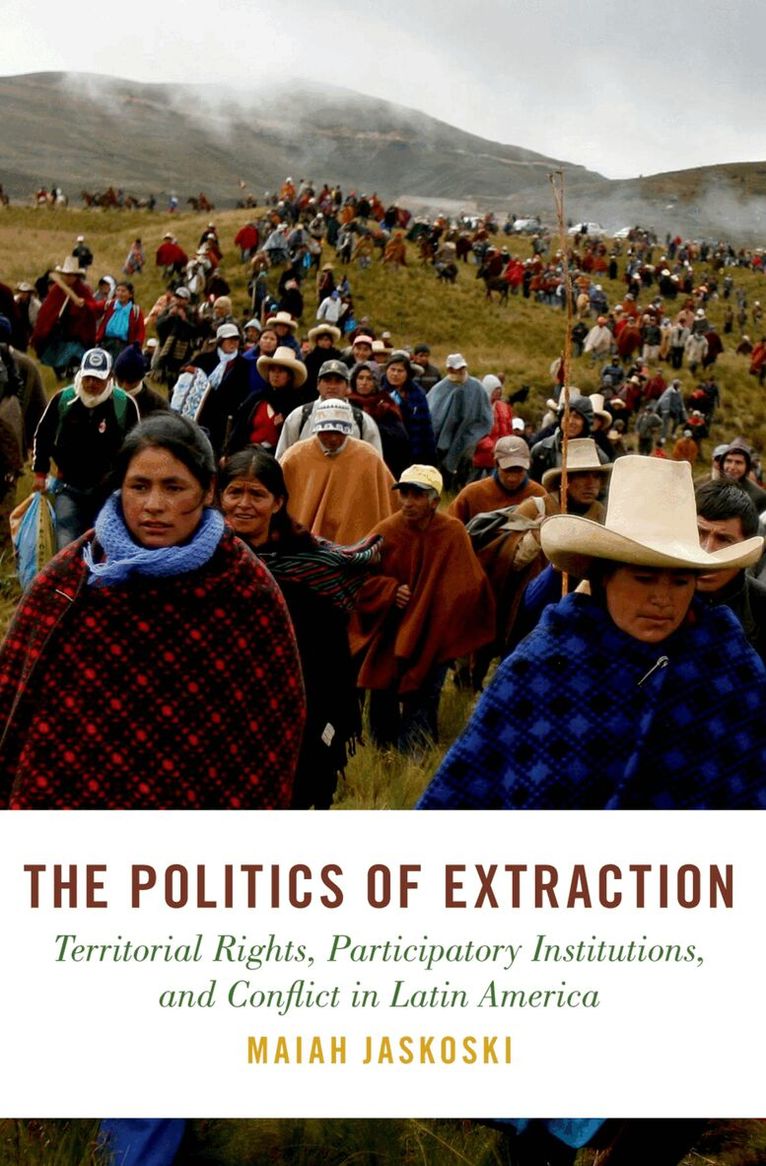
    The Politics of Extraction

    Territorial Rights, Participatory Institutions, and Conflict in Latin America

    AvMaiah Jaskoski

    Häftad, Engelska, 2025

    Del i serien Studies in Comparative Energy and Environmental Politics

    463 kr

    Beställningsvara. Skickas inom 5-8 vardagar. Fri frakt över 249 kr.

    Fler format och utgåvor

    Inbunden

    1 084 kr

    Beskrivning

    Mining and hydrocarbon production in Latin America is high-stakes for extractive firms, communities in resource-rich zones, and states. Amid global commodity price increases and liberal economic policies, the sectors have expanded dramatically in recent decades. This surge has made private investors and governments in the region ever more committed to extraction. It also has increased alarm within local communities, which have organized around the environmental, cultural, and social impacts of mining and hydrocarbons. Moreover, activists have mobilized to demand material benefits, in the forms of royalty distributions and direct company investment in local services and infrastructure. These conflicts take the form of legal battles, large-scale protests, and standoffs that pit communities against companies and the state, and consequently have suspended production, destabilized politics, and expended state security resources. In The Politics of Extraction, Maiah Jaskoski looks at how mobilized communities in Latin America's hydrocarbon and mining regions use participatory institutions to challenge extraction. In some cases, communities act within formal participatory spaces, while in others, they organize "around" or "in reaction to" these institutions, using participatory procedures as focal points in the escalation of conflict. Based on analysis of thirty major extractive conflicts in Bolivia, Colombia, and Peru in the 2000s and 2010s, Jaskoski examines community uses of public hearings built into environmental licensing, state-led prior consultation with native communities affected by large-scale development, and local popular consultations or referenda. She finds that communities select their strategies in response to the specific participatory challenges they confront: the trials of initiating participatory processes, gaining inclusion in participatory events, and, for communities with such access, expressing views about extraction at the participatory stage. Surprisingly, the communities least likely to channel their concerns through state institutions are the most unified and have the strongest guarantee of participation. Including a wealth of data and complex stories, Jaskoski provides the first systematic study of how participatory institutions either channel or exacerbate conflict over extraction.

    Produktinformation

    • Utgivningsdatum:2025-07-24
    • Mått:159 x 233 x 17 mm
    • Vikt:435 g
    • Format:Häftad
    • Språk:Engelska
    • Serie:Studies in Comparative Energy and Environmental Politics
    • Antal sidor:296
    • Förlag:OUP USA
    • ISBN:9780197812549

    Utforska kategorier

    • Miljövetenskap och miljöpolitik inom Naturvetenskap och teknik
    • Internationella relationer inom Samhälle och politik

    Mer om författaren

    Maiah Jaskoski is Associate Professor of Political Science at Northern Arizona University. She specializes in environmental and indigenous politics, military roles, security privatization, and borders, in Latin America. She is the author of Military Politics and Democracy in the Andes and numerous academic journal articles. She also co-authored and co-edited American Crossings: Border Politics in the Western Hemisphere.

    Recensioner i media

    This book is an outstanding analysis of one of the most urgent issues in Latin American politics: the impact of new participatory institutions on the conflict between extractive companies and nearby communities...This book is an outstanding analysis of one of the most urgent issues in Latin American politics: the impact of new participatory institutions on the conflict between extractive companies and nearby communities.

    Innehållsförteckning

    • Acknowledgements List of Acronyms and Abbreviations Part I. Introduction 1. PARTICIPATORY INSTITUTIONS AND EXTRACTIVE CONFLICT Part II. National Political Dynamics 2. EXTRACTION AND CONFLICT IN BOLIVIA, COLOMBIA, AND PERU3. PARTICIPATORY INSTITUTIONS AND THEIR UNDERLYING BOUNDARIES Part III. The Conflicts 4. THE EVENT INITIATION CHALLENGE AND CONTESTED POLICY JURISDICTIONS5. THE INCLUSION CHALLENGE AND CONTESTED GEOGRAPHIC BOUNDARIES 6. THE ARTICULATION CHALLENGE AND CONTESTED COMMUNITY REPRESENTATION Part IV. Conclusions 7. BOUNDARY STRUGGLES IN LATIN AMERICA'S EXTRACTIVE ZONES Appendix A. Omission of the Tintaya/Antapaccay Conflict Appendix B. Study Participants References