• Fri frakt över 249 kr
  • •
  • Snabba leveranser
  • •
  • Billiga böcker
Kundservice

Du är på sajten för privatpersoner.

Företag, bibliotek eller offentlig verksamhet?

Du handlar på classic.bokus.com, där alla dina funktioner finns intakta.
Till classic.bokus.com
Bokus logotyp. Gå till startsidan.
  • Erbjudanden
  • Nyheter
  • Student
  • Topplistor
  • Barn & ungdom
  • Bokus Play
  • E-böcker
  • Pocketböcker
  • Spel & pussel

10% rabatt på allt med kod: NYSTART10 →

Sidfot

Mina sidor

    Hjälp

    • Kundservice
    • Vanliga frågor och svar
    • Frakt och leverans
    • Retur vid ångerrätt
    • Reklamera vara
    • Betalning
    • Köpvillkor
    • Allmänna villkor
    • Information om webbplatsens tillgänglighet

    Om Bokus

    • Om oss
    • Pressrum
    • För studenter
    • För företag
    • För bibliotek och offentlig verksamhet
    • För leverantörer
    • Hållbarhet

    Populärt

    • Aktuella erbjudanden
    • Presentkort
    • Studentlitteratur
    • Nya böcker
    • Topplistor
    • Signerade böcker
    • Engelska böcker

    Inspiration

    • Boktips
    • BookTok
    • Populära bokserier
    • Barnbokskaraktärer
    • Populära författare
    Logotyp för Bokus
    Följ oss på Facebook (extern länk)Följ oss på Instagram (extern länk)Följ oss på YouTube (extern länk)Följ oss på TikTok (extern länk)
    bokus @ CookiesAnpassa cookiesIntegritetspolicyKöpvillkor
    Till Citymail hemsida (extern länk)Till Budbee hemsida (extern länk)Till Postnord hemsida (extern länk)Till Schenker hemsida (extern länk)Till Early Bird hemsida (extern länk)Till Walleys hemsida (extern länk)
    1. Samhälle och politik
    2. Samhälle och kultur
    3. Kultur och medier
    4. Referensverk och tvärvetenskap

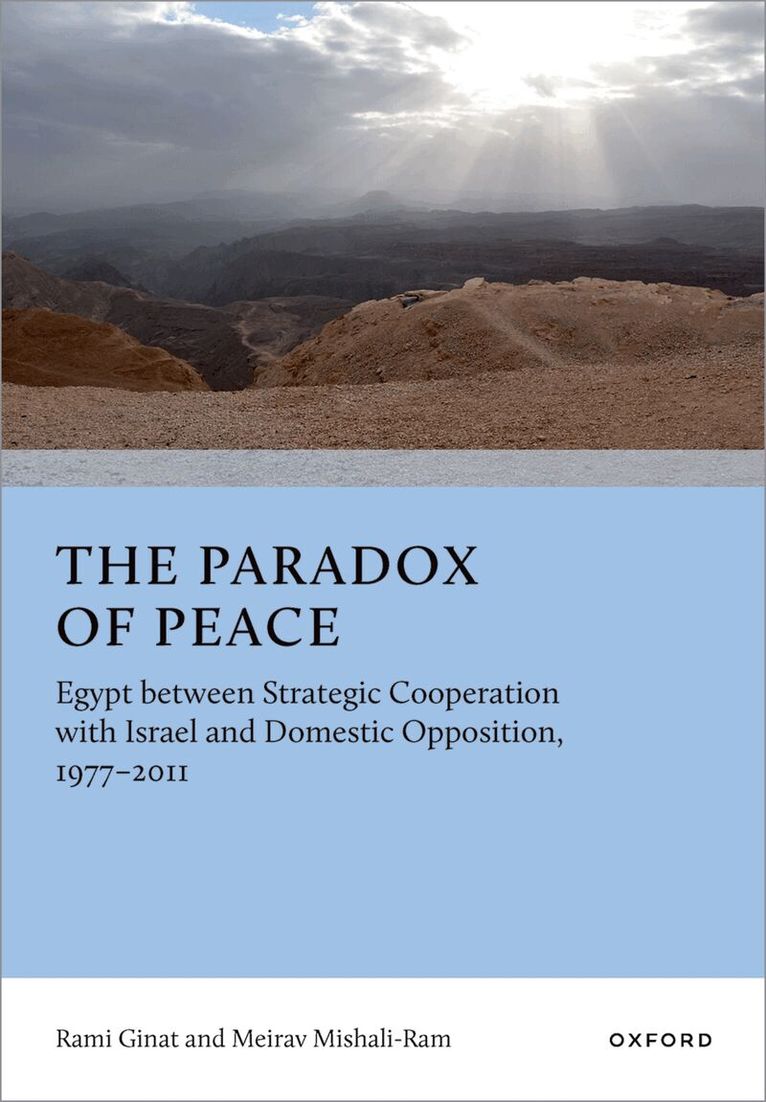
    The Paradox of Peace

    Egypt between Strategic Cooperation with Israel and Domestic Opposition, 1977–2011

    AvRami Ginat,Meirav Mishali-Ram

    Inbunden, Engelska, 2027

    1 263 kr

    Kommande

    Beskrivning

    The Paradox of Peace offers the first comprehensive, interdisciplinary examination of Egyptian–Israeli relations from Anwar Sadat's historic 1977 peace initiative through the end of Husni Mubarak's rule in 2011. It explores the central paradox of Egypt's sustained strategic cooperation with Israel at the state level, alongside deep and persistent opposition to normalization at the societal level. Despite major regional crises and internal challenges, genuine normalization has remained elusive, yet the strategic peace proved to be stable for over four decades.At the heart of the book is an inquiry into why Egypt's peace with Israel matured into a stable strategic partnership without progressing towards warmer, more integrated relations. Combining political and intellectual history with peace and conflict studies, the book charts the evolution of peace across different historical phases and distinguishes between "cold," "strategic," and "warm" peace. It introduces a new conceptual framework that differentiates between utilitarian and cultural normalization, offering a novel lens through which to assess the Egyptian–Israeli relationship. Anchored in a wide array of primary sources in Arabic, Hebrew, and English, the book brings new evidence and interpretations to the fore. The analysis includes materials from journals and newspapers associated with left-wing, Islamist, liberal, nationalist, and unaffiliated currents, as well as cultural products and public debates that reveal the broader societal context. It focuses on the Egyptian discourse on Israel, examining how leaders, intellectual elites, and the public engaged with the peace process over time; the writings and views of Egyptian intellectuals from across the political spectrum, whose voices reflected both the diversity and the intensity of opposition to normalization; and the role of civil society and various opposition groups in resisting the Egyptian–Israeli peace and shaping its trajectory. It emphasizes the interplay between Egypt's strategic interests and its Arab and Palestinian commitments, as well as the psychological and ideological barriers that have prevented deeper reconciliation with Israel, but not the establishment of a stable peace.

    Produktinformation

    • Utgivningsdatum:2027-01-09
    • Mått:178 x 254 x undefined mm
    • Format:Inbunden
    • Språk:Engelska
    • Antal sidor:304
    • Förlag:OUP USA
    • ISBN:9780197859643

    Utforska kategorier

    • Referensverk och tvärvetenskap inom Samhälle och politik
    • Internationella relationer inom Samhälle och politik
    • Krig och försvar inom Samhälle och politik

    Mer om författaren

    Rami Ginat is a Professor of Modern Middle Eastern Politics, specializing in the region's international politics, ideological movements, and Cold War geopolitics (specially Egypt and Syria). He has published numerous books and articles in prestigious academic forums, and his works pay careful attention to the mutual feedback between politics and ideology. Ginat has served as Head of the Department of Political Studies at Bar-Ilan University, Israel, and holds a PhD in Government from the London School of Economics. Now based in Oxfordshire, UK, he has been endorsed for Global Talent status by the British Academy in recognition for scholarly contributions.Meirav Mishali-Ram, PhD in International Relations, is a Senior Lecturer in the Department of Political Studies at Bar-Ilan University, where she previously served as Head of Special Programs. She has published extensively on international conflict, including issues such as conflict resolution, normalization, global terrorism, civilwar, and identity politics, with regional specialization in the Middle East and South Asia.

    Innehållsförteckning

    • Introduction 1: The War Is Over: What's Next? 2: The Intellectual Landscape: Initial Responses to Sadat's Peace Strategy 3: Normalization: The Promising Phase (1979-1982) 4: The Peace that Ran Aground: The Lebanon War and the Taba Crisis 5: Bilateral Relations in a Shifting Middle East: Mubarak's Janus-Faced Politics and the Complex Peace 6: People-to-People Peace: Can the Impasse Be Broken? 7: The Wonder of Peace: From Crisis Management to Strategic Cooperation Conclusion