• Fri frakt över 249 kr
  • •
  • Snabba leveranser
  • •
  • Billiga böcker
Kundservice

Du är på sajten för privatpersoner.

Företag, bibliotek eller offentlig verksamhet?

Du handlar på classic.bokus.com, där alla dina funktioner finns intakta.
Till classic.bokus.com
Bokus logotyp. Gå till startsidan.
  • Erbjudanden
  • Nyheter
  • Student
  • Topplistor
  • Barn & ungdom
  • Bokus Play
  • E-böcker
  • Pocketböcker
  • Spel & pussel

10% rabatt på allt med kod NYSTART10 →

Sidfot

Mina sidor

    Hjälp

    • Kundservice
    • Vanliga frågor och svar
    • Frakt och leverans
    • Retur vid ångerrätt
    • Reklamera vara
    • Betalning
    • Köpvillkor
    • Allmänna villkor
    • Information om webbplatsens tillgänglighet

    Om Bokus

    • Om oss
    • Pressrum
    • För studenter
    • För företag
    • För bibliotek och offentlig verksamhet
    • För leverantörer
    • Hållbarhet

    Populärt

    • Aktuella erbjudanden
    • Presentkort
    • Studentlitteratur
    • Nya böcker
    • Topplistor
    • Signerade böcker
    • Engelska böcker

    Inspiration

    • Boktips
    • BookTok
    • Populära bokserier
    • Barnbokskaraktärer
    • Populära författare
    Logotyp för Bokus
    Följ oss på Facebook (extern länk)Följ oss på Instagram (extern länk)Följ oss på YouTube (extern länk)Följ oss på TikTok (extern länk)
    bokus @ CookiesAnpassa cookiesIntegritetspolicyKöpvillkor
    Till Citymail hemsida (extern länk)Till Budbee hemsida (extern länk)Till Postnord hemsida (extern länk)Till Schenker hemsida (extern länk)Till Early Bird hemsida (extern länk)Till Walleys hemsida (extern länk)
    1. Data och IT
    2. Systemvetenskap och AI

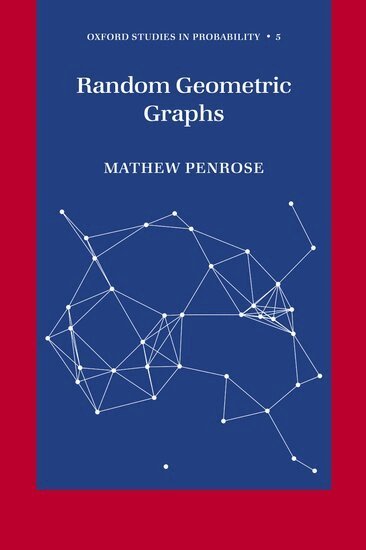
    Random Geometric Graphs

    AvMathew Penrose

    Inbunden, Engelska, 2003

    Del 5 i serien Oxford Studies in Probability

    2 810 kr

    Beställningsvara. Skickas inom 5-8 vardagar. Fri frakt över 249 kr.

    Beskrivning

    This monograph sets out a body of mathematical theory for finite graphs with nodes placed randomly in Euclidean space and edges added to connect points that are close to each other. As an alternative to classical random graph models, these geometric graphs are relevant to the modelling of real-world networks having spatial content, arising in numerous applications such as wireless communications, parallel processing, classification, epidemiology, astronomy, and the internet. Aimed at graduate students and researchers in probability, combinatorics, statistics, and theoretical computer science, it covers topics such as edge and component counts, vertex degrees, cliques, colourings, connectivity, giant component phenomena, vertex ordering and partitioning problems. It also illustrates and extends the application to geometric probability of modern techniques including Stein's method, martingale methods and continuum percolation.

    Produktinformation

    • Utgivningsdatum:2003-05-01
    • Mått:162 x 241 x 22 mm
    • Vikt:649 g
    • Format:Inbunden
    • Språk:Engelska
    • Serie:Oxford Studies in Probability
    • Antal sidor:344
    • Förlag:OUP OXFORD
    • ISBN:9780198506263

    Utforska kategorier

    • Systemvetenskap och AI inom Data och IT
    • Matematisk statistik inom Naturvetenskap och teknik
    • Matematik inom Naturvetenskap och teknik

    Recensioner i media

    The book is suitable to design a graduate course in random geometric graphs. Its scope stretches far beyond geometric probability and includes exciting material from Poisson approximation, percolation and statistical physics. This elegantly written monograph belongs to the collection of important books vital for every probabilist.

    Innehållsförteckning

    • 1. Introduction ; 2. Probabilistic ingredients ; 3. Subgraph and component counts ; 4. Typical vertex degrees ; 5. Geometrical ingredients ; 6. Maximum degree, cliques and colourings ; 7. Minimum degree: laws of large numbers ; 8. Minimum degree: convergence in distribution ; 9. Percolative ingredients ; 10. Percolation and the largest component ; 11. The largest component for a binomial process ; 12. Ordering and partitioning problems ; 13. Connectivity and the number of components ; References ; Index