• Fri frakt över 249 kr
  • •
  • Snabba leveranser
  • •
  • Billiga böcker
Kundservice

Du är på sajten för privatpersoner.

Företag, bibliotek eller offentlig verksamhet?

Du handlar på classic.bokus.com, där alla dina funktioner finns intakta.
Till classic.bokus.com
Bokus logotyp. Gå till startsidan.
  • Erbjudanden
  • Nyheter
  • Student
  • Topplistor
  • Barn & ungdom
  • Bokus Play
  • E-böcker
  • Pocketböcker
  • Spel & pussel

10% rabatt på allt med kod: NYSTART10 →

Sidfot

Mina sidor

    Hjälp

    • Kundservice
    • Vanliga frågor och svar
    • Frakt och leverans
    • Retur vid ångerrätt
    • Reklamera vara
    • Betalning
    • Köpvillkor
    • Allmänna villkor
    • Information om webbplatsens tillgänglighet

    Om Bokus

    • Om oss
    • Pressrum
    • För studenter
    • För företag
    • För bibliotek och offentlig verksamhet
    • För leverantörer
    • Hållbarhet

    Populärt

    • Aktuella erbjudanden
    • Presentkort
    • Studentlitteratur
    • Nya böcker
    • Topplistor
    • Signerade böcker
    • Engelska böcker

    Inspiration

    • Boktips
    • BookTok
    • Populära bokserier
    • Barnbokskaraktärer
    • Populära författare
    Logotyp för Bokus
    Följ oss på Facebook (extern länk)Följ oss på Instagram (extern länk)Följ oss på YouTube (extern länk)Följ oss på TikTok (extern länk)
    bokus @ CookiesAnpassa cookiesIntegritetspolicyKöpvillkor
    Till Citymail hemsida (extern länk)Till Budbee hemsida (extern länk)Till Postnord hemsida (extern länk)Till Schenker hemsida (extern länk)Till Early Bird hemsida (extern länk)Till Walleys hemsida (extern länk)
    1. Juridik
    2. Särskilda rättsområden
    3. Finansrätt

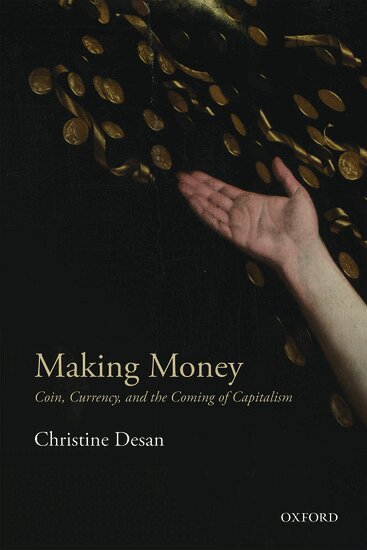
    Making Money

    Coin, Currency, and the Coming of Capitalism

    AvChristine Desan

    Inbunden, Engelska, 2014

    2 257 kr

    Beställningsvara. Skickas inom 3-6 vardagar. Fri frakt över 249 kr.

    Fler format och utgåvor

    E-bok

    425 kr

    E-bok

    425 kr

    Häftad

    618 kr

    Beskrivning

    Money travels the modern world in disguise. It looks like a convention of human exchange - a commodity like gold or a medium like language. But its history reveals that money is a very different matter. It is an institution engineered by political communities to mark and mobilize resources. As societies change the way they create money, they change the market itself - along with the rules that structure it, the politics and ideas that shape it, and the benefits that flow from it.One particularly dramatic transformation in money's design brought capitalism to England. For centuries, the English government monopolized money's creation. The Crown sold people coin for a fee in exchange for silver and gold. 'Commodity money' was a fragile and difficult medium; the first half of the book considers the kinds of exchange and credit it invited, as well as the politics it engendered. Capitalism arrived when the English reinvented money at the end of the 17th century. When it established the Bank of England, the government shared its monopoly over money creation for the first time with private investors, institutionalizing their self-interest as the pump that would produce the money supply. The second half of the book considers the monetary revolution that brought unprecedented possibilities and problems. The invention of circulating public debt, the breakdown of commodity money, the rise of commercial bank currency, and the coalescence of ideological commitments that came to be identified with the Gold Standard - all contributed to the abundant and unstable medium that is modern money. All flowed as well from a collision between the individual incentives and public claims at the heart of the system. The drama had constitutional dimension: money, as its history reveals, is a mode of governance in a material world. That character undermines claims in economics about money's neutrality. The monetary design innovated in England would later spread, producing the global architecture of modern money.

    Produktinformation

    • Utgivningsdatum:2014-11-27
    • Mått:178 x 250 x 34 mm
    • Vikt:1 052 g
    • Format:Inbunden
    • Språk:Engelska
    • Antal sidor:502
    • Förlag:OUP OXFORD
    • ISBN:9780198709572

    Utforska kategorier

    • Finansrätt inom Juridik
    • Rättshistoria inom Juridik
    • Finansiering inom Ekonomi och Ledarskap

    Mer om författaren

    Christine A. Desan is the Leo Gottlieb Professor of Law at Harvard Law School. She teaches about the international monetary system, the constitutional law of money, constitutional history, political economy, and legal theory. She is the co-founder of Harvard's Program on the Study of Capitalism; with its co-director, Professor Sven Beckert (History), she has taught the Program's anchoring research seminar, the Workshop on the Political Economy of Modern Capitalism, since 2005. Desan's research explores money as a legal and political project, one that configures the market it sets out to measure.

    Recensioner i media

    This fascinating book offers an innovative approach to monetary history, by using the historical development of currency in England from the high middle ages to the nineteenth century to challenge the established theory of money and its role in the economyâ This book is an excellent contribution to the existing literature [âand] must also be considered an important contribution to fields such as law, economics, political science, and the history of economic ideas.

    Innehållsförteckning

    • Introduction ; 1. Creation Stories ; 2. From Metal to Money: Producing the "Just Penny" ; 3. Commodity Money as an Extreme Sport: Flows, Famines, Debasements, and Imitation Pennies ; 4. The High Politics of Medieval Money: Strong Coin, Heavy Taxes, and the English Invention of Public Credit ; 5. The Social Stratigraphy of Coin and Credit in Late Medieval England ; 6. Priming the Pump: The Sovereign Path Towards Paying for Coin and Circulating Credit ; 7. Interests, Rights, and the Currency of Public Debt ; 8. Reinventing Money: The Beginning of Bank Currency ; 9. Re-theorizing Money: The Struggle Over the Modern Imagination ; 10. The Eighteenth Century Architecture of Modern Money ; 11. Epilogue to the Eighteenth Century: the Gold Standard in an Era of Inconvertibility ; Conclusion: From Blood to Water ; Bibliography