• Fri frakt över 249 kr
  • •
  • Snabba leveranser
  • •
  • Billiga böcker
Kundservice

Du är på sajten för privatpersoner.

Företag, bibliotek eller offentlig verksamhet?

Du handlar på classic.bokus.com, där alla dina funktioner finns intakta.
Till classic.bokus.com
Bokus logotyp. Gå till startsidan.
  • Erbjudanden
  • Nyheter
  • Student
  • Topplistor
  • Barn & ungdom
  • Bokus Play
  • E-böcker
  • Pocketböcker
  • Spel & pussel

10% rabatt på allt med kod NYSTART10 →

Sidfot

Mina sidor

    Hjälp

    • Kundservice
    • Vanliga frågor och svar
    • Frakt och leverans
    • Retur vid ångerrätt
    • Reklamera vara
    • Betalning
    • Köpvillkor
    • Allmänna villkor
    • Information om webbplatsens tillgänglighet

    Om Bokus

    • Om oss
    • Pressrum
    • För studenter
    • För företag
    • För bibliotek och offentlig verksamhet
    • För leverantörer
    • Hållbarhet

    Populärt

    • Aktuella erbjudanden
    • Presentkort
    • Studentlitteratur
    • Nya böcker
    • Topplistor
    • Signerade böcker
    • Engelska böcker

    Inspiration

    • Boktips
    • BookTok
    • Populära bokserier
    • Barnbokskaraktärer
    • Populära författare
    Logotyp för Bokus
    Följ oss på Facebook (extern länk)Följ oss på Instagram (extern länk)Följ oss på YouTube (extern länk)Följ oss på TikTok (extern länk)
    bokus @ CookiesAnpassa cookiesIntegritetspolicyKöpvillkor
    Till Citymail hemsida (extern länk)Till Budbee hemsida (extern länk)Till Postnord hemsida (extern länk)Till Schenker hemsida (extern länk)Till Early Bird hemsida (extern länk)Till Walleys hemsida (extern länk)
    1. Djur och Natur
    2. Naturböcker
    3. Växtböcker

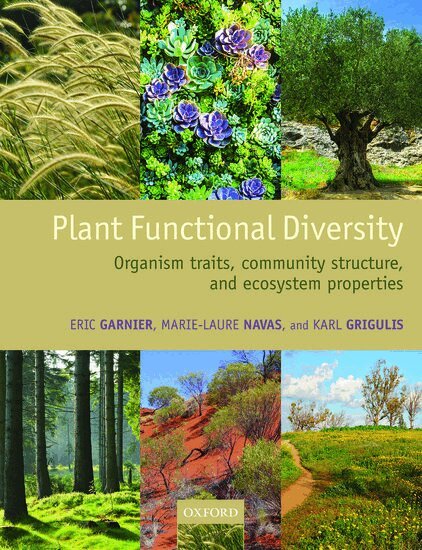
    Plant Functional Diversity

    Organism traits, community structure, and ecosystem properties

    AvEric Garnier,Marie-Laure Navas

    Inbunden, Engelska, 2015

    2 766 kr

    Beställningsvara. Skickas inom 5-8 vardagar. Fri frakt över 249 kr.

    Fler format och utgåvor

    Häftad

    979 kr

    Beskrivning

    Biological diversity, the variety of living organisms on Earth, is traditionally viewed as the diversity of taxa, and species in particular. However, other facets of diversity also need to be considered for a comprehensive understanding of evolutionary and ecological processes. This novel book demonstrates the advantages of adopting a functional approach to diversity in order to improve our understanding of the functioning of ecological systems and their components. The focus is on plants, which are major components of these systems, and for which the functional approach has led to major scientific advances over the last 20 years. Plant Functional Diversity presents the rationale for a trait-based approach to functional diversity in the context of comparative plant ecology and agroecology. It demonstrates how this approach can be used to address a number of highly debated questions in plant ecology pertaining to plant responses to their environment, controls on plant community structure, ecosystem properties, and the services these deliver to human societies. This research level text will be of particular relevance and use to graduate students and professional researchers in plant ecology, agricultural sciences and conservation biology.

    Produktinformation

    • Utgivningsdatum:2015-12-10
    • Mått:196 x 249 x 19 mm
    • Vikt:724 g
    • Format:Inbunden
    • Språk:Engelska
    • Antal sidor:256
    • Förlag:OUP OXFORD
    • ISBN:9780198757368

    Utforska kategorier

    • Växtböcker inom Djur och Natur
    • Botanik inom Naturvetenskap och teknik
    • Miljövetenskap och miljöpolitik inom Naturvetenskap och teknik

    Mer om författaren

    Eric Garnier is a researcher in plant functional ecology. His work on plant functional diversity is based on a combination of conceptual, experimental and methodological approaches, and contributes to the broad field of trait-based comparative ecology. He has pioneered some of the developments of conceptual models of relationships between plant functional traits, plant function, and biogeochemistry, and has participated in the development of standardized approaches to the measurement of plant traits towards a worldwide application. More recently, he has contributed to the emergence of ecoinformatics at the French national scale, especially through his work as the Director of CEntre for the Synthesis and Analysis of Biodiversity.Marie-Laure Navas works on the identification of the functional diversity of plant species. More precisely, her work focuses on i) the identification of assembly rules of plant communities due to biotic and abiotic processes; ii) the characterization of changes in functional structure of plant communities along environmental gradients; iii) the identification of traits related to competition and facilitation ability of plants. These questions are addressed with the example of managed grasslands, especially in the French Mediterranean area. Recently, Marie-Laure Navas also developed collaborations with researchers in crop science and weed science, in order to test the relevance of the functional approach for developing new cropping systems based on more ecological-directed regulation of pests.Karl Grigulis works as a research engineer in the Laboratoire d'Ecologie Alpine in Grenoble, France. Initially working as an agronomist in south-east Australia on topics of population ecology using pasture weeds as model systems, more recently in France he participates in projects focussed on functional and community ecology, in particular the field assessment of community functional structure as a determinant of ecosystem services.

    Recensioner i media

    Each of the ten chapters is excellently structured... The book is also nicely illustrated, extremely well referenced and has a useful index. In a nutshell, the book is an absolute must-read for graduate students, ecologists, agricultural scientists and conservation biologists interested in the functional approach to biological diversity.

    Innehållsförteckning

    • 1. A functional approach to biological diversity ; 2. Trait-based ecology: definitions, methods, and a conceptual framework ; 3. The functional characterisation of plants ; 4. Gradients, response traits, and ecological strategies ; 5. A functional approach to plant community structure ; 6. Plant traits and ecosystem properties ; 7. Functional diversity and ecosystem services ; 8. Functional diversity in agriculture: the cases of grasslands and crop weeds ; 9. Managing functional diversity data ; 10. Perspectives for functional diversity research