• Fri frakt över 249 kr
  • •
  • Snabba leveranser
  • •
  • Billiga böcker
Kundservice

Du är på sajten för privatpersoner.

Företag, bibliotek eller offentlig verksamhet?

Du handlar på classic.bokus.com, där alla dina funktioner finns intakta.
Till classic.bokus.com
Bokus logotyp. Gå till startsidan.
  • Erbjudanden
  • Nyheter
  • Student
  • Topplistor
  • Barn & ungdom
  • Bokus Play
  • E-böcker
  • Pocketböcker
  • Spel & pussel

10% rabatt på allt med kod: NYSTART10 →

Sidfot

Mina sidor

    Hjälp

    • Kundservice
    • Vanliga frågor och svar
    • Frakt och leverans
    • Retur vid ångerrätt
    • Reklamera vara
    • Betalning
    • Köpvillkor
    • Allmänna villkor
    • Information om webbplatsens tillgänglighet

    Om Bokus

    • Om oss
    • Pressrum
    • För studenter
    • För företag
    • För bibliotek och offentlig verksamhet
    • För leverantörer
    • Hållbarhet

    Populärt

    • Aktuella erbjudanden
    • Presentkort
    • Studentlitteratur
    • Nya böcker
    • Topplistor
    • Signerade böcker
    • Engelska böcker

    Inspiration

    • Boktips
    • BookTok
    • Populära bokserier
    • Barnbokskaraktärer
    • Populära författare
    Logotyp för Bokus
    Följ oss på Facebook (extern länk)Följ oss på Instagram (extern länk)Följ oss på YouTube (extern länk)Följ oss på TikTok (extern länk)
    bokus @ CookiesAnpassa cookiesIntegritetspolicyKöpvillkor
    Till Citymail hemsida (extern länk)Till Budbee hemsida (extern länk)Till Postnord hemsida (extern länk)Till Schenker hemsida (extern länk)Till Early Bird hemsida (extern länk)Till Walleys hemsida (extern länk)
    1. Samhälle och politik
    2. Politik och statsskick
    3. Statsskick och politiska processer

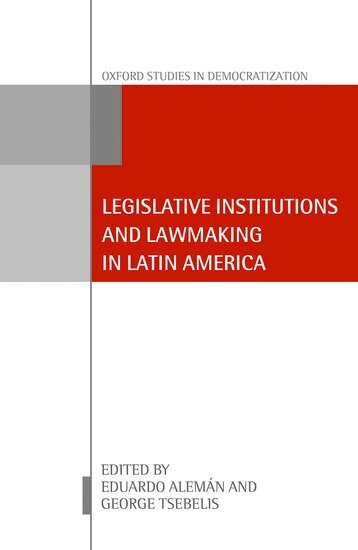
    Legislative Institutions and Lawmaking in Latin America

    AvEduardo Aleman,Eduardo Alemán

    Inbunden, Engelska, 2016

    Del i serien Oxford Studies in Democratization

    1 495 kr

    Beställningsvara. Skickas inom 7-10 vardagar. Fri frakt över 249 kr.

    Beskrivning

    In this volume, twelve experts on Latin American politics investigate the ways in which the interaction between legislative institutions and the policy positions of key actors affects the initiation and passage of legislation, covering seven Latin American Countries: Argentina, Brazil, Chile, Colombia, Mexico, Peru, and Uruguay. These seven presidential systems vary widely in terms of their legislative institutions and the position of relevant actors.The introduction provides a framework to understand the interaction of legislative majorities, political institutions, and policy position, and each chapter begins with a description of the constitutional and congressional rules that allocate powers to propose, amend, and veto legislation. The authors then identify the political actors who have these prerogatives and apply the framework to show how their policy positions and relative strengths influence legislative decision-making. The findings are consistent with the basic argument of the book that presidents with extensive legislative powers may be constrained by the positions of their legislative allies, whereas weaker presidents may be well-positioned to build successful coalitions to achieve their legislative goals. The essays in this volume demonstrate that institutional design, which determines the allocation of legislative powers, must be considered along with the policy preferences of key legislative actors in order to construct a full picture of law-making.Oxford Studies in Democratization is a series for scholars and students of comparative politics and related disciplines. Volumes concentrate on the comparative study of the democratization process that accompanied the decline and termination of the cold war. The geographical focus of the series is primarily Latin America, the Caribbean, Southern and Eastern Europe, and relevant experiences in Africa and Asia. The series editor is Laurence Whitehead, Senior Research Fellow, Nuffield College, University of Oxford.

    Produktinformation

    • Utgivningsdatum:2016-06-09
    • Mått:160 x 241 x 20 mm
    • Vikt:564 g
    • Format:Inbunden
    • Språk:Engelska
    • Serie:Oxford Studies in Democratization
    • Antal sidor:286
    • Förlag:OUP OXFORD
    • ISBN:9780198777861

    Utforska kategorier

    • Statsskick och politiska processer inom Samhälle och politik
    • Statsvetenskap och politisk teori inom Samhälle och politik

    Mer om författaren

    Eduardo Alemán is an Associate Professor in the Department of Political Science at the University of Houston. He specializes in the comparative analysis of political institutions and Latin American politics. His research focuses on executive-legislative relations, legislative politics, and political parties. He has published articles in such journals as World Politics, Comparative Politics, Comparative Political Studies, Legislative Studies Quarterly, and Latin American Research Review.George Tsebelis is Anatol Rapoport Collegiate Professor of Political Science at the University of Michigan. He is a comparativist who specializes in political institutions. His works covers Western European countries and the European Union. His more recent work studies political institutions in Latin America and Eastern Europe. He is the author of four books: Nested Games (University of California Press, 1991), Bicameralism (coauthored with Jeanette Money, Cambridge University Press, 1997), Veto Players (Princeton University Press, 2002), and Reforming the European Union: Realizing the Impossible (coauthored with Daniel Finke, Thomas Koenig, and Sven Oliver Proksch, Princeton University Press, 2012). His work has appeared in numerous academic journals and has been reprinted and translated in several languages.

    Recensioner i media

    By including in their theoretical model the ideological positions of partisan executive and legislative players, Aleman and Tsebelis significantly advance our understanding of lawmaking in Latin America. Rarely does an edited collection exhibit such consistency between the overall theoretical argument and the case chapters, and rarely are case chapters so rigorous. Barry Ames, Professor of Political Science, University of Pittsburgh The importance of agenda setting institutions for the functioning of democratic regimes cannot be overemphasized. This book shows how these institutions interact with the government's majority status and the actors' preferences to produce different patterns of policy-making. It shows that there are institutional and ideological conditions under which minority presidential governments can be legislatively successful, even if at times they cannot get exactly what they would have preferred. All chapters have completely moved away from the models that predicted the catastrophic failure of minority presidential democracies and demonstrate the multiple ways executive-legislative relations are shaped by the interaction between institutions and political conditions. In this sense, this book is a great example of how sophisticated research on Latin American presidentialism has become. Jose A. Cheibub, Professor of Political Science, University of Illinois at Urbana-Champaign Legislative Institutions and Agenda Control is a major theoretical and empirical contribution to the literatures on legislatures, legislative/executive relationships, and policy-making. Scott Mainwaring, Eugene and Helen Conley Professor of Political Science, University of Notre Dame

    Innehållsförteckning

    • 1: Eduardo Alemán and George Tsebelis: Introduction: Legislative Institutions and Agenda Setting 2: Ernesto Calvo and Iñaki Sagarzazu: Presidential Agenda Authority in Plurality-Led Congresses: Agenda Setting Prerogatives without Majority Support 3: Taeko Hiroi and Lucio R. Rennó: Agenda Setting and Gridlock in a Multiparty Coalitional Presidential System: The Case of Brazil 4: Eduardo Alemán and Patricio Navia: Presidential Power, Legislative Rules, and Lawmaking in Chile 5: Royce Carroll and Mónica Pachón: The Unrealized Potential of Presidential Coalitions in Colombia 6: María Amparo Casar: Parliamentary Agenda-Setting in Latin America: The Case of Mexico 7: Aldo F. Ponce: Strong Presidents, Weak Parties, and Agenda Setting: Lawmaking in Democratic Peru 8: Daniel Chasquetti: Agenda Setting and Lawmaking in Uruguay 9: Eduardo Alemán and George Tsebelis: Conclusions