• Fri frakt över 249 kr
  • •
  • Snabba leveranser
  • •
  • Billiga böcker
Kundservice

Du är på sajten för privatpersoner.

Företag, bibliotek eller offentlig verksamhet?

Du handlar på classic.bokus.com, där alla dina funktioner finns intakta.
Till classic.bokus.com
Bokus logotyp. Gå till startsidan.
  • Erbjudanden
  • Nyheter
  • Student
  • Topplistor
  • Barn & ungdom
  • Bokus Play
  • E-böcker
  • Pocketböcker
  • Spel & pussel

Må bättre, för mindre! Upp till 50% rabatt på hälsoböcker

Sidfot

Mina sidor

    Hjälp

    • Kundservice
    • Vanliga frågor och svar
    • Frakt och leverans
    • Retur vid ångerrätt
    • Reklamera vara
    • Betalning
    • Köpvillkor
    • Allmänna villkor
    • Information om webbplatsens tillgänglighet

    Om Bokus

    • Om oss
    • Pressrum
    • För studenter
    • För företag
    • För bibliotek och offentlig verksamhet
    • För leverantörer
    • Hållbarhet

    Populärt

    • Aktuella erbjudanden
    • Presentkort
    • Studentlitteratur
    • Nya böcker
    • Topplistor
    • Signerade böcker
    • Engelska böcker

    Inspiration

    • Boktips
    • BookTok
    • Populära bokserier
    • Barnbokskaraktärer
    • Populära författare
    Logotyp för Bokus
    Följ oss på Facebook (extern länk)Följ oss på Instagram (extern länk)Följ oss på YouTube (extern länk)Följ oss på TikTok (extern länk)
    bokus @ CookiesAnpassa cookiesIntegritetspolicyKöpvillkor
    Till Citymail hemsida (extern länk)Till Budbee hemsida (extern länk)Till Postnord hemsida (extern länk)Till Schenker hemsida (extern länk)Till Early Bird hemsida (extern länk)Till Walleys hemsida (extern länk)
    1. Skönlitteratur
    2. Litteraturvetenskap
    3. Litteraturvetenskap

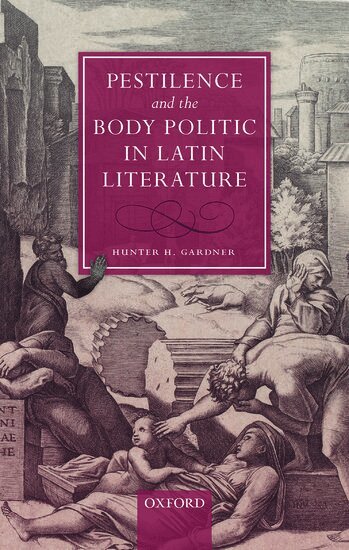
    Pestilence and the Body Politic in Latin Literature

    AvHunter H. Gardner

    Inbunden, Engelska, 2019

    2 260 kr

    Beställningsvara. Skickas inom 3-6 vardagar. Fri frakt över 249 kr.

    Fler format och utgåvor

    E-bok

    1 450 kr

    E-bok

    1 450 kr

    Beskrivning

    Scientists, journalists, novelists, and filmmakers continue to generate narratives of contagion, stories shaped by a tradition of disease discourse that extends to early Greco-Roman literature. Lucretius, Vergil, and Ovid developed important conventions of the western plague narrative as a response to the breakdown of the Roman res publica in the mid-first century CE and the reconstitution of stabilized government under the Augustan Principate (31 BCE-14 CE): relying on the metaphoric relationship between the human body and the body politic, these authors used largely fictive representations of epidemic disease to address the collapse of the social order and suggest remedies for its recovery. Theorists such as Susan Sontag and René Girard have observed how the rhetoric of disease frequently signals social, psychological, or political pathologies, but their observations have rarely been applied to Latin literary practices. Pestilence and the Body Politic in Latin Literature explores how the origins and spread of outbreaks described by Roman writers enact a drama in which the concerns of the individual must be weighed against those of the collective, staged in an environment signalling both reversion to a pre-historic Golden Age and the devastation characteristic of a post-apocalyptic landscape. Such innovations in Latin literature have impacted representations as diverse as Carlo Coppola's paintings of a seventeenth-century outbreak of bubonic plague in Naples and Margaret Atwood's Maddaddam Trilogy. Understanding why Latin writers developed these tropes for articulating contagious disease and imbuing them with meaning for the collapse of the Roman body politic allows us to clarify what more recent disease discourses mean both for their creators and for the populations they afflict in contemporary media.

    Produktinformation

    • Utgivningsdatum:2019-07-16
    • Mått:143 x 220 x 25 mm
    • Vikt:524 g
    • Format:Inbunden
    • Språk:Engelska
    • Antal sidor:316
    • Förlag:OUP OXFORD
    • ISBN:9780198796428

    Utforska kategorier

    • Litteraturvetenskap inom Skönlitteratur
    • Film inom Kultur
    • Medicinhistoria inom Medicin

    Mer om författaren

    Hunter H. Gardner is Associate Professor of Classics and Comparative Literature at the University of South Carolina, where she teaches a wide range of courses on Greek, Latin, and the ancient Greco-Roman Mediterranean. She is the author of Gendering Time in Augustan Love Elegy (OUP, 2013) and co-editor of Odyssean Identities in Modern Cultures: The Journey Home (with Sheila Murnaghan; Ohio State University Press, 2014).

    Recensioner i media

    ...this outstanding work has already changed our knowledge of the late Republican imagery of the pestilence in the political culture and discourses. It is now a must-read for any future research on the plague metaphor(s) applied to the body politic beyond the Latin literature.

    Innehållsförteckning

    • Frontmatter List of Illustrations 0: Introduction PART 1: Tabula Rasa: A New Kind of Plague Narrative 1: Roman Pestilence: Tenor and Vehicle 1.1: Experiencing and observing epidemic disease in ancient Rome 1.2: Theorizing fictions of the end 1.3: Caveat: on the dangers of invoking plague discourse 2: Livy, Pestilentia, and the Pathologies of Class Strife 2.1: Plague and seditio of the fifth century 2.2: Pestilence and the lectisternium of 399 BCE 2.3: Plague and Rome's ludi scaenici PART 2: Experiments in Apocalyptic Thinking 3: Human and Civic Corpora in Lucretius' Treatment of the Athenian Plague 3.1: Transgressing the threshold of death 3.2: Repetition, accumulation, and iterative mortality 3.3: Contending for "one's own": familial devotion and civic discord 3.4: Terminating the interminable: saecular and literary evolutions 4: Plague, Civil War, and Epochal Evolution in Vergil's Georgics 4.1: Plague and the (post-) apocalypse: inverting the ages in Vergil's Noricum 4.2: Bees and the body politic 4.3: Coda: the Cretan plague of Aeneid 3 5: That Other Dream of Plague: Augustus' Novus Ordo and Ovid's Origin of the Myrmidons 5.1: Noricum in Aegina: Ovid's Georgic plague 5.2: The ties that bind: familial bonds and the Aeginetan Plague 5.3: The old pietas of Aegina and the Augustan Principate 5.4: Toward a new kind of pietas 5.5: Ants as citizens: anticipating another dream of plague 5.6: No one wants a plague, of course: a chance to begin again 5.7: Coda: Metamorphoses 15 PART 3: Transmitting Roman Plague 6: Imperial Receptions: Lucan, Seneca, and Silius Italicus 6.1: Lucan and the rabies of civil war 6.2: Quasi-plague and failed closure in Bellum Civile 6.3: Seneca's Oedipus 6.4: Refractions of a new order 6.5: Pro misera pietas! 6.6: Plague, individualism, and exemplary behavior in Silius Italicus' Punica 7: Relapse: Transmitting Roman Plague in the West 7.1: Endelechius and Paulus: Christian visions of a New Jerusalem 7.2: Visions of chaos, manifestations of order: plague iconography in the Italian Renaissance and beyond 7.3: A new order for homo sapiens? From biopolitics to bioengineering in Anglo-American fiction 7.4: Epilogue Endmatter Bibliography Index