• Fri frakt över 249 kr
  • •
  • Snabba leveranser
  • •
  • Billiga böcker
Kundservice

Du är på sajten för privatpersoner.

Företag, bibliotek eller offentlig verksamhet?

Du handlar på classic.bokus.com, där alla dina funktioner finns intakta.
Till classic.bokus.com
Bokus logotyp. Gå till startsidan.
  • Erbjudanden
  • Nyheter
  • Student
  • Topplistor
  • Barn & ungdom
  • Bokus Play
  • E-böcker
  • Pocketböcker
  • Spel & pussel

10% rabatt på allt med kod NYSTART10 →

Sidfot

Mina sidor

    Hjälp

    • Kundservice
    • Vanliga frågor och svar
    • Frakt och leverans
    • Retur vid ångerrätt
    • Reklamera vara
    • Betalning
    • Köpvillkor
    • Allmänna villkor
    • Information om webbplatsens tillgänglighet

    Om Bokus

    • Om oss
    • Pressrum
    • För studenter
    • För företag
    • För bibliotek och offentlig verksamhet
    • För leverantörer
    • Hållbarhet

    Populärt

    • Aktuella erbjudanden
    • Presentkort
    • Studentlitteratur
    • Nya böcker
    • Topplistor
    • Signerade böcker
    • Engelska böcker

    Inspiration

    • Boktips
    • BookTok
    • Populära bokserier
    • Barnbokskaraktärer
    • Populära författare
    Logotyp för Bokus
    Följ oss på Facebook (extern länk)Följ oss på Instagram (extern länk)Följ oss på YouTube (extern länk)Följ oss på TikTok (extern länk)
    bokus @ CookiesAnpassa cookiesIntegritetspolicyKöpvillkor
    Till Citymail hemsida (extern länk)Till Budbee hemsida (extern länk)Till Postnord hemsida (extern länk)Till Schenker hemsida (extern länk)Till Early Bird hemsida (extern länk)Till Walleys hemsida (extern länk)
    1. Medicin
    2. Medicin: allmänt
    3. Samhällsmedicin och preventiv medicin
    4. Epidemiologi och medicinsk statistik

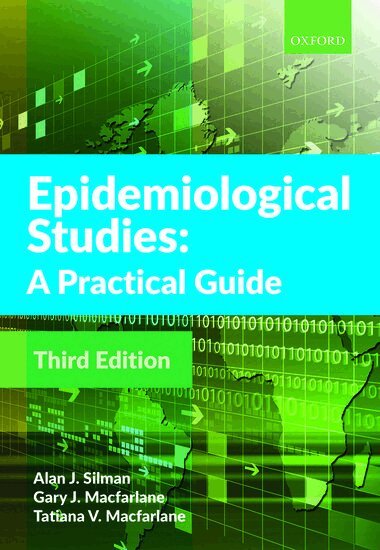
    Epidemiological Studies: A Practical Guide

    AvAlan J. Silman,Gary J. Macfarlane

    Häftad, Engelska, 2018

    748 kr

    Beställningsvara. Skickas inom 5-8 vardagar. Fri frakt över 249 kr.

    Beskrivning

    To successfully conduct an epidemiological study, academic subject knowledge must be combined with careful consideration of the practical elements involved. From an academic perspective, insights into the basis of epidemiology, the concepts behind how we study diseases, and the challenges and limitations of the results that emerge are prioritised. However, the success of the academic analysis depends on how, when, and where the data used is collected. Epidemiological Studies: A Practical Guide focuses on the practical challenges of epidemiological data collection. Essential topics, such as how to choose the population to study, how to maximise participation and retention, and how to frame questions so that subjects provide the information required, are the core of the material presented. The book explains the skills needed to conduct a study where data is collected and presented accurately, and in appropriate formats. In addition to presenting a step-by-step guide to epidemiological investigations, the chapters in the book are accompanied by examples of how to phrase the letters and forms needed for each stage of conducting a study. Focusing on measurement, study designs, statistics, methodological issues, and key skills, the book provides a valuable background to epidemiological study. With detailed tables and figures, a clear chapter outline, and a straightforward index, the information presented is easily accessible and can quickly be applied to the reader's own work. Extensively revised, this new edition includes updates on case-crossover, Mendelian randomisation, and case-cohort. New chapters have been added to reflect the areas a student is now likely to encounter in an introductory epidemiological course, such as evidence synthesis, use of routine data, association or causation, feasibility, and pilot studies. Epidemiological Studies: A Practical Guide is ideal for students in epidemiology, public health, health research, and health services research. It is also highly relevant to post-graduate research students, and early stage clinical and non-clinical researchers.

    Produktinformation

    • Utgivningsdatum:2018-10-25
    • Mått:173 x 246 x 16 mm
    • Vikt:598 g
    • Format:Häftad
    • Språk:Engelska
    • Antal sidor:304
    • Upplaga:3
    • Förlag:OUP OXFORD
    • ISBN:9780198814726

    Utforska kategorier

    • Epidemiologi och medicinsk statistik inom Medicin

    Mer om författaren

    Alan Silman is an epidemiologist and rheumatologist. He was Director of Arthritis Research UK's Epidemiology Unit at the University of Manchester from 1988-2006, before moving on to become that organisation's first Medical Director from 2007-2014. Since 2015 he has been Professor of Musculoskeletal Health at the University of Oxford working in the fields of comorbidity and big data.Gary Macfarlane trained in statistics and then medicine at the University of Glasgow before undertaking a PhD in epidemiology at the University of Bristol. He was a cancer epidemiologist at the European Institute of Oncology, Milan, held the Chair in Epidemiology at the University of Manchester and currently holds the same position at The University of Aberdeen (as well as being a Consultant in the Department of Public Health at NHS Grampian) with a research focus on musculoskeletal conditions.Tatiana Macfarlane trained in mathematics at Lomonosov Moscow State University. She was a cancer epidemiologist at the Blokhin Cancer Research Centre in Moscow, the International Agency for Research on Cancer in Lyons and the European Institute of Oncology in Milan. She undertook a PhD in epidemiology at The University of Manchester Dental School where she was Lecturer then Senior Lecturer. She was a Reader in Epidemiology at The University of Aberdeen and is currently an epidemiologist at The University of Dundee.

    Recensioner i media

    The book accomplishes precisely what it aimed to do -- it provides a comprehensive yet straightforward, practical guide for designing and completing an epidemiological study. It is surely a useful tool for those doing research in epidemiology.

    Innehållsförteckning

    • Part A: Introudction 1: Scope of epidemiological enquiry and overview of main problem areas Part B: Measuring the Occurrence of Disease 2: Which measure of disease occurrence? 3: Comparing rates: between and within populations 4: Studies of disease occurrence: the population 5: Studies of disease occurrence: assessing disease status in study populations Part C: Studying Associations between Exposures and Disease 6: Which type of epidemiological study? 7: Quantifying the association between exposures and diseases: which measure? Part D: Selection of Populations and Samples to Study in studies of disease aetiology 8: Studies of disease causation 9: Use of secondary data Part E: Information from Epidemiological Studies 10: Collecting information 11: Obtaining valid information 12: Repeatability 13: Participation in epidemiology studies 14: Feasibility and pilot studies Part F: Analysis and Interpretation of Epidemiological Data 15: Preparation of collected primary data for statistical analysis 16: Introductory data analysis: descriptive epidemiology 17: Introductory data analysis: analytical epidemiology 18: Confounding 19: Bias 20: Association or causation Part G: Coherence of evidence across studies 21: Reviews of evidence 22: Meta-analysis Part H: Other Practical Issues 23: Ethical issues in epidemiology 24: The costs of an epidemiological study