• Fri frakt över 249 kr
  • •
  • Snabba leveranser
  • •
  • Billiga böcker
Kundservice

Du är på sajten för privatpersoner.

Företag, bibliotek eller offentlig verksamhet?

Du handlar på classic.bokus.com, där alla dina funktioner finns intakta.
Till classic.bokus.com
Bokus logotyp. Gå till startsidan.
  • Erbjudanden
  • Nyheter
  • Student
  • Topplistor
  • Barn & ungdom
  • Bokus Play
  • E-böcker
  • Pocketböcker
  • Spel & pussel

10% rabatt på allt med kod: NYSTART10 →

Sidfot

Mina sidor

    Hjälp

    • Kundservice
    • Vanliga frågor och svar
    • Frakt och leverans
    • Retur vid ångerrätt
    • Reklamera vara
    • Betalning
    • Köpvillkor
    • Allmänna villkor
    • Information om webbplatsens tillgänglighet

    Om Bokus

    • Om oss
    • Pressrum
    • För studenter
    • För företag
    • För bibliotek och offentlig verksamhet
    • För leverantörer
    • Hållbarhet

    Populärt

    • Aktuella erbjudanden
    • Presentkort
    • Studentlitteratur
    • Nya böcker
    • Topplistor
    • Signerade böcker
    • Engelska böcker

    Inspiration

    • Boktips
    • BookTok
    • Populära bokserier
    • Barnbokskaraktärer
    • Populära författare
    Logotyp för Bokus
    Följ oss på Facebook (extern länk)Följ oss på Instagram (extern länk)Följ oss på YouTube (extern länk)Följ oss på TikTok (extern länk)
    bokus @ CookiesAnpassa cookiesIntegritetspolicyKöpvillkor
    Till Citymail hemsida (extern länk)Till Budbee hemsida (extern länk)Till Postnord hemsida (extern länk)Till Schenker hemsida (extern länk)Till Early Bird hemsida (extern länk)Till Walleys hemsida (extern länk)
    1. Historia och arkeologi
    2. Historia
    3. Militärhistoria
    4. Andra världskriget

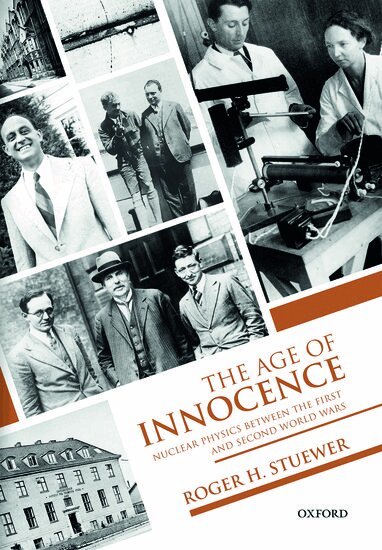
    The Age of Innocence

    Nuclear Physics between the First and Second World Wars

    AvRoger H. Stuewer

    Inbunden, Engelska, 2018

    974 kr

    Beställningsvara. Skickas inom 5-8 vardagar. Fri frakt över 249 kr.

    Fler format och utgåvor

    Häftad

    528 kr

    Beskrivning

    The two decades between the first and second world wars saw the emergence of nuclear physics as the dominant field of experimental and theoretical physics, owing to the work of an international cast of gifted physicists. Prominent among them were Ernest Rutherford, George Gamow, the husband and wife team of Frédéric and Irène Joliot-Curie, John Cockcroft and Ernest Walton, Gregory Breit and Eugene Wigner, Lise Meitner and Otto Robert Frisch, the brash Ernest Lawrence, the prodigious Enrico Fermi, and the incomparable Niels Bohr.Their experimental and theoretical work arose from a quest to understand nuclear phenomena; it was not motivated by a desire to find a practical application for nuclear energy. In this sense, these physicists lived in an 'Age of Innocence'. They did not, however, live in isolation. Their research reflected their idiosyncratic personalities; it was shaped by the physical and intellectual environments of the countries and institutions in which they worked. It was also buffeted by the political upheavals after the Great War: the punitive postwar treaties, the runaway inflation in Germany and Austria, the Great Depression, and the intellectual migration from Germany and later from Austria and Italy.Their pioneering experimental and theoretical achievements in the interwar period therefore are set within their personal, institutional, and political contexts. Both domains and their mutual influences are conveyed by quotations from autobiographies, biographies, recollections, interviews, correspondence, and other writings of physicists and historians.

    Produktinformation

    • Utgivningsdatum:2018-08-07
    • Mått:176 x 248 x 31 mm
    • Vikt:1 088 g
    • Format:Inbunden
    • Språk:Engelska
    • Antal sidor:502
    • Förlag:OUP OXFORD
    • ISBN:9780198827870

    Utforska kategorier

    • Andra världskriget inom Historia och arkeologi
    • Fysik inom Naturvetenskap och teknik
    • Modern militärhistoria inom Historia och arkeologi

    Mer om författaren

    Roger H. Stuewer received a double Ph.D. major in history of science and physics at the University of Wisconsin and founded the Program in History of Science and Technology at the University of Minnesota where he is Professor Emeritus. He has held appointments at Boston University and Harvard University, and has been visiting professor at the Universities of Munich, Vienna, Graz, and Amsterdam. He received the Abraham Pais Prize for History of Physics in 2013 and the Distinguished Alumni Award of the Department of Physics at the University of Wisconsin in 2014. He is a Fellow of the American Physical Society, the American Association for the Advancement of Science, and the American Association of Physics Teachers.

    Recensioner i media

    Overall, this work would serve as an excellent overview of both the scientific and the political situation in Europe between the wars... Summing Up: Highly Recommended.

    Innehållsförteckning

    • 1: Cambridge and the Cavendish 2: European and Nuclear Disintegration 3: Vienna and the Institute for Radium Research 4: The Cambridge-Vienna Controversy 5: The Quantum-Mechanical Nucleus 6: Nuclear Electrons and Nuclear Structure 7: New Particles 8: New Machines 9: Nuclear Physicists at the Crosswroads 10: Exiles and Immigrants 11: Artificial Radioactivity 12: Bet Decay Redux, Slow Neutrons, Bohr and his Realm 13: New Theories of Nuclear Reactions 14: The Plague Spreads to Austria and Italy 15: The New World