• Fri frakt över 249 kr
  • •
  • Snabba leveranser
  • •
  • Billiga böcker
Kundservice

Du är på sajten för privatpersoner.

Företag, bibliotek eller offentlig verksamhet?

Du handlar på classic.bokus.com, där alla dina funktioner finns intakta.
Till classic.bokus.com
Bokus logotyp. Gå till startsidan.
  • Erbjudanden
  • Nyheter
  • Student
  • Topplistor
  • Barn & ungdom
  • Bokus Play
  • E-böcker
  • Pocketböcker
  • Spel & pussel

10% rabatt på allt med kod: NYSTART10 →

Sidfot

Mina sidor

    Hjälp

    • Kundservice
    • Vanliga frågor och svar
    • Frakt och leverans
    • Retur vid ångerrätt
    • Reklamera vara
    • Betalning
    • Köpvillkor
    • Allmänna villkor
    • Information om webbplatsens tillgänglighet

    Om Bokus

    • Om oss
    • Pressrum
    • För studenter
    • För företag
    • För bibliotek och offentlig verksamhet
    • För leverantörer
    • Hållbarhet

    Populärt

    • Aktuella erbjudanden
    • Presentkort
    • Studentlitteratur
    • Nya böcker
    • Topplistor
    • Signerade böcker
    • Engelska böcker

    Inspiration

    • Boktips
    • BookTok
    • Populära bokserier
    • Barnbokskaraktärer
    • Populära författare
    Logotyp för Bokus
    Följ oss på Facebook (extern länk)Följ oss på Instagram (extern länk)Följ oss på YouTube (extern länk)Följ oss på TikTok (extern länk)
    bokus @ CookiesAnpassa cookiesIntegritetspolicyKöpvillkor
    Till Citymail hemsida (extern länk)Till Budbee hemsida (extern länk)Till Postnord hemsida (extern länk)Till Schenker hemsida (extern länk)Till Early Bird hemsida (extern länk)Till Walleys hemsida (extern länk)
    1. Samhälle och politik
    2. Politik och statsskick
    3. Statsskick och politiska processer

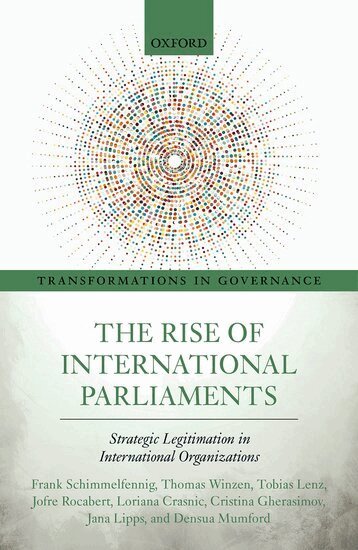
    The Rise of International Parliaments

    Strategic Legitimation in International Organizations

    AvFrank Schimmelfennig,Thomas Winzen

    Inbunden, Engelska, 2021

    Del i serien Transformations in Governance

    1 871 kr

    Beställningsvara. Skickas inom 5-8 vardagar. Fri frakt över 249 kr.

    Beskrivning

    International parliaments are on the rise. An increasing number of international organizations establishes 'international parliamentary institutions' or IPIs, which bring together members of national parliaments or - in rare cases - elected representatives of member state citizens. Yet, IPIs have generally remained powerless institutions with at best a consultative role in the decision-making process of international organizations. Why do the member states of international organizations create IPIs but do not vest them with relevant institutional powers? This study argues that neither the functional benefits of delegation nor the internalization of democratic norms answer this question convincingly. Rather, IPIs are best understood as an instrument of strategic legitimation. By establishing institutions that mimic national parliaments, governments seek to ensure that audiences at home and in the wider international environment recognize their international organizations as democratically legitimate. At the same time, they seek to avoid being effectively constrained by IPIs in international governance.The Rise of International Parliaments provides a systematic study of the establishment and empowerment of IPIs based on a novel dataset. In a statistical analysis covering the world's most relevant international organizations and a series of case studies from all major world regions, we find two varieties of international parliamentarization. International organizations with general purpose and high authority create and empower IPIs to legitimate their region-building projects domestically. Alternatively, the establishment of IPIs is induced by the international diffusion of democratic norms and prominent templates, above all that of the European Parliament.Transformations in Governance is a major academic book series from Oxford University Press. It is designed to accommodate the impressive growth of research in comparative politics, international relations, public policy, federalism, and environmental and urban studies concerned with the dispersion of authority from central states to supranational institutions, subnational governments, and public-private networks. It brings together work that advances our understanding of the organization, causes, and consequences of multilevel and complex governance. The series is selective, containing annually a small number of books of exceptionally high quality by leading and emerging scholars.The series is edited by Liesbet Hooghe and Gary Marks of the University of North Carolina, Chapel Hill, and Walter Mattli of the University of Oxford.

    Produktinformation

    • Utgivningsdatum:2021-01-12
    • Mått:162 x 143 x 24 mm
    • Vikt:672 g
    • Format:Inbunden
    • Språk:Engelska
    • Serie:Transformations in Governance
    • Antal sidor:368
    • Förlag:OUP OXFORD
    • ISBN:9780198864974

    Utforska kategorier

    • Statsskick och politiska processer inom Samhälle och politik
    • Internationella relationer inom Samhälle och politik

    Mer om författaren

    Frank Schimmelfennig is Professor of European Politics, Center for Comparative and International Studies, ETH Zurich. His research focuses on European integration and, specifically, integration theory, enlargement, differentiated integration, EU democracy promotion and democratization. Previous publications include Ever Looser Union? Differentiated European Integration (with Thomas Winzen, OUP, 2020) and The EU, NATO, and the Integration of Europe: Rules and Rhetoric (CUP, 2003, Winner of the EUSA Best Book Award 2005).Thomas Winzen is a Lecturer in Government, University of Essex. His research focuses on the design and legitimate governance of the European Union and other international institutions with a particular interest in differentiated integration, parliamentarization, and emerging structures of global internet governance. Previous publications include Ever Looser Union? Differentiated European Integration (with Frank Schimmelfennig, OUP, 2020) and Constitutional Preferences and Parliamentary Reform: Explaining National Parliaments' Adaptation to European Integration (OUP, 2017, Winner of the 2018 Best Book Prize of UACES Academic Association for Contemporary European Studies).Tobias Lenz is Professor of International Relations, Leuphana University Lüneburg. His research focuses on the design and evolution of international organizations, their legitimacy and legitimation and on the role of the European Union in global regionalism. Previous publications include A Theory of International Organization (with Liesbet Hooghe and Gary Marks, OUP, 2019).Jofre Rocabert is a post-doctoral fellow, Hebrew University of Jerusalem, and the Free University of Berlin. His research concentrates on the legitimation of International Organizations.Loriana Crasnic is a post-doctoral researcher, Chair of International Relations and International Political Economy, University of Zurich. Her research explores the performance of and dynamics within international organizations and institutions, especially in financial and environmental domains.Cristina Gherasimov is a research fellow, German Council on Foreign Relations. Her research includes democratic transitions and institution-building in Central and Eastern Europe and post-communist states, European and Eurasian integration, good governance, rule of law, anti-corruption policy, and democratic backsliding.Jana Lipps is a PhD candidate in the European Politics Research Group, Center for Comparative and International Studies, ETH Zurich. Her research focuses on IO parliamentarization and European integration, specifically, the political economy of differentiation, inequality and public support for the EU.Densua Mumford is Assistant Professor of International Relations, Leiden University. Her research explores the institutional design of international organisations in the Global South and the foreign policy of African states.

    Innehållsförteckning

    • Part I 1: Introduction 2: International Parliamentary Institutions 3: Strategic Democratic Legitimation: Why International Organizations Establish Parliamentary Institutions 4: The Emergence of International Parliamentary Institutions: A Quantitative Analysis Part II 5: Introduction to the Case Studies 6: The European Union 7: The Organization of Security and Co-operation in Europe 8: The Commonwealth of Independent States and the Eurasian Economic Union 9: The Andean Community 10: Mercosur 11: The North American Free-Trade Agreement 12: The Economic Community of West African States 13: The East African Community 14: The Association of Southeast Asian Nations 15: The Pacific Islands Forum 16: Comparative Case Study Analysis: Varieties of International Parliamentarization 17: The Rise of International Parliaments: Conclusions