• Fri frakt över 249 kr
  • •
  • Snabba leveranser
  • •
  • Billiga böcker
Kundservice

Du är på sajten för privatpersoner.

Företag, bibliotek eller offentlig verksamhet?

Du handlar på classic.bokus.com, där alla dina funktioner finns intakta.
Till classic.bokus.com
Bokus logotyp. Gå till startsidan.
  • Erbjudanden
  • Nyheter
  • Student
  • Topplistor
  • Barn & ungdom
  • Bokus Play
  • E-böcker
  • Pocketböcker
  • Spel & pussel

10% studentrabatt med kod TERM26

Sidfot

Mina sidor

    Hjälp

    • Kundservice
    • Vanliga frågor och svar
    • Frakt och leverans
    • Retur vid ångerrätt
    • Reklamera vara
    • Betalning
    • Köpvillkor
    • Allmänna villkor
    • Information om webbplatsens tillgänglighet

    Om Bokus

    • Om oss
    • Pressrum
    • För studenter
    • För företag
    • För bibliotek och offentlig verksamhet
    • För leverantörer
    • Hållbarhet

    Populärt

    • Aktuella erbjudanden
    • Presentkort
    • Studentlitteratur
    • Nya böcker
    • Topplistor
    • Signerade böcker
    • Engelska böcker

    Inspiration

    • Boktips
    • BookTok
    • Populära bokserier
    • Barnbokskaraktärer
    • Populära författare
    Logotyp för Bokus
    Följ oss på Facebook (extern länk)Följ oss på Instagram (extern länk)Följ oss på YouTube (extern länk)Följ oss på TikTok (extern länk)
    bokus @ CookiesAnpassa cookiesIntegritetspolicyKöpvillkor
    Till Citymail hemsida (extern länk)Till Budbee hemsida (extern länk)Till Postnord hemsida (extern länk)Till Schenker hemsida (extern länk)Till Early Bird hemsida (extern länk)Till Walleys hemsida (extern länk)
    1. Naturvetenskap och teknik
    2. Matematik och naturvetenskap
    3. Kemi
    4. Analytisk kemi
    • -10% student

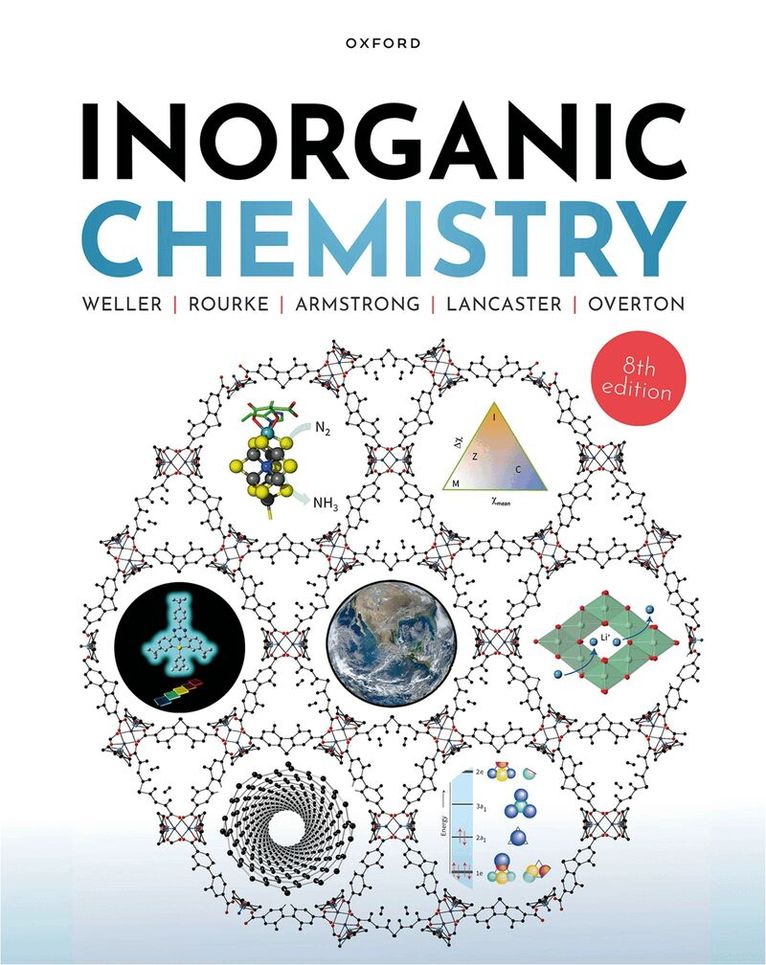
    Inorganic Chemistry

    AvMark Weller,Jonathan Rourke

    Häftad, Engelska, 2025

    939 kr

    Beställningsvara. Skickas inom 5-8 vardagar. Fri frakt över 249 kr.

    Beskrivning

    Leading you from the fundamental principles of inorganic chemistry right through to cutting-edge research at the forefront of the subject, Inorganic Chemistry is the ideal course companion for the duration of your degree. BL Written by an experienced and research-active author team, the unique four-part structure of this text provides comprehensive and contemporary coverage of inorganic chemistry from fundamental theory through to cutting-edge interdisciplinary research and current applications, making this text the ideal companion for the duration of a degree. BL Additional qualitative explanation to help students get to grips with the more mathematical treatments. BL An extensive range of learning features is provided to support students, including 'context boxes’, ‘notes on good practice’, ‘key points’ and ‘brief illustrations’. BL Numerous worked examples, self-test questions, exercises, and the more stretching tutorial problems encourage students to develop vital problem-solving skills. BL The 8th edition is available for students and institutions to purchase in a variety of formats: the e-book and Science Trove offer a mobile experience and convenient access along with embedded three-dimensional visualisations of many of the structures that appear throughout the book, video overviews, and a suite of multiple-choice questions functionality tools, navigation features and links that offer extra learning support. For more information about e-books, please visit www.oxfordtextbooks.co.uk/ebooks.

    Produktinformation

    • Utgivningsdatum:2025-02-21
    • Mått:219 x 275 x 41 mm
    • Vikt:2 578 g
    • Format:Häftad
    • Språk:Engelska
    • Antal sidor:1 056
    • Upplaga:8
    • Förlag:OUP OXFORD
    • ISBN:9780198866916

    Ingår i kampanjer

    -10% student

    Utforska kategorier

    • Analytisk kemi inom Naturvetenskap och teknik
    • Oorganisk kemi inom Naturvetenskap och teknik

    Mer om författaren

    Mark Weller is an honorary professor of chemistry at Cardiff University.  His research interests cover a wide range of synthetic and structural inorganic chemistry including photovoltaic compounds, zeolites, battery materials, and specialist pigments. Mark has taught both inorganic chemistry and physical chemistry methods at undergraduate and postgraduate levels for over 40 years, with his lectures covering topics across materials chemistry, the inorganic chemistry of the s- and f- block elements, and analytical methods applied to inorganic compounds. He is a co-author of OUP’s Characterisation Methods in Inorganic Chemistry and an OUP Primer (23) on Inorganic Materials Chemistry.Jonathan Rourke is Reader in Chemistry at Cardiff University and Honorary Professor of Chemistry at the University of Warwick. He received his PhD at the University of Sheffield on organometallic polymers and liquid crystals, followed by postdoctoral work in Canada and back in Britain. His initial independent research career began at Bristol University and then at Warwick, before he moved to Cardiff. Over the years Dr Rourke has taught most aspects of inorganic chemistry, all the way from basic bonding, through symmetry analysis to advanced transition metal chemistry.Fraser Armstrong is an Emeritus Research Fellow of St John’s College, University of Oxford. He was an Associate Professor at the University of California, Irvine, before joining the Department of Chemistry at Oxford in 1993. His interests span the fields of renewable energy, hydrogen, enzymology, mechanistic biological inorganic chemistry, and electrocatalysis by enzymes. He has received numerous awards and honours, including the European Medal for Biological Inorganic Chemistry (1998), the Joseph Chatt Medal (2010), The Davy Medal of the Royal Society (2012), the Bailar Medal of the University of Illinois (2015/16), the Glenn T. Seaborg Lectureship in Inorganic Chemistry, University of California, Berkeley (2021-22), and the Mok Hing-Yiu Distinguished Visiting Professorship in Chemistry at the University of Hong Kong, 2023-25. He was elected as a Fellow of the Royal Society of London (FRS) in 2008.Simon Lancaster has taught Chemistry at the University of East Anglia since his appointment as a lecturer in 2000. He won a National Teaching Fellowship and an RSC Higher Education Teaching Award in 2013 for 'blurring the boundaries between the internet and the lecture theatre'. Simon was promoted to a chair in Chemistry Education in 2014. He was selected as one of RSC's 175 face of diversity in 2016 and championed inclusion and diversity as President of the Education Division Council from 2017-2020. He is a passionate advocate for evidence-based teaching innovation, and is in demand as a speaker and consultant well beyond the chemistry arena. He has shaped UEA's Science teaching provision as Associate Dean for Learning and Teaching since 2022 and has led the adoption of tailored active blended learning approaches and extended reality technologies. He regards the lecture theatre as his laboratory and continues to teach over 100 contact hours a year.Tina Overton was the Director of the Leeds Institute for Teaching Excellence at the University of Leeds, UK.

    Recensioner i media

    An excellent textbook, covering the full range from fundamental aspects of atomic and molecular structure to structures and properties of bioinorganic macromolecules and novel nanomaterials.

    Innehållsförteckning

    • Part 1: Foundations 1: Atomic structure 2: Molecular structure, bonding, and energetics 3: Molecular symmetry 4: The structures and energetics of simple solids 5: Acids and bases 6: Oxidation and reduction 7: An introduction to coordination compounds 8: Physical techniques in inorganic chemistry Part 2: The elements and their compounds 9: Periodic trends 10: Themes across the Periodic Table 11: Hydrogen 12: The Group 1 elements 13: The Group 2 elements 14: The Group 13 elements 15: The Group 14 elements 16: The Group 15 elements 17: The Group 16 elements 18: The Group 17 elements 19: The Group 18 elements 20: The d-block elements 21: The f-block elements 22: d- and f-metal complexes: electronic and magnetic properties 23: Coordination chemistry: reactions of complexes 24: d-Metal organometallic chemistry 24: Materials chemistry and nanomaterials Part Three: Advanced Inorganic Chemistry 25: Advanced solid state chemistry: structures, compounds, and electronic properties 26: Biological inorganic chemistry Part Four: Horizons and Applications 27: Green chemistry 28: Nanoparticle inorganic chemistry 29: Framework and porous materials 30: Energy materials 31: Catalysis 32: Inorganic chemistry in medicine