E-bok, Engelska, 2025
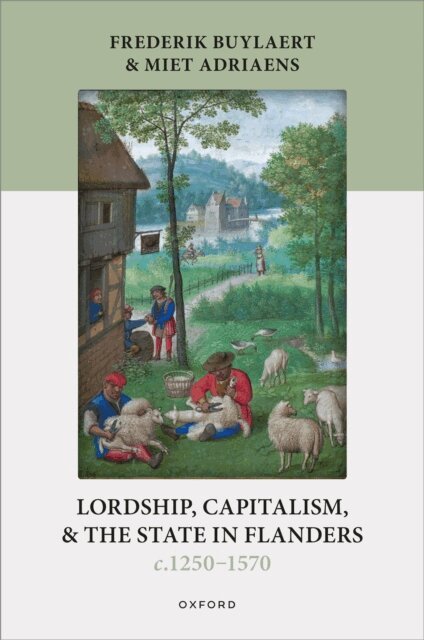
Lordship, Capitalism, and the State in Flanders (c. 1250-1570)
Av Miet Adriaens, Frederik Buylaert
1303 kr
Läs direkt i Bokus Reader – eller ladda ned till din enhet (PDF kräver ofta zoom och scroll på små skärmar).
Beskrivning
This is an open access title available under the terms of a CC BY-NC-ND 4.0 International licence. It is free to read at Oxford Scholarship Online and offered as a free PDF download from OUP and selected open access locations.
Until recently, historians tended to assume that in the late medieval period local lordship was effectively crushed between strong cities and states. Developing recent debates to the contrary, Lordship, Capitalism, and the State in Flanders draws on qualitative and quantitative evidence from the county of Flanders to reconsider the ways in which lordship continued to be a cornerstone of life in rural Europe across this period. Flanders is an extreme example of a scenario in which seigneuries were not so much vehicles for the elite interests of lords, but dynamic instruments for village communities; and lordship here was as important, if not moreso, at the start of the Dutch Revolt in 1567 than it was around the mid-thirteenth century, where this study begins.
As a forerunner in the commercialization and urbanization of society, Flanders saw the rise of mighty towns who provided the inhabitants of their hinterlands with a shield against seigneurial oppression, up to the point that the seigneurial administration could only continue to function if it was closely aligned with the interests of peasants. Next to this, the Low Countries, including Flanders, became part of the mighty Burgundian-Habsburg polity. Rather than undermining seigneurial lordship, however, the princely administration increasingly relied on the peasant aldermen of seigneuries to provide justice and governance to villages. The self-rule of Flemish peasantries through lordship meant that the seigneurie was the forum in which contemporaries made a critical decision, that being how to respond to the new and all-encompassing phenomenon of agrarian capitalism, a mode of agricultural production that first emerged in the Low Countries and Flanders before spreading to the rest of the globe.
The persistence and transformation of seigneurial lordship into what might be called ''middle-class lordship'' thus had great consequences for Flemish society across the late medieval period and beyond-and this story helps scholars to understand more generally how power relations between lords and peasants differed from one region to the next, in dialogue with different trajectories in urbanization, economic change, and state formation
Until recently, historians tended to assume that in the late medieval period local lordship was effectively crushed between strong cities and states. Developing recent debates to the contrary, Lordship, Capitalism, and the State in Flanders draws on qualitative and quantitative evidence from the county of Flanders to reconsider the ways in which lordship continued to be a cornerstone of life in rural Europe across this period. Flanders is an extreme example of a scenario in which seigneuries were not so much vehicles for the elite interests of lords, but dynamic instruments for village communities; and lordship here was as important, if not moreso, at the start of the Dutch Revolt in 1567 than it was around the mid-thirteenth century, where this study begins.
As a forerunner in the commercialization and urbanization of society, Flanders saw the rise of mighty towns who provided the inhabitants of their hinterlands with a shield against seigneurial oppression, up to the point that the seigneurial administration could only continue to function if it was closely aligned with the interests of peasants. Next to this, the Low Countries, including Flanders, became part of the mighty Burgundian-Habsburg polity. Rather than undermining seigneurial lordship, however, the princely administration increasingly relied on the peasant aldermen of seigneuries to provide justice and governance to villages. The self-rule of Flemish peasantries through lordship meant that the seigneurie was the forum in which contemporaries made a critical decision, that being how to respond to the new and all-encompassing phenomenon of agrarian capitalism, a mode of agricultural production that first emerged in the Low Countries and Flanders before spreading to the rest of the globe.
The persistence and transformation of seigneurial lordship into what might be called ''middle-class lordship'' thus had great consequences for Flemish society across the late medieval period and beyond-and this story helps scholars to understand more generally how power relations between lords and peasants differed from one region to the next, in dialogue with different trajectories in urbanization, economic change, and state formation
Produktinformation
- Utgivningsdatum: 2025-04-30
- Språk: Engelska
- Filformat: PDF
- Kopieringsskydd: LCP
- ISBN: 9780198945734
- Förlag: Oxford University Press
Utforska kategorier
Betyg & recensioner
0 recensioner
Inga recensioner tillgängliga.