Inbunden, Engelska, 2026
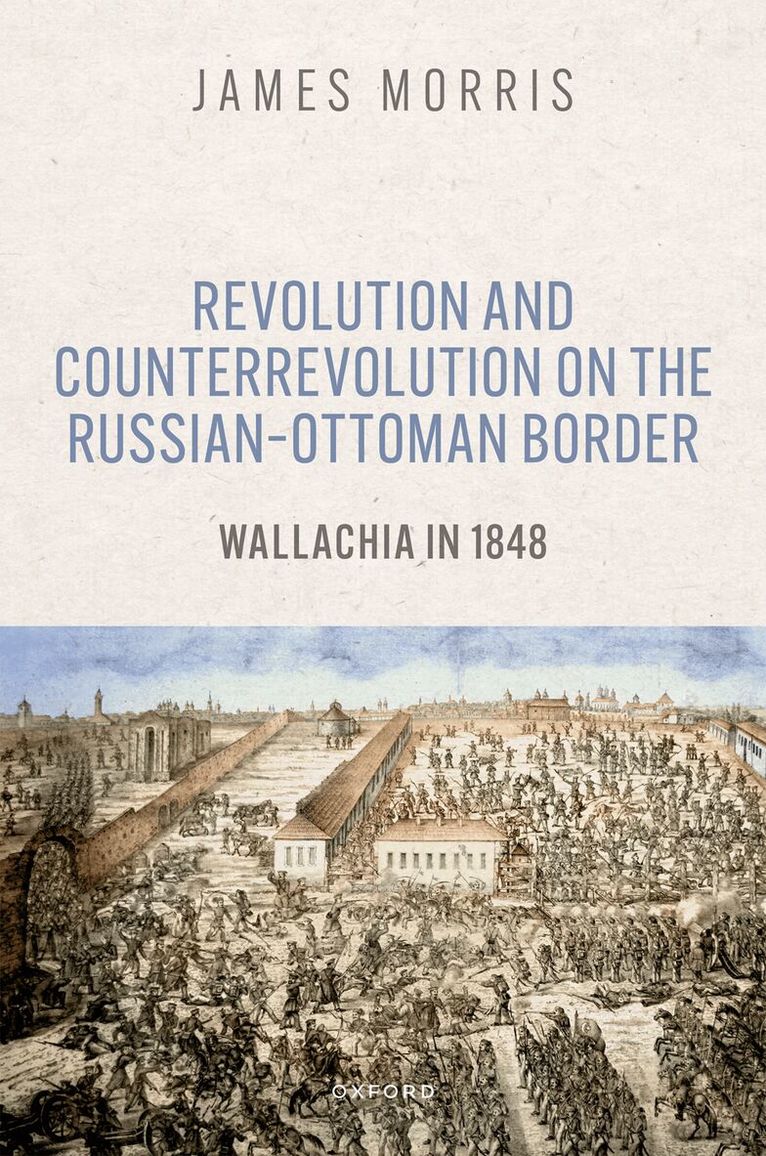
Revolution and Counterrevolution on the Russian–Ottoman Border
Av James Morris
1979 kr
Beställningsvara. Skickas inom 5-8 vardagar. Fri frakt över 249 kr.
Beskrivning
The Wallachian revolution of 1848 was exactly the kind of event that European statesmen feared in the decades after the Congress of Vienna of 1815. Unlike most of the mid-century revolutions, which began as spontaneous manifestations of popular grievances, the Wallachian one was planned by a small coterie of young men who saw an opportunity to effect change in the wake of what was known as the ‘Springtime of Peoples’. Instead of street fighting and violence, their movement began peacefully with the reading of a revolutionary proclamation in a small village called Islaz near the confluence of the Olt River and the Danube on 21 June. From there it spread to Bucharest, where gathered crowds led the reigning Prince Bibescu, perhaps spooked by an earlier attempt on his life, to accept the revolutionary programme without modification and then swiftly abdicate and flee the principality, leaving the revolution’s leaders to take power and begin their three-month experiment in government. Few of these men had held state office before. Far from experienced statesmen, they were mostly newspaper editors, military officers, and perpetual students. Together they would learn statecraft in office while promoting the development of an urban revolutionary culture and educating the principality’s peasantry in revolutionary politics through a vigorous rural propaganda campaign. By these means, they endeavoured to revolutionise Wallachia.This is the first book-length account of the Wallachian Revolution of 1848 available in English. Rather than treating events in the principality alongside those in neighbouring Moldavia and Transylvania as part of a story about the eventual establishment of a Romanian national state, it considers the revolution in Wallachian, European, and trans-imperial terms. Nestled between the Ottoman and Russian empires and subject to the suzerainty of one and the protection of the other, Wallachia's geopolitical position was unusual, which meant that the principality's revolution would be, too. Rather than seizing control of the state, as revolutionaries could do in France, or struggling with a single imperial overlord, as the revolutionaries of the Habsburg empire did, the leaders of the Wallachian movement would have to negotiate with competing and overlapping centres of authority. Their revolution more than any other in 1848 was a geopolitical event.By considering events in a small and comparatively unknown principality, this book offers new insights into the mid-century revolutionary moment as well as the broader history of nineteenth-century European empires. It takes readers out into the fields to show that the oft-neglected peasants of Eastern Europe could be willing and active participants in the revolutionary world. Wallachia emerges as a testing ground for new forms of popular politics encompassing both the urban crowd and the village community, and a space in which the relationship between imperial centres and peripheries could be reconsidered in both revolutionary and counterrevolutionary fashions.
Produktinformation
- Utgivningsdatum: 2026-03-19
- Mått: 156 x 18 x 234 mm
- Vikt: 535 g
- Format: Inbunden
- Språk: Engelska
- Antal sidor: 280
- Förlag: OUP OXFORD
- ISBN: 9780198987284
Utforska kategorier
Betyg & recensioner
0 recensioner
Inga recensioner tillgängliga.