• Fri frakt över 249 kr
  • •
  • Snabba leveranser
  • •
  • Billiga böcker
Kundservice

Du är på sajten för privatpersoner.

Företag, bibliotek eller offentlig verksamhet?

Du handlar på classic.bokus.com, där alla dina funktioner finns intakta.
Till classic.bokus.com
Bokus logotyp. Gå till startsidan.
  • Erbjudanden
  • Nyheter
  • Student
  • Topplistor
  • Barn & ungdom
  • Bokus Play
  • E-böcker
  • Pocketböcker
  • Spel & pussel

10% rabatt på allt med kod: NYSTART10 →

Sidfot

Mina sidor

    Hjälp

    • Kundservice
    • Vanliga frågor och svar
    • Frakt och leverans
    • Retur vid ångerrätt
    • Reklamera vara
    • Betalning
    • Köpvillkor
    • Allmänna villkor
    • Information om webbplatsens tillgänglighet

    Om Bokus

    • Om oss
    • Pressrum
    • För studenter
    • För företag
    • För bibliotek och offentlig verksamhet
    • För leverantörer
    • Hållbarhet

    Populärt

    • Aktuella erbjudanden
    • Presentkort
    • Studentlitteratur
    • Nya böcker
    • Topplistor
    • Signerade böcker
    • Engelska böcker

    Inspiration

    • Boktips
    • BookTok
    • Populära bokserier
    • Barnbokskaraktärer
    • Populära författare
    Logotyp för Bokus
    Följ oss på Facebook (extern länk)Följ oss på Instagram (extern länk)Följ oss på YouTube (extern länk)Följ oss på TikTok (extern länk)
    bokus @ CookiesAnpassa cookiesIntegritetspolicyKöpvillkor
    Till Citymail hemsida (extern länk)Till Budbee hemsida (extern länk)Till Postnord hemsida (extern länk)Till Schenker hemsida (extern länk)Till Early Bird hemsida (extern länk)Till Walleys hemsida (extern länk)
    1. Ekonomi och Ledarskap
    2. Företagsekonomi
    3. Organisation och ägarskap

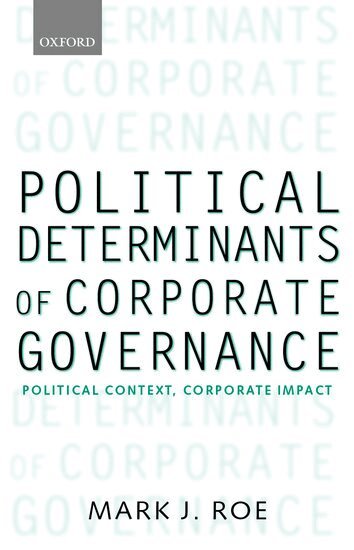
    Political Determinants of Corporate Governance

    Political Context, Corporate Impact

    AvMark J. Roe

    Häftad, Engelska, 2006

    Del i serien Clarendon Lectures in Management Studies

    896 kr

    Beställningsvara. Skickas inom 5-8 vardagar. Fri frakt över 249 kr.

    Fler format och utgåvor

    Inbunden

    3 084 kr

    Beskrivning

    Before a nation can produce, it must achieve social peace. That social peace has been reached in different nations by differing means, some of which have then been embedded in business firms, in corporate ownership patterns, and in corporate governance structures. The large publicly held, diffusely owned firm dominates business in the United States despite its infirmities, namely the frequently fragile relations between stockholders and managers. But in other economically advanced nations, ownership is not diffuse but concentrated. It is concentrated in no small measure because the delicate threads that tie managers to shareholders in the public firm fray easily in common political environments, such as those in the continental European social democracies. Social democracies press managers to stabilize employment, to forego some profit-maximizing risks with the firm, and to use up capital in place rather than to downsize when markets no longer are aligned with the firm's production capabilities. Since managers must have discretion in the public firm, how they use that discretion is crucial to stockholders, and social democratic pressures induce managers to stray farther than otherwise from their shareholders' profit-maximizing goals. Moreover, the means that align managers with diffuse stockholders in the United States-incentive compensation, hostile takeovers, and strong shareholder-wealth maximization norms-are weaker and sometimes denigrated in continental social democracies.Hence, public firms there have higher managerial agency costs, and large-block shareholding has persisted as shareholders' best remaining way to control those costs. Social democracies may enhance total social welfare, but if they do, they do so with fewer public firms than less socially responsive nations. The author therefore uncovers not only a political explanation for ownership concentration in Europe, but also a crucial political prerequisite to the rise of the public firm in the United States, namely the weakness of social democratic pressures on the American business firm.

    Produktinformation

    • Utgivningsdatum:2006-07-20
    • Mått:156 x 234 x 15 mm
    • Vikt:340 g
    • Format:Häftad
    • Språk:Engelska
    • Serie:Clarendon Lectures in Management Studies
    • Antal sidor:244
    • Förlag:OUP OXFORD
    • ISBN:9780199205301

    Utforska kategorier

    • Organisation och ägarskap inom Ekonomi och Ledarskap
    • Affärsstrategi inom Ekonomi och Ledarskap
    • Statsvetenskap och politisk teori inom Samhälle och politik

    Mer om författaren

    Mark J. Roe is Berg Professor Law at the Harvard Law School. He has previously held positions at Columbia University School of Law; University of Pennsylvania School of Law; and Rutgers University School of Law. His publications include Corporate Reorganization and Bankruptcy: Legal and Financial Materials (Foundation Press, 2000) and Strong Managers, Weak Owners: The Political Roots of American Corporate Finance (Princeton University Press, 1994).

    Recensioner i media

    Review from previous edition Review from other book by this author Strong Managers, Weak Owners does for corporate governance what Alfred Chandler's The Visiting Hand did for the corporation: makes history essential to understanding current practice and policy.

    Innehållsförteckning

    • Introduction ; PART I: POLITICAL CONFLICT AND THE CORPORATION ; 1. Peace as Predicate ; 2. The Wealthy West's Differing Corporate Governance Structures ; 3. A General Theory ; PART II: SOCIAL CONFLICT AND THE INSTITUTIONS OF CORPORATE GOVERNANCE ; 4. Social Democracies and Agency Costs: Raising the Stakes ; 5. Reducing Shareholders' Power to Control Managers ; PART III: LEFT-RIGHT POLITICS AND OWNERSHIP SEPARATION: DATA ; 6. Data and Confirmation ; PART IV: NATION BY NATION ; 7. France ; 8. Germany ; 9. Italy ; 10. Japan ; 11. Sweden ; 12. United Kingdom ; 13. United States ; 14. Extending the Sample? ; PART V: THE DIRECTION OF CAUSALITY ; 15. Alternative Formulations of the Thesis ; 16. Backlash ; 17. Contract as Metaphor ; 18. Rents ; 19. Rents and Politics ; 20. Rents and Ownership Concentration ; 21. Political Change in Continental Europe ; 22. Alternative Formulations: Data ; PART VI: THE QUALITY OF CORPORATE LAW ARGUMENT AND ITS LIMITS ; 23. Corporate Law as the Foundation for Securities Markets: The Theory ; 24. Its Limits: Theory ; 25. Its Limits: Data ; 26. The Quality of Corporate Law and its Limits ; PART VII: UNIFYING THE POLITICAL THEORIES ; 27. Populism and Socialism in Corporate Governance ; Conclusion