• Fri frakt över 249 kr
  • •
  • Snabba leveranser
  • •
  • Billiga böcker
Kundservice

Du är på sajten för privatpersoner.

Företag, bibliotek eller offentlig verksamhet?

Du handlar på classic.bokus.com, där alla dina funktioner finns intakta.
Till classic.bokus.com
Bokus logotyp. Gå till startsidan.
  • Erbjudanden
  • Nyheter
  • Student
  • Topplistor
  • Barn & ungdom
  • Bokus Play
  • E-böcker
  • Pocketböcker
  • Spel & pussel

10% studentrabatt med kod TERM26

Sidfot

Mina sidor

    Hjälp

    • Kundservice
    • Vanliga frågor och svar
    • Frakt och leverans
    • Retur vid ångerrätt
    • Reklamera vara
    • Betalning
    • Köpvillkor
    • Allmänna villkor
    • Information om webbplatsens tillgänglighet

    Om Bokus

    • Om oss
    • Pressrum
    • För studenter
    • För företag
    • För bibliotek och offentlig verksamhet
    • För leverantörer
    • Hållbarhet

    Populärt

    • Aktuella erbjudanden
    • Presentkort
    • Studentlitteratur
    • Nya böcker
    • Topplistor
    • Signerade böcker
    • Engelska böcker

    Inspiration

    • Boktips
    • BookTok
    • Populära bokserier
    • Barnbokskaraktärer
    • Populära författare
    Logotyp för Bokus
    Följ oss på Facebook (extern länk)Följ oss på Instagram (extern länk)Följ oss på YouTube (extern länk)Följ oss på TikTok (extern länk)
    bokus @ CookiesAnpassa cookiesIntegritetspolicyKöpvillkor
    Till Citymail hemsida (extern länk)Till Budbee hemsida (extern länk)Till Postnord hemsida (extern länk)Till Schenker hemsida (extern länk)Till Early Bird hemsida (extern länk)Till Walleys hemsida (extern länk)
    1. Kultur
    2. Arkitektur
    3. Arkitekturhistoria

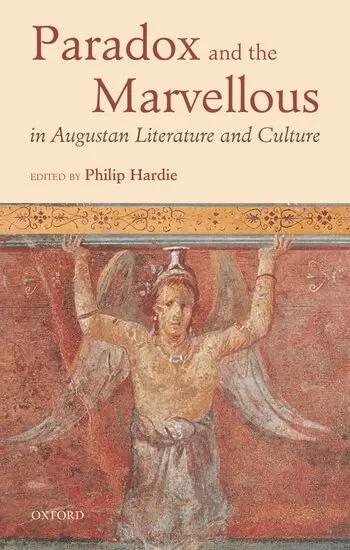
    Paradox and the Marvellous in Augustan Literature and Culture

    AvPhilip Hardie

    Inbunden, Engelska, 2009

    2 151 kr

    Beställningsvara. Skickas inom 7-10 vardagar. Fri frakt över 249 kr.

    Beskrivning

    The literature and art of Augustan Rome are often thought of as the product of an age of high classicism, characterized by maturity, balance, and harmony. This volume examines the presence of what might be seen as an unclassical love of paradox and the marvellous, and shows that it is an important strain in the poetry of Virgil, Horace, and Ovid, as well as in prose works of history and rhetoric, and in the Augustan visual arts. The volume includes chapters by some of the leading experts in the Augustan period as well as a number of younger scholars. It will be of interest to all students of Roman literature and culture.

    Produktinformation

    • Utgivningsdatum:2009-05-28
    • Mått:145 x 222 x 26 mm
    • Vikt:618 g
    • Format:Inbunden
    • Språk:Engelska
    • Antal sidor:404
    • Förlag:OUP OXFORD
    • ISBN:9780199231249

    Utforska kategorier

    • Arkitekturhistoria inom Kultur
    • Konsthistoria inom Kultur
    • Litteraturvetenskap inom Skönlitteratur

    Mer om författaren

    Philip Hardie is Senior Research Fellow, Trinity College, Cambridge.

    Recensioner i media

    A refreshing and remarkably coherant collection edited by Philip Hardie.

    Innehållsförteckning

    • 1. Introduction: Paradox and the marvellous in Augustan literature and culture ; 2. Horace's Ars poetica and the marvellous ; 3. Where the wild things are: locating the marvellous in Augustan wall-painting ; 4. Against nature? Some Augustan responses to man-made marvels ; 5. Virgil: a paradoxical poet? ; 6. The question of the marvellous in the Georgics of Virgil ; 7. In search of the lost Hercules: strategies of the marvellous in the Aeneid ; 8. Thaumatographia, or 'What is a theme?' ; 9. Phaethon and the monsters ; 10. Prodigiosa mendacia uatum. Responses to the marvellous in Ovid's narrative of Perseus (Metamorphoses 4-5) ; 11. Encountering the fantastic: expectations, forms of communication, reactions ; 12. Constructing a narrative of mira deum: the story of Philemon and Baucis (Ovid Metamorphoses 8) ; 13. Ovid, Metamorphoses 1.416-51: noua monstra and the foedera naturae ; 14. Alien divinities. How to tame monsters through aetiology ; 15. Ordering wonderland: Ovid's Pythagoras and the Augustan vision ; 16. Delusions of grandeur: Lucretian 'passages' in Livy ; 17. The strange art of the sententious declaimer