• Fri frakt över 249 kr
  • •
  • Snabba leveranser
  • •
  • Billiga böcker
Kundservice

Du är på sajten för privatpersoner.

Företag, bibliotek eller offentlig verksamhet?

Du handlar på classic.bokus.com, där alla dina funktioner finns intakta.
Till classic.bokus.com
Bokus logotyp. Gå till startsidan.
  • Erbjudanden
  • Nyheter
  • Student
  • Topplistor
  • Barn & ungdom
  • Bokus Play
  • E-böcker
  • Pocketböcker
  • Spel & pussel

10% rabatt på allt med kod: NYSTART10 →

Sidfot

Mina sidor

    Hjälp

    • Kundservice
    • Vanliga frågor och svar
    • Frakt och leverans
    • Retur vid ångerrätt
    • Reklamera vara
    • Betalning
    • Köpvillkor
    • Allmänna villkor
    • Information om webbplatsens tillgänglighet

    Om Bokus

    • Om oss
    • Pressrum
    • För studenter
    • För företag
    • För bibliotek och offentlig verksamhet
    • För leverantörer
    • Hållbarhet

    Populärt

    • Aktuella erbjudanden
    • Presentkort
    • Studentlitteratur
    • Nya böcker
    • Topplistor
    • Signerade böcker
    • Engelska böcker

    Inspiration

    • Boktips
    • BookTok
    • Populära bokserier
    • Barnbokskaraktärer
    • Populära författare
    Logotyp för Bokus
    Följ oss på Facebook (extern länk)Följ oss på Instagram (extern länk)Följ oss på YouTube (extern länk)Följ oss på TikTok (extern länk)
    bokus @ CookiesAnpassa cookiesIntegritetspolicyKöpvillkor
    Till Citymail hemsida (extern länk)Till Budbee hemsida (extern länk)Till Postnord hemsida (extern länk)Till Schenker hemsida (extern länk)Till Early Bird hemsida (extern länk)Till Walleys hemsida (extern länk)
    1. Samhälle och politik
    2. Sociologi och antropologi
    3. Antropologi

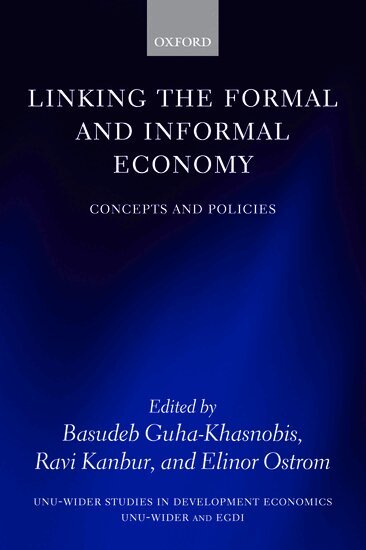
    Linking the Formal and Informal Economy

    Concepts and Policies

    AvBasudeb Guha-Khasnobis,Ravi Kanbur

    Häftad, Engelska, 2007

    Del i serien WIDER Studies in Development Economics

    948 kr

    Beställningsvara. Skickas inom 5-8 vardagar. Fri frakt över 249 kr.

    Beskrivning

    The concepts of formal and informal remain central to the theory and practice of development more than half a century after they were introduced into the debate. They help structure the way that statistical services collect data on the economies of developing countries, the development of theoretical and empirical analysis, and, most important, the formulation and implementation of policy. This volume brings together a significant new collection of studies on formality and informality in developing countries. The volume is multidisciplinary in nature, with contributions from anthropologists, economists, sociologists, and political scientists. It contains contributions from among the very best analysts in development studies. Between them the chapters argue for moving beyond the formal-informal dichotomy. Useful as it has proven to be, a more nuanced approach is needed in light of conceptual and empirical advances, and in light of the policy failures brought about by a characterization of the 'informal' as 'disorganized'. The wealth of empirical information in these studies, and in the literature more widely, can be used to develop guiding principles for intervention that are based on ground level reality.

    Produktinformation

    • Utgivningsdatum:2007-09-20
    • Mått:156 x 234 x 16 mm
    • Vikt:478 g
    • Format:Häftad
    • Språk:Engelska
    • Serie:WIDER Studies in Development Economics
    • Antal sidor:312
    • Förlag:OUP OXFORD
    • ISBN:9780199237296

    Utforska kategorier

    • Antropologi inom Samhälle och politik
    • Referensverk och tvärvetenskap inom Samhälle och politik
    • Internationell ekonomi inom Ekonomi och Ledarskap

    Mer om författaren

    Basudeb Guha-Khasnobis is a Senior Research Fellow at UNU-WIDER. He is a PhD from the University of Rochester and worked for IGIDR (Mumbai), ICRIER (New Delhi) and The Exim Bank of India. His research interests include international economics, development economics and financial economics.Ravi Kanbur is T.H. Lee Professor of World Affairs, International Professor of Applied Economics and Management, and Professor of Economics at Cornell University, and previously Professor of Economics at the University of Warwick, and Chief Economist for Africa at the World Bank.Elinor Ostrom was Arthur F. Bentley Professor of Political Science at Indiana University. She was also Co-Director, Workshop in Political Theory and Policy Analysis and Co-Director, Center for the Study of Institutions, Population and Environmental Change (CIPEC) at Indiana University. She was a member of the Expert Group on Development Issues of the Swedish Ministry for Foreign Affairs.

    Recensioner i media

    Review from previous edition No matter how you divide up the developing world-'formal-informal', 'legal-extralegal' (my preference)- one thing is not debatable: most people are poor, on the outside of the system looking in, and getting angrier every day. The message of this book is it's time to stop talking and start designing reforms based on the informal practices and organizations that poor entrepreneurs already use. I second that motion. If you rebuild the system from the bottom-up, they will come, with their enterprise, creativity, and piles of potential capital.

    Innehållsförteckning

    • 1. Beyond Formality and Informality ; CONCEPTS AND MEASUREMENT ; 2. Bureaucratic Form and the Informal Economy ; 3. The Global Path: Soft Law and Non-sovereigns Formalizing the Potency of the Informal Sector ; 4. The Relevance of the Concepts of Formality and Informality: A Theoretical Appraisal ; 5. Rethinking the Informal Economy: Linkages with the Formal Economy and the Formal Regulatory Environment ; 6. Formal and Informal Enterprises: Concept, Definition, and Measurement Issues in India ; EMPIRICAL STUDIES OF POLICIES AND INTERLINKING ; 7. The Impact of Regulation on Growth and Informality: Cross-Country Evidence ; 8. Financial Liberalization in Vietnam: Impact on Loans from Informal, Formal, and Semi-formal Providers ; 9. Blocking Human Potential: How Formal Policies Block the Informal Economy in the Maputo Corridor ; 10. Microinsurance for the Informal Economy Workers in India ; 11. Turning to Forestry for a Way Out of Poverty: Is Formalizing Property Rights Enough? ; 12. Voluntary Contributions to Informal Activities Producing Public Goods: Can These be Induced by Government and other Formal Sector Agents? Some Evidence from Indonesian Posyandus ; 13. Social Capital, Survival Strategies, and their Potential for Post-Conflict Governance in Liberia ; 14. Enforcement and Compliance in Lima's Street Markets: The Origins and Consequences of Policy Incoherence Toward Informal Traders ; 15. Formalizing the Informal: Is There a Way to Safely Unlock Human Potential Through Land Entitlement? A Review of Changing Land Administration in Africa