• Fri frakt över 249 kr
  • •
  • Snabba leveranser
  • •
  • Billiga böcker
Kundservice

Du är på sajten för privatpersoner.

Företag, bibliotek eller offentlig verksamhet?

Du handlar på classic.bokus.com, där alla dina funktioner finns intakta.
Till classic.bokus.com
Bokus logotyp. Gå till startsidan.
  • Erbjudanden
  • Nyheter
  • Student
  • Topplistor
  • Barn & ungdom
  • Bokus Play
  • E-böcker
  • Pocketböcker
  • Spel & pussel

10% rabatt på allt med kod: NYSTART10 →

Sidfot

Mina sidor

    Hjälp

    • Kundservice
    • Vanliga frågor och svar
    • Frakt och leverans
    • Retur vid ångerrätt
    • Reklamera vara
    • Betalning
    • Köpvillkor
    • Allmänna villkor
    • Information om webbplatsens tillgänglighet

    Om Bokus

    • Om oss
    • Pressrum
    • För studenter
    • För företag
    • För bibliotek och offentlig verksamhet
    • För leverantörer
    • Hållbarhet

    Populärt

    • Aktuella erbjudanden
    • Presentkort
    • Studentlitteratur
    • Nya böcker
    • Topplistor
    • Signerade böcker
    • Engelska böcker

    Inspiration

    • Boktips
    • BookTok
    • Populära bokserier
    • Barnbokskaraktärer
    • Populära författare
    Logotyp för Bokus
    Följ oss på Facebook (extern länk)Följ oss på Instagram (extern länk)Följ oss på YouTube (extern länk)Följ oss på TikTok (extern länk)
    bokus @ CookiesAnpassa cookiesIntegritetspolicyKöpvillkor
    Till Citymail hemsida (extern länk)Till Budbee hemsida (extern länk)Till Postnord hemsida (extern länk)Till Schenker hemsida (extern länk)Till Early Bird hemsida (extern länk)Till Walleys hemsida (extern länk)
    1. Filosofi och religion
    2. Filosofi
    3. Filosofiska discipliner

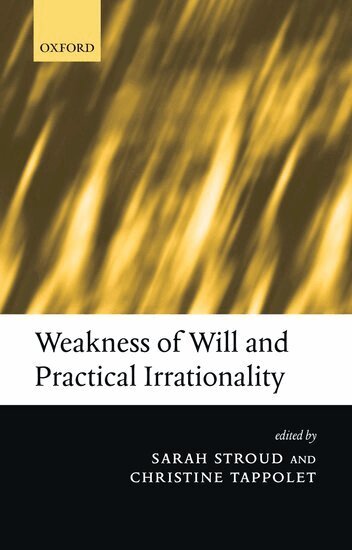
    Weakness of Will and Practical Irrationality

    AvSarah Stroud,Christine Tappolet

    Inbunden, Engelska, 2003

    1 923 kr

    Beställningsvara. Skickas inom 5-8 vardagar. Fri frakt över 249 kr.

    Beskrivning

    Among the many practical failures that threaten us, weakness of will or akrasia is often considered to be a paradigm of irrationality. The eleven new essays in this collection, written by an excellent international team of philosophers, some well-established, some younger scholars, give a rich overview of the current debate over weakness of will and practical irrationality more generally.Issues covered include classical questions such as the distinction between weakness and compulsion, the connection between evaluative judgement and motivation, the role of emotions in akrasia, rational agency, and the existence of the will. The also include new topics, such as group akrasia, strength of will, the nature of correct choice, the structure of decision theory, the temporality of prudential reasons, and emotional rationality. Because these questions cut across philosophy of mind and ethics, the collection will be essential reading for scholars, postgraduates, and upper-level undergraduates in both these fields.

    Produktinformation

    • Utgivningsdatum:2003-09-04
    • Mått:163 x 241 x 22 mm
    • Vikt:598 g
    • Format:Inbunden
    • Språk:Engelska
    • Antal sidor:328
    • Förlag:OUP OXFORD
    • ISBN:9780199257362

    Utforska kategorier

    • Filosofiska discipliner inom Filosofi och religion

    Recensioner i media

    ... an attractive volume ... Combining all the references together at the end proved to be very helpful as did the fine index ... this volume represents an important contribution to action theory, philosophy of mind and moral psychology, and should be read by anyone who works in these areas.

    Innehållsförteckning

    • Introduction ; 1. Rational Capacities, or: How to Distinguish Recklessness, Weakness, and Compulsion ; 2. How is Strength of Will Possible? ; 3. Akrasia, Collective and Individual ; 4. Emotions and the Intelligibility of Akratic Action ; 5. Weakness of Will and Practical Judgement ; 6. Accidie, Evaluation, and Motivation ; 7. The Work of the Will ; 8. Choosing Rationally and Choosing Correctly ; 9. Prudence and the Temporal Structure of Practical Reasons ; 10. Practical Irrationality and the Structure of Decision Theory ; 11. Paradoxical Emotion: On sui generis Emotional Irrationality