• Fri frakt över 249 kr
  • •
  • Snabba leveranser
  • •
  • Billiga böcker
Kundservice

Du är på sajten för privatpersoner.

Företag, bibliotek eller offentlig verksamhet?

Du handlar på classic.bokus.com, där alla dina funktioner finns intakta.
Till classic.bokus.com
Bokus logotyp. Gå till startsidan.
  • Erbjudanden
  • Nyheter
  • Student
  • Topplistor
  • Barn & ungdom
  • Bokus Play
  • E-böcker
  • Pocketböcker
  • Spel & pussel

10% rabatt på allt med kod NYSTART10 →

Sidfot

Mina sidor

    Hjälp

    • Kundservice
    • Vanliga frågor och svar
    • Frakt och leverans
    • Retur vid ångerrätt
    • Reklamera vara
    • Betalning
    • Köpvillkor
    • Allmänna villkor
    • Information om webbplatsens tillgänglighet

    Om Bokus

    • Om oss
    • Pressrum
    • För studenter
    • För företag
    • För bibliotek och offentlig verksamhet
    • För leverantörer
    • Hållbarhet

    Populärt

    • Aktuella erbjudanden
    • Presentkort
    • Studentlitteratur
    • Nya böcker
    • Topplistor
    • Signerade böcker
    • Engelska böcker

    Inspiration

    • Boktips
    • BookTok
    • Populära bokserier
    • Barnbokskaraktärer
    • Populära författare
    Logotyp för Bokus
    Följ oss på Facebook (extern länk)Följ oss på Instagram (extern länk)Följ oss på YouTube (extern länk)Följ oss på TikTok (extern länk)
    bokus @ CookiesAnpassa cookiesIntegritetspolicyKöpvillkor
    Till Citymail hemsida (extern länk)Till Budbee hemsida (extern länk)Till Postnord hemsida (extern länk)Till Schenker hemsida (extern länk)Till Early Bird hemsida (extern länk)Till Walleys hemsida (extern länk)
    1. Medicin
    2. Medicin: allmänt

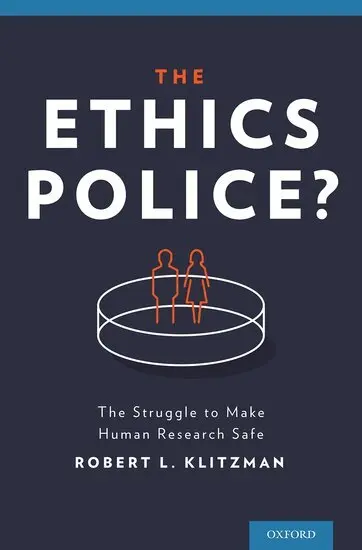
    The Ethics Police?

    The Struggle to Make Human Research Safe

    AvRobert Klitzman

    Inbunden, Engelska, 2015

    856 kr

    Beställningsvara. Skickas inom 5-8 vardagar. Fri frakt över 249 kr.

    Beskrivning

    Research on human beings saves countless lives, but has at times harmed the participants. To what degree then should government regulate science, and how? The horrors of Nazi concentration camp experiments and the egregious Tuskegee syphilis study led the US government, in 1974, to establish Research Ethics Committees, known as Institutional Review Boards (IRBs) to oversee research on humans. The US now has over 4,000 IRBs, which examine yearly tens of billions of dollars of research -- all studies on people involving diseases, from cancer to autism, and behavior. Yet ethical violations persist. At the same time, critics have increasingly attacked these committees for delaying or blocking important studies. Partly, science is changing, and the current system has not kept up. Since the regulations were first conceived 40 years ago, research has burgeoned 30-fold. Studies often now include not a single university, but multiple institutions, and 40 separate IRBs thus need to approve a single project. One committee might approve a study quickly, while others require major changes, altering the scientific design, and making the comparison of data between sites difficult. Crucial dilemmas thus emerge of whether the current system should be changed, and if so, how. Yet we must first understand the status quo to know how to improve it. Unfortunately, these committees operate behind closed doors, and have received relatively little in-depth investigation. Robert Klitzman thus interviewed 45 IRB leaders and members about how they make decisions. What he heard consistently surprised him. This book reveals what Klitzman learned, providing rare glimpses into the conflicts and complexities these individuals face, defining science, assessing possible future risks and benefits of studies, and deciding how much to trust researchers -- illuminating, more broadly, how we view and interpret ethics in our lives today, and perceive and use power.These committees reflect many of the most vital tensions of our time - concerning science and human values, individual freedom, government control, and industry greed. Ultimately, as patients, scientists, or subjects, the decisions of these men and women affect us all.

    Produktinformation

    • Utgivningsdatum:2015-05-14
    • Mått:236 x 157 x 38 mm
    • Vikt:717 g
    • Format:Inbunden
    • Språk:Engelska
    • Antal sidor:434
    • Förlag:OUP USA
    • ISBN:9780199364602

    Utforska kategorier

    • Medicin: allmänt inom Medicin
    • Biovetenskap inom Naturvetenskap och teknik

    Mer om författaren

    Robert Klitzman, MD, is a Professor of Clinical Psychiatry in the College of Physicians and Surgeons and the Joseph Mailman School of Public Health, and the Director of the Masters of Bioethics Program at Columbia University. He has conducted research and written about a variety of bioethical issues, and has authored or co-authored over 100 articles, and seven books, including Am I My Genes?: Confronting Fate and Family Secrets in the Age of Genetic Testing; When Doctors Become Patients; Mortal Secrets: Truth and Lies in the Age of AIDS; Being Positive; A Year-long Night: Tales of a Medical Internship; The Trembling Mountain: A Personal Account of Kuru, Cannibals, and Mad Cow Disease; and In a House of Dreams and Glass: Becoming a Psychiatrist. His work has appeared in JAMA, Science, and elsewhere, and also has written for the New York Times, Newsweek, The Nation, and other publications.

    Recensioner i media

    The book succeeds in providing readers with an insight into a system that operates 'at complex intersections of science, politics, sociology, psychology, money and ethics'. Klitzman conveys how making human research safe is a difficult balancing act between the public's eagerness for treatments and the research community's propensity to respond.

    Innehållsförteckning

    • Part I: Introduction ; Chapter 1: Protecting the People We Experiment On ; Part II: Who IRBs Are ; Chapter 2: "Inside the Black Box": Becoming and Being IRB Members ; Part III: What IRBs Do: The Contents of IRB Decisions ; Chapter 3: Weighing Risks and Benefits and Undue Inducement ; Chapter 4: Defining Research and How Good It Needs To Be ; Chapter 5: What to Tell Subjects: Battles Over Consent Forms ; Chapter 6: From "Nitpicky" to "User-Friendly": Inter-IRB Variations and Their Causes ; Part IV: IRBs vs. Institutions: The Contexts of Decisions ; Chapter 7: Federal Agencies vs. Local IRBs ; Chapter 8: The Roles of Industry ; Chapter 9: The Local Ecologies of Institutions ; Part V: IRBs vs. Researchers ; Chapter 10: Trusting vs. Policing Researchers ; Chapter 11: Bad Behavior: Research Integrity ; Chapter 12: Researchers Abroad: Studies in the Developing World ; Part VI: The Future ; Chapter 13: Changing National Policies ; Chapter 14: Conclusions: Other Changes ; Appendices ; Appendix A: Additional Methodological Information ; Appendix B: Semi-Structured Interview ; Appendix C: List of Acronyms ; Acknowledgements