• Fri frakt över 249 kr
  • •
  • Snabba leveranser
  • •
  • Billiga böcker
Kundservice

Du är på sajten för privatpersoner.

Företag, bibliotek eller offentlig verksamhet?

Du handlar på classic.bokus.com, där alla dina funktioner finns intakta.
Till classic.bokus.com
Bokus logotyp. Gå till startsidan.
  • Erbjudanden
  • Nyheter
  • Student
  • Topplistor
  • Barn & ungdom
  • Bokus Play
  • E-böcker
  • Pocketböcker
  • Spel & pussel

Må bättre, för mindre! Upp till 50% rabatt på hälsoböcker

Sidfot

Mina sidor

    Hjälp

    • Kundservice
    • Vanliga frågor och svar
    • Frakt och leverans
    • Retur vid ångerrätt
    • Reklamera vara
    • Betalning
    • Köpvillkor
    • Allmänna villkor
    • Information om webbplatsens tillgänglighet

    Om Bokus

    • Om oss
    • Pressrum
    • För studenter
    • För företag
    • För bibliotek och offentlig verksamhet
    • För leverantörer
    • Hållbarhet

    Populärt

    • Aktuella erbjudanden
    • Presentkort
    • Studentlitteratur
    • Nya böcker
    • Topplistor
    • Signerade böcker
    • Engelska böcker

    Inspiration

    • Boktips
    • BookTok
    • Populära bokserier
    • Barnbokskaraktärer
    • Populära författare
    Logotyp för Bokus
    Följ oss på Facebook (extern länk)Följ oss på Instagram (extern länk)Följ oss på YouTube (extern länk)Följ oss på TikTok (extern länk)
    bokus @ CookiesAnpassa cookiesIntegritetspolicyKöpvillkor
    Till Citymail hemsida (extern länk)Till Budbee hemsida (extern länk)Till Postnord hemsida (extern länk)Till Schenker hemsida (extern länk)Till Early Bird hemsida (extern länk)Till Walleys hemsida (extern länk)
    1. Psykologi och pedagogik
    2. Psykologi
    3. Socialpsykologi och gruppsykologi

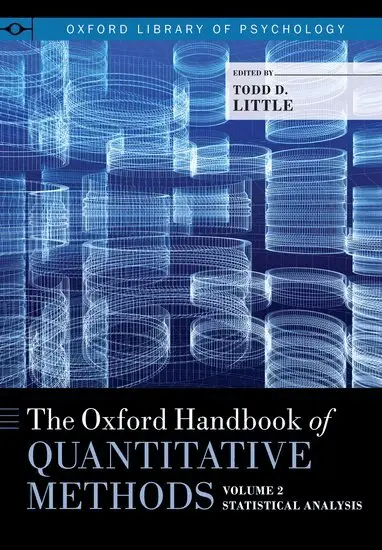
    The Oxford Handbook of Quantitative Methods in Psychology, Volume 2

    AvTodd Little

    Häftad, Engelska, 2014

    Del i serien Oxford Library of Psychology

    1 377 kr

    Beställningsvara. Skickas inom 5-8 vardagar. Fri frakt över 249 kr.

    Beskrivning

    Research today demands the application of sophisticated and powerful research tools. Fulfilling this need, The Oxford Handbook of Quantitative Methods in Psychology is the complete tool box to deliver the most valid and generalizable answers to today's complex research questions. It is a one-stop source for learning and reviewing current best-practices in quantitative methods as practiced in the social, behavioral, and educational sciences.Comprising two volumes, this handbook covers a wealth of topics related to quantitative research methods. It begins with essential philosophical and ethical issues related to science and quantitative research. It then addresses core measurement topics before delving into the design of studies. Principal issues related to modern estimation and mathematical modeling are also detailed. Topics in the handbook then segway into the realm of statistical inference and modeling with chapters dedicated to classical approaches as well as modern latent variable approaches. Numerous chapters associated with longitudinal data and more specialized techniques round out this broad selection of topics. Comprehensive, authoritative, and user-friendly, this two-volume set will be an indispensable resource for serious researchers across the social, behavioral, and educational sciences.

    Produktinformation

    • Utgivningsdatum:2014-04-03
    • Mått:178 x 251 x 38 mm
    • Vikt:1 317 g
    • Format:Häftad
    • Språk:Engelska
    • Serie:Oxford Library of Psychology
    • Antal sidor:784
    • Förlag:OUP USA
    • ISBN:9780199370160

    Utforska kategorier

    • Socialpsykologi och gruppsykologi inom Psykologi och pedagogik
    • Sociologi och antropologi inom Samhälle och politik

    Mer om författaren

    Todd D. Little, Ph.D., is a Professor of Psychology, Director of the Quantitative Training Program, Director of the Undergraduate Social and Behavioral Sciences Methodology minor, and a member of the Developmental Training program

    Innehållsförteckning

    • 1. Introduction ; Todd Little ; 2. Overview of Traditional/Classical Statistical Approaches ; Bruce Thompson ; 3. Generalized Linear Models ; Stefany Coxe, Stephen G. West, and Leona S. Aiken ; 4. Categorical Methods ; Carol M. Woods ; 5. Configural Frequency Analysis ; Alexander von Eye, Eun-Young Mun, Patrick Mair, and Stefan von Weber ; 6. Nonparametric Statistical Techniques ; Trent D. Buskirk, Lisa M. Willoughby, and Terry T. Tomazic ; 7. Correspondence Analysis ; Michael J. Greenacre ; 8. Spatial Analysis ; Luc Anselin, Alan T. Murray, and Sergio J. Rey ; 9. Analysis of Imaging Data ; Larry R. Price ; 10. Quantitative Analysis of Genes ; Sarah E. Medland ; 11. Twin Studies and Behavior Genetics ; Gabriella A.M. Blokland, Miriam A. Mosing, Karin J.H. Verweij, and Sarah E. Medland ; 12. Multidimensional Scaling ; Cody S. Ding ; 13. Latent Variable Measurement Models ; Timothy A. Brown ; 14. Multilevel Regression and Multilevel Structural Equation Modeling ; Joop J. Hox ; 15. Structural Equation Models ; John J. McArdle and Kelly M. Kadlec ; 16. Developments in Mediation Analysis ; David P. MacKinnon, Yasemin Kisbu-Sakarya, and Amanda C. Gottschall ; 17. Moderation ; Herbert W. Marsh, Kit-Tai Hau, Zhonglin Wen, Benjamin Nagengast, and Alexandre J.S. Morin ; 18. Longitudinal Data Analysis ; Wei Wu, James P. Selig, and Todd D. Little ; 19. Dynamical Systems and Models of Continuous Time ; Deboeck, P. R. ; 20. Intensive Longitudinal Data ; Theodore A. Walls ; 21. Dynamic Factor Analysis: Modeling Person-specific Process ; Nilam Ram, Annette Brose, and Peter C. M. Molenaar ; 22. Time Series Analysis ; William W.S. Wei ; 23. Analyzing Event History Data ; Trond Peterson ; 24. Clustering and Classification ; Andre A. Rupp ; 25. Latent Class Analysis and Finite Mixture Modeling ; Katherine E. Masyn ; 26. Taxometrics ; Theodore P. Beauchaine ; 27. Missing Data Methods ; Amanda N. Baraldi and Craig K. Enders ; 28. Secondary Data Analysis ; M. Brent Donnellan and Richard E. Lucas ; 29. Data Mining ; Carolin Strobl ; 30. Meta-analysis and Quantitative Research Synthesis ; Noel A. Card and Deborah M. Casper ; 31. Common Fallacies in Quantitative Research Methodology ; Lihshing Leigh Wang, Amber S. Watts, Rawni A. Anderson, and Todd D. Little