• Fri frakt över 249 kr
  • •
  • Snabba leveranser
  • •
  • Billiga böcker
Kundservice

Du är på sajten för privatpersoner.

Företag, bibliotek eller offentlig verksamhet?

Du handlar på classic.bokus.com, där alla dina funktioner finns intakta.
Till classic.bokus.com
Bokus logotyp. Gå till startsidan.
  • Erbjudanden
  • Nyheter
  • Student
  • Topplistor
  • Barn & ungdom
  • Bokus Play
  • E-böcker
  • Pocketböcker
  • Spel & pussel

10% rabatt på allt med kod: NYSTART10 →

Sidfot

Mina sidor

    Hjälp

    • Kundservice
    • Vanliga frågor och svar
    • Frakt och leverans
    • Retur vid ångerrätt
    • Reklamera vara
    • Betalning
    • Köpvillkor
    • Allmänna villkor
    • Information om webbplatsens tillgänglighet

    Om Bokus

    • Om oss
    • Pressrum
    • För studenter
    • För företag
    • För bibliotek och offentlig verksamhet
    • För leverantörer
    • Hållbarhet

    Populärt

    • Aktuella erbjudanden
    • Presentkort
    • Studentlitteratur
    • Nya böcker
    • Topplistor
    • Signerade böcker
    • Engelska böcker

    Inspiration

    • Boktips
    • BookTok
    • Populära bokserier
    • Barnbokskaraktärer
    • Populära författare
    Logotyp för Bokus
    Följ oss på Facebook (extern länk)Följ oss på Instagram (extern länk)Följ oss på YouTube (extern länk)Följ oss på TikTok (extern länk)
    bokus @ CookiesAnpassa cookiesIntegritetspolicyKöpvillkor
    Till Citymail hemsida (extern länk)Till Budbee hemsida (extern länk)Till Postnord hemsida (extern länk)Till Schenker hemsida (extern länk)Till Early Bird hemsida (extern länk)Till Walleys hemsida (extern länk)
    1. Ekonomi och Ledarskap
    2. Företagsekonomi
    3. Organisationsteori

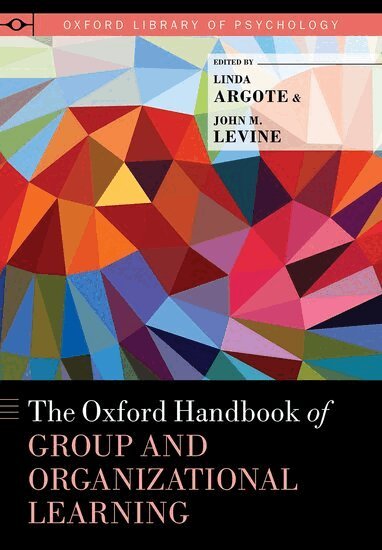
    The Oxford Handbook of Group and Organizational Learning

    AvLinda Argote,John M. Levine

    Inbunden, Engelska, 2020

    Del i serien Oxford Library of Psychology

    2 041 kr

    Beställningsvara. Skickas inom 5-8 vardagar. Fri frakt över 249 kr.

    Beskrivning

    Groups and organizations vary dramatically in their ability to learn. Some acquire substantial knowledge as a function of experience, while others do not. In groups, learning can occur at the level of the individual member and/or the group as a whole. In organizations, learning can occur at both of these levels as well as that of the wider collective. Besides varying in the amount and kind of information they acquire, groups and organizations also vary regarding their success in retaining knowledge and transferring it to other units. In general, groups and organizations that are proficient in acquiring, retaining, and transfering knowledge are more productive and more enduring than their less able counterparts. The goal of this handbook is to bring together cutting-edge theoretical and empirical work on group and organizational learning by leading scholars from several disciplines. Because many of the same processes influence learning in groups and organizations, including both kinds of learning in the same volume has the potential to facilitate the integration of knowledge and the cross-fertilization of ideas. These benefits are reciprocal, in that research at the group level can shed light on how organizations learn whereas research at the organizational level can illuminate how groups learn. By clarifying similarities and differences in the processes that underlie learning in groups and organizations, the handbook advances understanding of the causes and consequences of learning in collectives of varying size and complexity.

    Produktinformation

    • Utgivningsdatum:2020-02-20
    • Mått:190 x 257 x 48 mm
    • Vikt:1 430 g
    • Format:Inbunden
    • Språk:Engelska
    • Serie:Oxford Library of Psychology
    • Antal sidor:704
    • Förlag:OUP USA
    • ISBN:9780190263362

    Utforska kategorier

    • Organisationsteori inom Ekonomi och Ledarskap
    • Arbetspsykologi inom Psykologi och pedagogik
    • Ledarskapsböcker inom Ekonomi och Ledarskap

    Mer om författaren

    Linda Argote is the David M. and Barbara A. Kirr Professor of Organizational Behavior and Theory in the Tepper School of Business at Carnegie Mellon University, where she directs the Center for Organizational Learning, Innovation and Knowledge. Her research focuses on organizational learning, knowledge transfer, transactive memory, and group processes and performance. Her book, Organizational Learning: Creating, Retaining and Transferring Knowledge was a finalist for the Terry Book Award of the Academy of Management. Dr. Argote served as Editor-in-Chief of Organization Science and Departmental Editor of Management Science. She was chosen as Distinguished Scholar by the Organization and Management Theory division of the Academy of Management. The International Network for Groups Research recognized her with the Joseph E. McGrath Award for Lifetime Achievement in the Study of Groups. She is a Fellow of the Academy of Management, the Association for Psychological Science, and theInstitute for Operations Research and Management Sciences.John M. Levine is Professor of Psychology and Senior Scientist, Learning Research and Development Center, at the University of Pittsburgh. His research focuses on small group processes, including newcomer innovation in work teams, reaction to deviance and disloyalty, and the impact of disagreement/argumentation on learning. He has served as Editor of the Journal of Experimental Social Psychology and Chair of the Society of Experimental Social Psychology. Dr. Levine was co-recipient of the Joseph E. McGrath Award for Lifetime Achievement in the Study of Groups from the Interdisciplinary Network for Group Research and received an Honorary Doctorate from the University of Lausanne, Switzerland. He is currently an Honorary Professor of Psychology at the University of Kent, Canterbury, UK.

    Innehållsförteckning

    • PART I. Introduction 1. John M. Levine and Linda Argote, Group and Organizational Learning: Past, Present, and Future 2. Psychological Foundations of Group and Organizational LearningZur Shapira PART II. Processes of Group and Organizational Learning Mindfulness of Learning Processes 3. Deliberate LearningMichael A. Lapré and Ingrid M. Nembhard 4. Organizational Learning and Organizational ImprovisationAnne S. Miner and Jay O'Toole Information Sampling and Search 5. Attention, Knowledge, and Organizational LearningWilliam Ocasio, Luke Rhee, and Daniel Milner 6. Sampling Biases Explain Decision BiasesJerker Denrell 7. Organizational Learning From Failure: Present Theory and Future InquiriesVinit M. Desai, David Maslach, and Peter M. Madsen Information Processing and Interpretation 8. Information Sharing Within Groups in Organizations: Situational and Motivational InfluencesJames R. Larson, Jr. and Amanda C. Egan 9. Learning While Deciding in GroupsR. Scott Tindale and Jeremy R. Winget 10. Team ReflexivityMichaéla C. Schippers, Amy C. Edmondson, and Michael A. West 11. Advancing Team Learning: Process Mechanisms, Knowledge Outcomes, and ImplicationsSteve W. J. Kozlowski and Bradford S. Bell Training 12. Team Training in Organizations: It Works-When Done RightEduardo Salas, Denise L. Reyes, and Amanda L. Woods 13. Team Training in the Organizational ContextNorbert K. Semmer and Franziska Tschan Remembering and Retaining Knowledge 14. How Interacting Groups Remember: Implications for Learning by Groups in OrganizationsVerlin B. Hinsz, Kevin R. Betts, Miriam Sánchez-Manzanares, and R. Scott Tindale 15. Is Organizational Memory a Useful Capability?: An Analysis of Its Effects on Productivity, Absorptive Capacity, and AdaptationAmit Jain Performance Feedback and Social Comparisons 16. Performance Feedback in Organizations and Groups: Common ThemesHenrich R. Greve and Vibha Gaba 17. Social Comparison and Learning From OthersChristine M. Beckman and Hyeun J. Lee Learning from Others and Transferring Knowledge 18. Personnel Movement as a Mechanism for Learning in Organizations and TeamsAimée A. Kane and Floor Rink 19. Knowledge Transfer: Barriers, Methods, and Timing of MethodsGabriel Szulanski and Sunkee Lee Innovation and Creating Knowledge 20. Group and Intergroup CreativityPaul B. Paulus and Jared B. Kenworthy 21. Team Innovation CyclesMartine R. Haas and Jonathon N. Cummings 22. Collective Paradoxical Frames: Managing Tensions in Learning and InnovationElla Miron-Spektor and Susannah B. F. Paletz PART III. Contextual Influences on Group and Organizational Learning Unit Composition23. Team Emotions and Team LearningDorthe Døjbak Håkonsson, Panagiotis Mitkidis, and Sebastian Wallot 24. Team Diversity and Learning in OrganizationsDaan van Knippenberg and Julija N. Mell 25. Collective Intelligence and Group LearningAnita Williams Woolley and Ishani Aggarwal Structures and Routines 26. Organizational Routines and Organizational LearningMarkus C. Becker 27. Organizational Structure and Organizational LearningPhanish Puranam and Boris Maciejovsky 28. How and When Can Social Hierarchy Promote Learning in Groups?J. Stuart Bunderson and Bret Sanner 29. Learning in Chains and What We Can Learn From ItAnne Marie Knott Intergroup Contexts 30. A Social Identity Model for EducationDominic Abrams, Diane M. Houston, Barbara M. Masser, and Blake M. McKimmie 31. Learning Who We Are From Our Leaders: How Leaders Shape Group and Organizational Norms and IdentitiesMichael A. Hogg 32. Organizational Learning and Multiteam SystemsLeslie A. DeChurch, Gina M. Bufton, Sophie A. Kay, Chelsea V. Velez, and Noshir S. Contractor Online Environments 33. Learning in Virtual TeamsYuqing Ren 34. Theorizing Knowledge Collaboration in Online CommunitiesAnn Majchrzak, Sirkka L. Jarvenpaa, and Samer Faraj