• Fri frakt över 249 kr
  • •
  • Snabba leveranser
  • •
  • Billiga böcker
Kundservice

Du är på sajten för privatpersoner.

Företag, bibliotek eller offentlig verksamhet?

Du handlar på classic.bokus.com, där alla dina funktioner finns intakta.
Till classic.bokus.com
Bokus logotyp. Gå till startsidan.
  • Erbjudanden
  • Student
  • Topplistor
  • Barn & ungdom
  • Bokus Play
  • E-böcker
  • Ljudböcker
  • Pocketböcker
  • Spel och pussel

Skapa nya rutiner – hälsoböcker upp till 50% →

Sidfot

Mina sidor

    Hjälp

    • Kundservice
    • Vanliga frågor och svar
    • Frakt och leverans
    • Retur vid ångerrätt
    • Reklamera vara
    • Betalning
    • Köpvillkor
    • Allmänna villkor
    • Information om webbplatsens tillgänglighet

    Om Bokus

    • Om oss
    • Pressrum
    • För studenter
    • För företag
    • För bibliotek och offentlig verksamhet
    • För leverantörer
    • Hållbarhet

    Populärt

    • Aktuella erbjudanden
    • Presentkort
    • Studentlitteratur
    • Nya böcker
    • Topplistor
    • Signerade böcker
    • Engelska böcker

    Inspiration

    • Boktips
    • BookTok
    • Barnbokskaraktärer
    • Populära författare
    Logotyp för Bokus
    Följ oss på Facebook (extern länk)Följ oss på Instagram (extern länk)Följ oss på YouTube (extern länk)Följ oss på TikTok (extern länk)
    bokus @ CookiesAnpassa cookiesIntegritetspolicyKöpvillkor
    Till Citymail hemsida (extern länk)Till Budbee hemsida (extern länk)Till Postnord hemsida (extern länk)Till Schenker hemsida (extern länk)Till Early Bird hemsida (extern länk)Till Walleys hemsida (extern länk)
    1. Ekonomi och Ledarskap
    2. Nationalekonomi

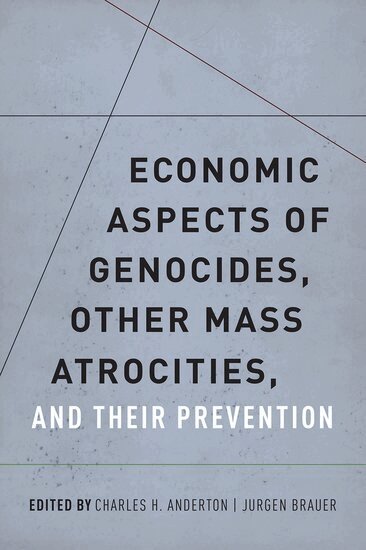
    Economic Aspects of Genocides, Other Mass Atrocities, and Their Preventions

    AvCharles H. Anderton,Jurgen Brauer

    Inbunden, Engelska, 2016

    Del i serien OXFORD UNIV PR

    2 627 kr

    Beställningsvara. Skickas inom 5-8 vardagar. Fri frakt över 249 kr.

    Beskrivning

    Alongside other types of mass atrocities, genocide has received extensive scholarly, policy, and practitioner attention. Missing, however, is the contribution of economists to better understand and prevent such crimes. This edited collection by 41 accomplished scholars examines economic aspects of genocides, other mass atrocities, and their prevention. Chapters include numerous case studies (e.g., California's Yana people, Australia's Aborigines peoples, Stalin's killing of Ukrainians, Belarus, the Holocaust, Rwanda, DR Congo, Indonesia, Pakistan, Colombia, Mexico's drug wars, and the targeting of suspects during the Vietnam war), probing literature reviews, and completely novel work based on extraordinary country-specific datasets. Also included are chapters on the demographic, gendered, and economic class nature of genocide. Replete with research- and policy-relevant findings, new insights are derived from behavioral economics, law and economics, political economy, macroeconomic modeling, microeconomics, development economics, industrial organization, identity economics, and other fields. Analytical approaches include constrained optimization theory, game theory, and sophisticated statistical work in data-mining, econometrics, and forecasting.A foremost finding of the book concerns atrocity architects' purposeful, strategic use of violence, often manipulating nonrational proclivities among ordinary people to sway their participation in mass murder. Relatively understudied in the literature, the book also analyzes the options of victims before, during, and after mass violence. Further, the book shows how well-intended prevention efforts can backfire and increase violence, how wrong post-genocide design can entrench vested interests to reinforce exclusion of vulnerable peoples, and how businesses can become complicit in genocide. In addition to the necessity of healthy opportunities in employment, education, and key sectors in prevention work, the book shows why new genocide prevention laws and institutions must be based on reformulated incentives that consider insights from law and economics, behavioral economics, and collective action economics.

    Produktinformation

    • Utgivningsdatum:2016-07-07
    • Mått:157 x 239 x 43 mm
    • Vikt:1 157 g
    • Format:Inbunden
    • Språk:Engelska
    • Serie:OXFORD UNIV PR
    • Antal sidor:728
    • Förlag:OUP USA
    • ISBN:9780199378296

    Utforska kategorier

    • Nationalekonomi inom Ekonomi och Ledarskap
    • Folkmord och etnisk rensning inom Historia och arkeologi
    • Referensverk och tvärvetenskap inom Samhälle och politik

    Mer om författaren

    Dr. Charles H. Anderton is Professor of Economics and the W. Arthur Garrity Sr. Professor in Human Nature, Ethics and Society at the College of the Holy Cross, Worcester, MA, where he has taught since 1986. His course offerings include the economics of war and peace and genocide and mass killing: perspectives from the social sciences. His research on war and peace has been published in a variety of journals and edited volumes in economics, international relations, and related fields.Dr. Jurgen Brauer is Professor of Economics, Hull College of Business, Georgia Regents University, Augusta, GA, and Visiting Professor of Economics, Chulalongkorn University, Bangkok, Thailand. Specializing in defense and peace economics, he is co-founder and co-editor of The Economics of Peace and Security Journal.

    Recensioner i media

    "The editors do an excellent job of locating materials regarding certain painful spheres in one place for easier access to readings, reflections, and directions for the future. This book is a must read for all who seek to better understand these complex dynamics and work toward solutions...Recommended."--CHOICE"Besides writing, jointly or separately, several keystone chapters that provide perspective and coherence to the whole collection, the editors clearly worked hard on planning the overall design and reviewing the individual papers to minimize straying."--Journal of Economic Literature"The contributors interweave the human experiences of mass atrocities, genocides, and other aspects of crime with economic theory. The presentation is systematically comprehensive and engages a great mass of data, critical thinking, and great reflections. The editors do an excellent job of locating materials regarding certain painful spheres in one place for easier access to readings, reflections, and directions for the future. This book is a must read for allwho seek to better understand these complex dynamics and work toward solutions." -- CHOICE"This volume builds a useful bridge between the worlds of mass atrocities and economic theory by presenting a comprehensive, systematic and easily-digestible analysis of key drivers, sustainers and consequences. Economic Aspects of Genocides, Other Mass Atrocities, and Their Prevention unveils six dimensions of interactivity (namely: choice, economic conditions, real economy, wealth appropriation, business organization and socio-economic fundamentals),which are expertly woven throughout the publication. These pillars are both illuminating and instructive for scholars and practitioners, who are continually challenged to grapple with the complex theoreticaland empirical underpinnings of the economics-mass atrocities nexus, while also gleaning keen policy insights for prevention and post-disaster reconstruction. This book is a must-read for all who are seeking to better understand these complex dynamics and work towards solutions that are effective and enduring!"-- Raymond Gilpin, Dean of the Africa Center for Strategic Studies in Washington D.C. and former Director for Economics and Associate Vice President at the United States Institute for Peace

    Innehållsförteckning

    • PART I - ECONOMICS AND MASS ATROCITIES: OVERVIEW Chapter 1: On the Economics of Genocides, Other Mass Atrocities, and Their PreventionCharles H. Anderton and Jurgen Brauer Chapter 2: "A Crime Without A Name": Defining Genocide and Mass AtrocityJames E. Waller Chapter 3: Datasets and Trends of Genocides, Mass Killings, and Other Civilian AtrocitiesCharles H. Anderton Chapter 4: The Demography of GenocideTadeusz Kugler Chapter 5: The Macroeconomic Toll of Genocide and the Sources of Economic DevelopmentDimitrios Soudis, Robert Inklaar, and Robbert Maseland PART II: ECONOMICS AND MASS ATROCITIES: THEORETICAL APPROACHES AND REVIEWS OF EMPIRICAL LITERATURE Chapter 6: Genocide and Mass Killing Risk and Prevention: Perspectives from Constrained Optimization ModelsCharles H. Anderton and Jurgen Brauer Chapter 7: Incentives and Constraints for Mass Killings: A Game-Theoretic ApproachJoan Esteban, Massimo Morelli, and Dominic Rohner Chapter 8: Genocide: From Social Structure to Political ConductNéstor Duch-Brown and Antonio Fonfría Chapter 9: The Microeconomic Causes and Consequences of Genocides and Mass AtrocitiesPatricia Justino Chapter 10: Development and the Risk of Mass Atrocities: An Assessment of the Empirical LiteratureAnke Hoeffler Chapter 11: Who Stays and Who Leaves During Mass Atrocities? Ana María Ibáñez and Andrés Moya Chapter 12: Media Persuasion, Ethnic Hatred, and Mass Violence: A Brief Overview of Recent AdvancesMaria Petrova and David Yanagizawa-Drott PART III - ECONOMICS AND MASS ATROCITIES: CASE STUDIES I Chapter 13: "For Being Aboriginal" - Economic Perspectives on Pre-Holocaust GenocidesJurgen Brauer and Raul Caruso Chapter 14: Identity and Incentives: An Economic Interpretation of the HolocaustRaul Caruso Chapter 15: The Economics of Genocide in RwandaWilla Friedman Chapter 16: Peace and the Killing: Compatible Logics in the Democratic Republic of the CongoZoë Marriage Chapter 17: Gender and the Genocidal EconomyElisa von Joeden-Forgey PART IV - ECONOMICS AND MASS ATROCITIES: CASE STUDIES II Chapter 18: On the Logistics of Violence: Evidence from Stalin's Great Terror, Nazi-Occupied Belarus, and Modern African Civil WarsYuri M. Zhukov Chapter 19: Strategic Atrocities: Civilians under Crossfire - Theory and Evidence from ColombiaJuan F. Vargas Chapter 20: From Pax Narcótica to Guerra Pública: Explaining Civilian Violence in Mexico's Illicit Drug WarsNeil T.N. Ferguson, Maren M. Michaelsen, and Topher L. McDougal Chapter 21: Long-Term Economic Development in the Presence of an Episode of Mass Killing: The Case of Indonesia, 1965-1966S. Mansoob Murshed and Mohammad Zulfan Tadjoeddin Chapter 22: Economic Foundations of Religious Killings and Genocide with Special Reference to Pakistan, 1978-2012Partha Gangopadhyay Chapter 23: Understanding Civil War Violence through Military Intelligence: Mining Suspects' Records from the Vietnam WarRex W. Douglass PART V - ECONOMICS AND MASS ATROCITIES: TOWARD PREDICTION AND PREVENTION Chapter 24: Economic Risk Factors and Predictive Modeling of Genocide and Mass KillingCharles R. Butcher and Benjamin E. Goldsmith Chapter 25: Business in Genocide: Understanding and Avoiding ComplicityNora M. Stel and Wim Naudé Chapter 26: Valuing Lives You Might Save: Understanding Psychic Numbing in the Face of GenocidePaul Slovic, Daniel Västfjäll, Robin Gregory, and Kimberly G. Olson Chapter 27: Genocides and Other Mass Atrocities: A Law and Economics ApproachJurgen Brauer, Charles H. Anderton, and David Schap Chapter 28: Local and National Democracy in Political ReconstructionRoger B. Myerson
    Hoppa över listan

    Du kanske också är intresserad av

    J. Paul Dunne, Christopher J. Coyne, Jurgen Brauer, Charles H. Anderton, Shikha Basnet Silwal - Economics of Conflict and Peace, E-bok

    Economics of Conflict and Peace

    J. Paul Dunne, Christopher J. Coyne, Jurgen Brauer, Charles H. Anderton, Shikha Basnet Silwal

    E-bok
    2021

    294 kr

    Shikha Basnet Silwal, Charles H. Anderton, Jurgen Brauer, Christopher J. Coyne, J. Paul Dunne - The Economics of Conflict and Peace, Häftad

    The Economics of Conflict and Peace

    Shikha Basnet Silwal, Charles H. Anderton, Jurgen Brauer, Christopher J. Coyne, J. Paul Dunne

    Häftad, 2021

    245 kr

    Jurgen Brauer, Charles H. Anderton - Economic Aspects of Genocides, Other Mass Atrocities, and Their Prevention, E-bok

    Economic Aspects of Genocides, Other Mass Atrocities, and Their Prevention

    Jurgen Brauer, Charles H. Anderton

    E-bok
    2016

    1 536 kr

    Jurgen Brauer, Charles H. Anderton - Economic Aspects of Genocides, Other Mass Atrocities, and Their Prevention, E-bok

    Economic Aspects of Genocides, Other Mass Atrocities, and Their Prevention

    Jurgen Brauer, Charles H. Anderton

    E-bok
    2016

    1 536 kr

    J. Paul Dunne, Christopher J. Coyne, Jurgen Brauer, Charles H. Anderton, Shikha Basnet Silwal - Economics of Conflict and Peace, E-bok

    Economics of Conflict and Peace

    J. Paul Dunne, Christopher J. Coyne, Jurgen Brauer, Charles H. Anderton, Shikha Basnet Silwal

    E-bok
    2021

    293 kr

    Charles H. Anderton, John R. Carter - Principles of Conflict Economics, Häftad

    Principles of Conflict Economics

    Charles H. Anderton, John R. Carter

    Häftad, 2019

    575 kr

    Charles H. Anderton - Screwtape's Master Plan, Häftad

    Screwtape's Master Plan

    Charles H. Anderton

    Häftad, 2012

    184 kr

    John R. Carter, Charles H. Anderton - Principles of Conflict Economics, E-bok

    Principles of Conflict Economics

    John R. Carter, Charles H. Anderton

    E-bok
    2019

    701 kr

    Charles H. Anderton - Screwtape's Master Plan, E-bok

    Screwtape's Master Plan

    Charles H. Anderton

    E-bok
    2012

    269 kr

    Charles H. Anderton, John R. Carter - Principles of Conflict Economics, Inbunden

    Principles of Conflict Economics

    Charles H. Anderton, John R. Carter

    Inbunden, 2019

    1 430 kr