• Fri frakt över 249 kr
  • •
  • Snabba leveranser
  • •
  • Billiga böcker
Kundservice

Du är på sajten för privatpersoner.

Företag, bibliotek eller offentlig verksamhet?

Du handlar på classic.bokus.com, där alla dina funktioner finns intakta.
Till classic.bokus.com
Bokus logotyp. Gå till startsidan.
  • Erbjudanden
  • Nyheter
  • Student
  • Topplistor
  • Barn & ungdom
  • Bokus Play
  • E-böcker
  • Pocketböcker
  • Spel & pussel

10% rabatt på allt med kod NYSTART10 →

Sidfot

Mina sidor

    Hjälp

    • Kundservice
    • Vanliga frågor och svar
    • Frakt och leverans
    • Retur vid ångerrätt
    • Reklamera vara
    • Betalning
    • Köpvillkor
    • Allmänna villkor
    • Information om webbplatsens tillgänglighet

    Om Bokus

    • Om oss
    • Pressrum
    • För studenter
    • För företag
    • För bibliotek och offentlig verksamhet
    • För leverantörer
    • Hållbarhet

    Populärt

    • Aktuella erbjudanden
    • Presentkort
    • Studentlitteratur
    • Nya böcker
    • Topplistor
    • Signerade böcker
    • Engelska böcker

    Inspiration

    • Boktips
    • BookTok
    • Populära bokserier
    • Barnbokskaraktärer
    • Populära författare
    Logotyp för Bokus
    Följ oss på Facebook (extern länk)Följ oss på Instagram (extern länk)Följ oss på YouTube (extern länk)Följ oss på TikTok (extern länk)
    bokus @ CookiesAnpassa cookiesIntegritetspolicyKöpvillkor
    Till Citymail hemsida (extern länk)Till Budbee hemsida (extern länk)Till Postnord hemsida (extern länk)Till Schenker hemsida (extern länk)Till Early Bird hemsida (extern länk)Till Walleys hemsida (extern länk)
    1. Naturvetenskap och teknik
    2. Matematik och naturvetenskap
    3. Biologi
    4. Djurens beteende

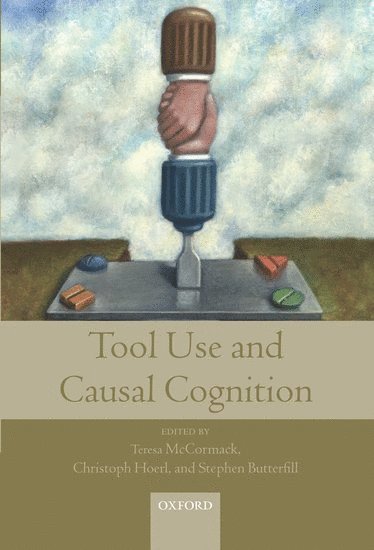
    Tool Use and Causal Cognition

    AvTeresa McCormack,Christoph Hoerl

    Inbunden, Engelska, 2011

    Del i serien Consciousness & Self-Consciousness Series

    1 112 kr

    Beställningsvara. Skickas inom 7-10 vardagar. Fri frakt över 249 kr.

    Beskrivning

    What cognitive abilities underpin the use of tools, and how are tools and their properties represented or understood by tool-users? Does the study of tool use provide us with a unique or distinctive source of information about the causal cognition of tool-users? Tool use is a topic of major interest to all those interested in animal cognition, because it implies that the animal has knowledge of the relationship between objects and their effects. There are countless examples of animals developing tools to achieve some goal-chimps sharpening sticks to use as spears, bonobos using sticks to fish for termites, and New Caledonian crows developing complex tools to extracts insects from logs. Studies of tool use have been used to examine an exceptionally wide range of aspects of cognition, such as planning, problem-solving and insight, naive physics, social relationship between action and perception. A key debate in recent research on animal cognition concerns the level of cognitive sophistication that is implied by animal tool use, and developmental psychologists have been addressing related questions regarding the processes through which children acquire the ability to use tools. In neuropsychology, patterns of impairments in tool use due to brain damage, and studies of neural changes associated with tool use, have also led to debates about the different types of cognitive abilities that might underpin tool use, and about how tool use may change the way space or the body is represented. Tool Use and Causal Cognition provides a new interdisciplinary perspective on these issues with contributions from leading psychologists studying tool use and philosophers providing new analyses of the nature of causal understandingA ground-breaking volume which covers several disciplines, this volume will be of interest to psychologists, including animal researchers and developmental psychologists as well as philosophers, and neuroscientists.

    Produktinformation

    • Utgivningsdatum:2011-08-25
    • Mått:175 x 240 x 35 mm
    • Vikt:554 g
    • Format:Inbunden
    • Språk:Engelska
    • Serie:Consciousness & Self-Consciousness Series
    • Antal sidor:272
    • Förlag:OUP OXFORD
    • ISBN:9780199571154

    Utforska kategorier

    • Djurens beteende inom Naturvetenskap och teknik
    • Djurböcker inom Djur och Natur
    • Referensverk och tvärvetenskap inom Samhälle och politik

    Mer om författaren

    Teresa McCormack is Professor of Developmental Psychology at the School of Psychology, Queen's University Belfast. She was co-director of the AHRC-funded project on Causal Understanding based at the University of Warwick. Her research primarily addresses issues concerning children's temporal and causal cognition. She has published two co-edited interdisciplinary books: Time and Memory: Perspectives in Philosophy and Psychology (OUP, 2001), with C. Hoerl, and Joint Attention and Communication (OUP, 2005), with N. Eilan, C. Hoerl, and J. Roessler. A further volume entitled Understanding Counterfactuals, Understanding Causation, co-edited with C. Hoerl and S. Beck is forthcoming with OUP.Christoph Hoerl is Associate Professor (Reader) in Philosophy at the University of Warwick. Between 2004 and 2008, he was co-director (with Teresa McCormack and Johannes Roessler) of the interdisciplinary AHRC Research Project 'Causal Understanding: Empirical and Theoretical Foundations for a New Approach'. With Teresa McCormack and Sarah Beck, he is co-editor of Understanding Counterfactuals, Understanding Causation (OUP, forthcoming).Stephen Butterfill is Associate Professor in Philosophy at the University of Warwick. His research focuses on philosophical issues in developmental psychology.

    Innehållsförteckning

    • 1. Tool Use and Causal Cognition: An Introduction ; 2. A Philosopher Looks at Tool Use and Causal Understanding ; 3. The Development of Tool Use Early in Life ; 4. Through a Floppy Tool Darkly: Toward a Conceptual Overthrow of Animal Alchemy ; 5. Causal Knowledge in Corvids, Primates and Children: More Than Meets the Eye? ; 6. The Evolutionary Origins of Causal Cognition: Learning and Using Causal Structures ; 7. Tool Use, Planning, and Future Thinking in Children and Animals ; 8. Representing Causality ; 9. Why Do Language and Tool Use Both Count as Manifestations of Intelligence? ; 10. Effects of brain damage on human tool use ; 11. Human tool-use: a causal role in plasticity of bodily and spatial representations ; 12. Tool-use and the representation of peripersonal space in humans