• Fri frakt över 249 kr
  • •
  • Snabba leveranser
  • •
  • Billiga böcker
Kundservice

Du är på sajten för privatpersoner.

Företag, bibliotek eller offentlig verksamhet?

Du handlar på classic.bokus.com, där alla dina funktioner finns intakta.
Till classic.bokus.com
Bokus logotyp. Gå till startsidan.
  • Erbjudanden
  • Nyheter
  • Student
  • Topplistor
  • Barn & ungdom
  • Bokus Play
  • E-böcker
  • Pocketböcker
  • Spel & pussel

10% rabatt på allt med kod NYSTART10 →

Sidfot

Mina sidor

    Hjälp

    • Kundservice
    • Vanliga frågor och svar
    • Frakt och leverans
    • Retur vid ångerrätt
    • Reklamera vara
    • Betalning
    • Köpvillkor
    • Allmänna villkor
    • Information om webbplatsens tillgänglighet

    Om Bokus

    • Om oss
    • Pressrum
    • För studenter
    • För företag
    • För bibliotek och offentlig verksamhet
    • För leverantörer
    • Hållbarhet

    Populärt

    • Aktuella erbjudanden
    • Presentkort
    • Studentlitteratur
    • Nya böcker
    • Topplistor
    • Signerade böcker
    • Engelska böcker

    Inspiration

    • Boktips
    • BookTok
    • Populära bokserier
    • Barnbokskaraktärer
    • Populära författare
    Logotyp för Bokus
    Följ oss på Facebook (extern länk)Följ oss på Instagram (extern länk)Följ oss på YouTube (extern länk)Följ oss på TikTok (extern länk)
    bokus @ CookiesAnpassa cookiesIntegritetspolicyKöpvillkor
    Till Citymail hemsida (extern länk)Till Budbee hemsida (extern länk)Till Postnord hemsida (extern länk)Till Schenker hemsida (extern länk)Till Early Bird hemsida (extern länk)Till Walleys hemsida (extern länk)
    1. Filosofi och religion
    2. Filosofi
    3. Filosofiska discipliner

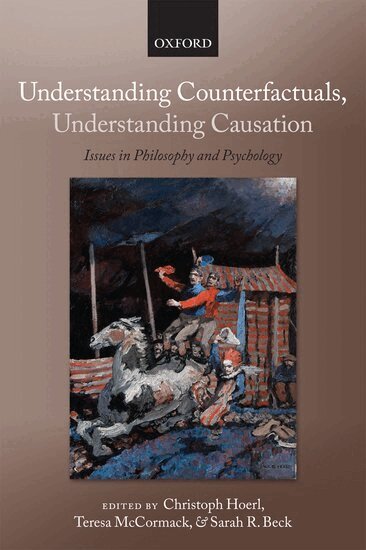
    Understanding Counterfactuals, Understanding Causation

    Issues in Philosophy and Psychology

    AvChristoph Hoerl,Teresa McCormack

    Inbunden, Engelska, 2011

    Del i serien Consciousness & Self-Consciousness Series

    2 411 kr

    Beställningsvara. Skickas inom 5-8 vardagar. Fri frakt över 249 kr.

    Beskrivning

    How are causal judgements such as 'The ice on the road caused the traffic accident' connected with counterfactual judgements such as 'If there had not been any ice on the road, the traffic accident would not have happened'? This volume throws new light on this question by uniting, for the first time, psychological and philosophical approaches to causation and counterfactuals. Traditionally, philosophers have primarily been interested in connections between causal and counterfactual claims on the level of meaning or truth-conditions. More recently, however, they have also increasingly turned their attention to psychological connections between causal and counterfactual understanding or reasoning. At the same time, there has been a surge in interest in empirical work on causal and counterfactual cognition amongst developmental, cognitive, and social psychologists--much of it inspired by work in philosophy. In this volume, twelve original contributions from leading philosophers and psychologists explore in detail what bearing empirical findings might have on philosophical concerns about counterfactuals and causation, and how, in turn, work in philosophy might help clarify the issues at stake in empirical work on the cognitive underpinnings of, and relationships between, causal and counterfactual thought.

    Produktinformation

    • Utgivningsdatum:2011-11-03
    • Mått:164 x 242 x 20 mm
    • Vikt:578 g
    • Format:Inbunden
    • Språk:Engelska
    • Serie:Consciousness & Self-Consciousness Series
    • Antal sidor:280
    • Förlag:OUP OXFORD
    • ISBN:9780199590698

    Utforska kategorier

    • Filosofiska discipliner inom Filosofi och religion
    • Kognitiv psykologi inom Psykologi och pedagogik

    Mer om författaren

    Christoph Hoerl is Associate Professor (Reader) in Philosophy at the University of Warwick. Between 2004 and 2008, he was co-director (with Teresa McCormack and Johannes Roessler) of the interdisciplinary AHRC Research Project 'Causal Understanding: Empirical and Theoretical Foundations for a New Approach'. With Teresa McCormack and Stephen Butterfill, he is co-editor of Tool Use and Causal Understanding (OUP, forthcoming).Teresa McCormack is Professor of Developmental Psychology at the School of Psychology, Queen's University Belfast. She was co-director of the AHRC-funded project on Causal Understanding based at the University of Warwick. Her research primarily addresses issues concerning children's temporal and causal cognition. She has published two co-edited interdisciplinary books: Time and Memory: Perspectives in Philosophy and Psychology (OUP, 2001), with C. Hoerl, and Joint Attention and Communication (OUP, 2005), with N. Eilan, C. Hoerl, and J. Roessler. A further volume entitled Tool Use and Causal Cognition, co-edited with C. Hoerl and S. Butterfill is forthcoming with OUP.Sarah Beck studied Psychology and Philosophy at the University of Oxford and gained her PhD in developmental psychology from the University of Birmingham, where she is currently a Senior Lecturer. Her research is concerned with children's and adults' thinking about time and knowledge, with particular interest in the cognitive processes involved in the development of counterfactual thinking.

    Recensioner i media

    an excellent addition to the field ... This is certainly an interesting volume and makes a major contribution to counterfactual accounts of causation. The analysis of empirical studies in the psychological literature provides an evidence-based approach for philosophers who are interested in counterfactual accounts of causation. Moreover, the conceptual problems are illuminated by these empirical studies and suggest more nuanced conceptual questions about the role of counterfactual reasoning in causal thought. This interdisciplinary volume is a must read for advanced students of causation in both philosophy and psychology as well as most obviously for academics in both fields.

    Innehållsförteckning

    • 1. Introduction: Understanding Counterfactuals and Causation ; 2. Psychological Studies of Causal and Counterfactual Reasoning ; 3. The Relationship between Children's Causal and Counterfactual Judgments ; 4. Perceptual Causality, Counterfactuals, and Special Causal Concepts ; 5. Counterfactual and Other Forms of Conditional Reasoning: Children Lost in the Nearest Possible World ; 6. Multiple Developments in Counterfactual Thinking ; 7. Domain-Specific Causal Knowledge and Children's Reasoning about Possibility ; 8. Mental Simulation and the Nexus of Causal and Counterfactual Explanation ; 9. Counterfactual Availability and Causal Judgement ; 10. The Role of Counterfactual Dependence in Causal Judgements ; 11. Counterfactual and Causal Thoughts about Exceptional Events ; 12. Causation First: Why Causation is Prior to Counterfactuals ; 13. Suppositions, Conditionals, and Causal Claims