• Fri frakt över 249 kr
  • •
  • Snabba leveranser
  • •
  • Billiga böcker
Kundservice

Du är på sajten för privatpersoner.

Företag, bibliotek eller offentlig verksamhet?

Du handlar på classic.bokus.com, där alla dina funktioner finns intakta.
Till classic.bokus.com
Bokus logotyp. Gå till startsidan.
  • Erbjudanden
  • Student
  • Topplistor
  • Barn & ungdom
  • Bokus Play
  • E-böcker
  • Ljudböcker
  • Pocketböcker
  • Spel och pussel

Pocketfynda! Hundratals böcker för 49 kr/st →

Sidfot

Mina sidor

    Hjälp

    • Kundservice
    • Vanliga frågor och svar
    • Frakt och leverans
    • Retur vid ångerrätt
    • Reklamera vara
    • Betalning
    • Köpvillkor
    • Allmänna villkor
    • Information om webbplatsens tillgänglighet

    Om Bokus

    • Om oss
    • Pressrum
    • För studenter
    • För företag
    • För bibliotek och offentlig verksamhet
    • För leverantörer
    • Hållbarhet

    Populärt

    • Aktuella erbjudanden
    • Presentkort
    • Studentlitteratur
    • Nya böcker
    • Topplistor
    • Signerade böcker
    • Engelska böcker

    Inspiration

    • Boktips
    • BookTok
    • Barnbokskaraktärer
    • Populära författare
    Logotyp för Bokus
    Följ oss på Facebook (extern länk)Följ oss på Instagram (extern länk)Följ oss på YouTube (extern länk)Följ oss på TikTok (extern länk)
    bokus @ CookiesAnpassa cookiesIntegritetspolicyKöpvillkor
    Till Citymail hemsida (extern länk)Till Budbee hemsida (extern länk)Till Postnord hemsida (extern länk)Till Schenker hemsida (extern länk)Till Early Bird hemsida (extern länk)Till Walleys hemsida (extern länk)
    1. Filosofi och religion
    2. Filosofi
    3. Filosofiska discipliner

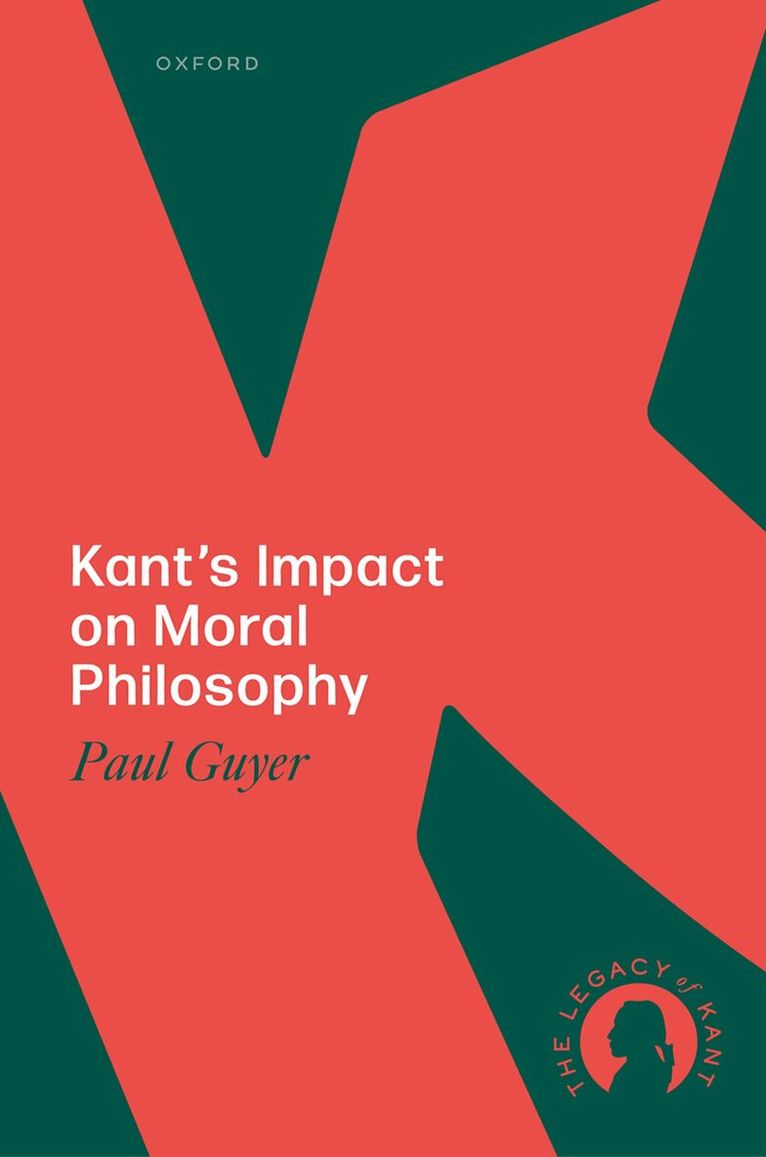
    Kant's Impact on Moral Philosophy

    AvPaul Guyer

    Inbunden, Engelska, 2024

    Del i serien Legacy Of Kant

    1 836 kr

    Beställningsvara. Skickas inom 5-8 vardagar. Fri frakt över 249 kr.

    Fler format och utgåvor

    E-bok

    1 468 kr

    E-bok

    1 468 kr

    Beskrivning

    Immanuel Kant introduced a new paradigm into modern moral philosophy, first with his Groundwork for the Metaphysics of Morals in 1785, followed by his Critique of Practical Reason in 1788, Religion within the Boundaries of Mere Reason in 1793, and Metaphysics of Morals in 1798. For Kant, the fundamental goal of morality is not the realization of the greatest happiness for the greatest number, under some interpretation of that formula, but the realization of human autonomy governed by pure reason in the form of the "categorical imperative." Kant's ideal of autonomy is nothing less than the greatest possible freedom of each human being to set his or her own ends compatible with the equal freedom of every other human being to do the same. As Kant put it in lectures to his own students, freedom "not restrained under certain rules . . . is the most terrible thing there could ever be," but the condition "under which alone the greatest use of freedom is possible, and under which it can be self-consistent" is the "essential end of humankind" and the "inner worth of the world."Kant's work immediately drew the attention of both critics and supporters. While some argued that Kant's categorical imperative was an "empty formalism," that he left no room for happiness in his morality, that he could not explain responsibility for evil, and that he allowed no room for moral feeling in morally worthy motivation, others have found inspiration in his underlying idea that maximal but equal freedom is the "inner worth of the world." This book examines the response to Kant by other significant moral philosophers from Fichte, Schelling, and Hegel to through T.H. Green, Josiah Royce, and Friedrich Nietzsche, to John Rawls, Onora O'Neill, Christine Korsgaard, and Derek Parfit, with many stops along the way. The book is not a history of Kant scholarship, but an examination of Kant's impact on other major moral philosophers from his time to our own. While it attempts to do justice to the arguments of every philosopher discussed, the book argues that the most profound responses to Kant have been precisely those that have developed in their own way Kant's ideal of freedom as the inner worth of the world.

    Produktinformation

    • Utgivningsdatum:2024-02-01
    • Mått:163 x 240 x 42 mm
    • Vikt:1 178 g
    • Format:Inbunden
    • Språk:Engelska
    • Serie:Legacy Of Kant
    • Antal sidor:684
    • Förlag:OUP OXFORD
    • ISBN:9780199592456

    Utforska kategorier

    • Filosofiska discipliner inom Filosofi och religion

    Mer om författaren

    Paul Guyer is Jonathan Nelson Professor of Humanities and Philosophy at Brown University. He received his AB and PhD from Harvard University. Prior to moving to Brown in 2012, he taught for thirty years at the University of Pennsylvania. He is the author, editor, and/or translator of twenty-seven books, many on the philosophy of Kant. He was the General Co-Editor of the Cambridge Edition of the Works of Immanuel Kant. Guyer has been president of the Eastern Division of the American Philosophical Association and the American Society of Aesthetics. He is a fellow of the American Academy of Arts and Sciences.

    Recensioner i media

    Kant's Impact on Moral Philosophy is a worthy successor to the Invention of Autonomy. Guyer pushes far beyond the usual narrative according to which Kant's greatest impact was on the German Idealists and Rawls(ians). His book will be of great interest to Kant scholars and Kantian ethicists, as well as to scholars who are curious about the Kantiandebts of many significant 19th- and 20th-century ethicists.

    Innehållsförteckning

    • Introduction Part I: Kant's Moral Philosophy 1: The Development of Kant's Moral Philosophy from 1764-65 to 1781 2: The Foundations of Kant's Mature Moral Philosophy in the Groundwork and Critique of Practical Reason 3: Kant's Moral Philosophy in the 1790s Part II: The Immediate Reception of Kant's Moral Philosophy 4: The Categorical Imperative, Empty Formalism and Happiness: The Early Reviews 5: Freedom and Immorality: Ulrich, Schmid, Reinhold, and Kant 6: Moral Feelings in Kantian Ethics Part III: German Idealism and Its Opponents 7: Fichte 8: Schelling 9: Hegel 10: Herbart and Schopenhauer 11: Nietzsche's Transvaluation of Kantian Values Part IV: The Anglophone Reception: Idealism Pro and Con 12: Kant and Anglophone Idealism: Bradley to Paton 13: Non-Idealist British Responses to Kant Kant in Cambridge: Sidgwick and Moore 14: Kant in Oxford: Prichard and Ross to Anscombe and Williams Part V: The Anglophone Reception: Consequentialism and Constructivism 15: Combining Kant and Consequentialism: Hare to Parfit 16: Kantian Constructivism I: Rawls 17: Kantian Constructivism II: Nagel, Korsgaard, Piper, and O'Neill