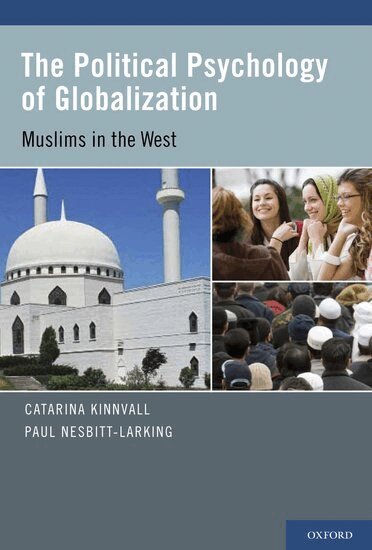
Inbunden, Engelska, 2011
The Political Psychology of Globalization
Muslims in the West
Av Catarina Kinnvall, Paul Nesbitt-Larking
1133 kr
Beställningsvara. Skickas inom 5-8 vardagar. Fri frakt över 249 kr.
Beskrivning
Produktinformation
- Utgivningsdatum: 2011-08-11
- Mått: 157 x 236 x 23 mm
- Vikt: 454 g
- Format: Inbunden
- Språk: Engelska
- Antal sidor: 240
- Förlag: OUP USA
- ISBN: 9780199747542
Utforska kategorier
Mer om författaren
Catarina Kinnvall is Professor in the Department of Political Science at Lund University in Sweden. She is also a former Vice President of the International Society of Political Psychology. Her research interests include political psychology, security, globalization, religion, and nationalism, with a particular focus on South Asia and Europe. She is the author of Globalization and Religious Nationalism in India: The Search for Ontological Security (Routledge), co-editor of On Behalf of Others: The Psychology of Care in a Global World (Oxford University Press), and author of numerous articles and book chapters.Paul Nesbitt-Larking is Professor in the Department of Political Science at Huron University College in Canada. His work on power, discourse, and identity is situated within the research traditions of critical theory, political psychology, and political sociology. His publications include Politics, Society, and the Media, published by the University of Toronto Press, and over fifty scholarly articles and book chapters.
Recensioner i media
"At this point in global history, there could not be a more timely discussion of the social, psychological, and political consequences of globalization, cultural change, and identities lived 'in between.' Drawing on the lived experiences of Muslims in Europe and North America, Nesbitt-Larking and Kinnvall develop a sophisticated analysis of changes in modern cultures that place identity, dialogue, and human agency at the center of our understanding of andambitions for intercultural relations, engaged citizenship, community cohesion, and societal change. I highly recommend this text to all those interested in understanding cultural change today, itspolitics, and its psychology." --Caroline Howarth, Lecturer, Institute of Social Psychology, The London School of Economics and Political Science"Written in a most engaging style, this book exhibits fine, empirically based scholarship and demonstrates theoretical sophistication and historical sensitivity in attending to one of the most politically volatile issues of our time. The authors' multidisciplinary approach illuminates the interplay among social, political, economic, and psychological forces. They offer us new ways of thinking about citizenship, multiculturalism, and globalization, ultimatelypointing to a viable and vibrant politics of engagement." --Molly Andrews, Professor of Sociology and Co-director, Centre for Narrative Research, University of East London"Drawing on a remarkable range of scholarship, the authors address some of the most critical issues facing us today: globalization, identity, and the challenges to Western liberalism posed by sources ranging from fundamentalism and terrorism to ethnocentrism, racism, and religious prejudice. Their analysis of the political psychology of identity among Diaspora and post-Diaspora communities sets a new level of discourse and is essential reading for anyoneinterested in the integration of Muslim communities into Western society. Their brilliant book will remain a classic text for those interested in how people construct hybrid identities and narratives thathelp them make sense of a constantly changing political reality." --Kristen R. Monroe, Professor of Political Science and Philosophy, and Director, Interdisciplinary Center for the Scientific Study of Ethics and Morality, University of California, Irvine"Kinnvall and Nesbitt-Larking forge a unique approach to processes of globalization. Comparing identity strategies and citizenship regimes in a context of multiculturalism, they bridge traditional dichotomies of individual and society and of the local and the global." --Bert Klandermans, Professor of Applied Social Psychology, VU University Amsterdam"This book fills an obvious lacuna in the field, and does so with authority and elegance... This study is both theoretically sophisticated and empirically grounded, and is a most timely book for scholars as well as policy makers. Summing up: Highly recommended. All readership levels." -- A. Ahmad, Black Hills State University, CHOICE"This book is an impressive combination of thorough empirical and comparative analysis combined with an inter-disciplinary and innovative theoretical angle. Through a well-defined structure, the authors provide an impressive tour de force of the field, introducing novel empirical material and theory rooted in political psychology. The added value rests on the extent of its comparative scope; its detailed case studies and the close integration between data and theory as well as a compellingly clear writing-style. The book is essential reading for anyone interested in European Muslim politics. It establishes a laudable goal of unshackling cosmopolitanism from its Eurocentric and orientalist origins. Whether this is realistic in terms of feasible practical policy options is open for debate and further work, but the urgency of the issue cannot be denied." -- Ethnic and Racial Studies"The Political Psychology of Globalization systematically analyzes various identity strategies within different citizenship regimes. Anyone interested in the issues of multiculturalism, integration of Muslims in the West, and identity might find this book useful. In addition, this book might be of interest to those seeking to understand the changing concepts of multiculturalism and identity in general." -- Sabina Cehajic-Clancy, PsycCRITIQUES
Betyg & recensioner
0 recensioner
Inga recensioner tillgängliga.