• Fri frakt över 249 kr
  • •
  • Snabba leveranser
  • •
  • Billiga böcker
Kundservice

Du är på sajten för privatpersoner.

Företag, bibliotek eller offentlig verksamhet?

Du handlar på classic.bokus.com, där alla dina funktioner finns intakta.
Till classic.bokus.com
Bokus logotyp. Gå till startsidan.
  • Erbjudanden
  • Nyheter
  • Student
  • Topplistor
  • Barn & ungdom
  • Bokus Play
  • E-böcker
  • Pocketböcker
  • Spel & pussel

10% rabatt på allt med kod: NYSTART10 →

Sidfot

Mina sidor

    Hjälp

    • Kundservice
    • Vanliga frågor och svar
    • Frakt och leverans
    • Retur vid ångerrätt
    • Reklamera vara
    • Betalning
    • Köpvillkor
    • Allmänna villkor
    • Information om webbplatsens tillgänglighet

    Om Bokus

    • Om oss
    • Pressrum
    • För studenter
    • För företag
    • För bibliotek och offentlig verksamhet
    • För leverantörer
    • Hållbarhet

    Populärt

    • Aktuella erbjudanden
    • Presentkort
    • Studentlitteratur
    • Nya böcker
    • Topplistor
    • Signerade böcker
    • Engelska böcker

    Inspiration

    • Boktips
    • BookTok
    • Populära bokserier
    • Barnbokskaraktärer
    • Populära författare
    Logotyp för Bokus
    Följ oss på Facebook (extern länk)Följ oss på Instagram (extern länk)Följ oss på YouTube (extern länk)Följ oss på TikTok (extern länk)
    bokus @ CookiesAnpassa cookiesIntegritetspolicyKöpvillkor
    Till Citymail hemsida (extern länk)Till Budbee hemsida (extern länk)Till Postnord hemsida (extern länk)Till Schenker hemsida (extern länk)Till Early Bird hemsida (extern länk)Till Walleys hemsida (extern länk)
    1. Ekonomi och Ledarskap
    2. Nationalekonomi
    3. Miljöekonomi

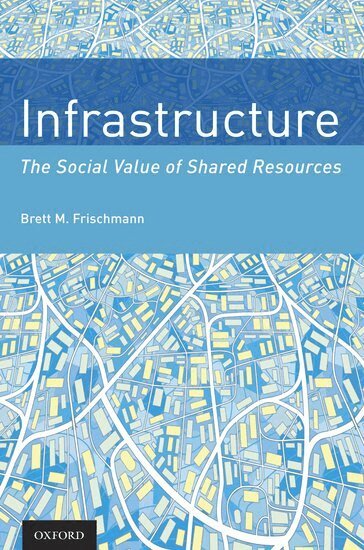
    Infrastructure

    The Social Value of Shared Resources

    AvBrett M. Frischmann

    Häftad, Engelska, 2013

    961 kr

    Beställningsvara. Skickas inom 5-8 vardagar. Fri frakt över 249 kr.

    Fler format och utgåvor

    E-bok

    556 kr

    Inbunden

    2 306 kr

    E-bok

    401 kr

    Beskrivning

    Infrastructure resources are the subject of many contentious public policy debates, including what to do about crumbling roads and bridges, whether and how to protect our natural environment, energy policy, even patent law reform, universal health care, network neutrality regulation and the future of the Internet. Each of these involves a battle to control infrastructure resources, to establish the terms and conditions under which the public receives access, and to determine how the infrastructure and various dependent systems evolve over time. Infrastructure: The Social Value of Shared Resources devotes much needed attention to understanding how society benefits from infrastructure resources and how management decisions affect a wide variety of interests. The book links infrastructure, a particular set of resources defined in terms of the manner in which they create value, with commons, a resource management principle by which a resource is shared within a community. The infrastructure commons ideas have broad implications for scholarship and public policy across many fields ranging from traditional infrastructure like roads to environmental economics to intellectual property to Internet policy.Economics has become the methodology of choice for many scholars and policymakers in these areas. The book offers a rigorous economic challenge to the prevailing wisdom, which focuses primarily on problems associated with ensuring adequate supply. The author explores a set of questions that, once asked, seem obvious: what drives the demand side of the equation, and how should demand-side drivers affect public policy? Demand for infrastructure resources involves a range of important considerations that bear on the optimal design of a regime for infrastructure management. The book identifies resource valuation and attendant management problems that recur across many different fields and many different resource types, and it develops a functional economic approach to understanding and analyzing these problems and potential solutions.

    Produktinformation

    • Utgivningsdatum:2013-01-17
    • Mått:155 x 231 x 17 mm
    • Vikt:499 g
    • Format:Häftad
    • Språk:Engelska
    • Antal sidor:436
    • Förlag:OUP USA
    • ISBN:9780199975501

    Utforska kategorier

    • Miljöekonomi inom Ekonomi och Ledarskap
    • Upphandlingsrätt inom Juridik
    • Statsvetenskap och politisk teori inom Samhälle och politik

    Mer om författaren

    Brett M. Frischmann is Professor of Law at the Benjamin N. Cardozo School of Law, Yeshiva University, where he teaches intellectual property and internet law. After clerking for the Honorable Fred I. Parker of the U.S. Court of Appeals for the Second Circuit and practicing at Wilmer, Cutler & Pickering in Washington, DC, he joined the Loyola University, Chicago law faculty in 2002. He has held visiting appointments at Cornell, Fordham, and Syracuse. He is a co-author of one of the leading internet law casebooks entitled: Cyberlaw: Problems of Policy and Jurisprudence in the Information Age, 4th Edition, along with Patricia L. Bellia, Paul Schiff Berman, and David G. Post. Professor Frischmann has written articles for the Columbia Law Review, Cornell Law Review, University of Chicago Law Review, Review of Law and Economics, and many other leading journals.

    Recensioner i media

    It is a rich book that neither ducks from challenging the disciplinary boundaries of economic theory nor from complex issues of spillover effects or hard-to-measure externalities. Frischmanns contribution includes the grand task of comparing and analysing the very much different types of infrastructurestransportations, telecommunications, environmental, intellectualin terms of managing commons.

    Innehållsförteckning

    • Acknowledgments ; Foreword ; Introduction ; Part I: Foundations ; Chapter One: Defining Infrastructure and Commons Management ; Chapter Two: Overview of Infrastructure Economics ; Chapter Three: Microeconomic Building Blocks ; Part II: A Demand Side Theory of Infrastructure and Commons Management ; Chapter Four: Infrastructural Resources ; Chapter Five: Managing Infrastructure as Commons ; Part III: Complications ; Chapter Six: Infrastructure Pricing ; Chapter Seven: Congestion ; Chapter Eight: Supply Side Incentives ; Part IV: Traditional Infrastructure ; Chapter Nine: Transportation Infrastructure-Roads ; Chapter Ten: Communications Infrastructure-Telecommunications ; Part V: Nontraditional Infrastructure ; Chapter Eleven: Environmental Infrastructure ; Chapter Twelve: Intellectual Infrastructure ; Part VI: Modern Debates ; Chapter Thirteen: Network Neutrality ; Chapter Fourteen: Application to Other Modern Debates ; Conclusion ; Bibliography ; Index