• Fri frakt över 249 kr
  • •
  • Snabba leveranser
  • •
  • Billiga böcker
Kundservice

Du är på sajten för privatpersoner.

Företag, bibliotek eller offentlig verksamhet?

Du handlar på classic.bokus.com, där alla dina funktioner finns intakta.
Till classic.bokus.com
Bokus logotyp. Gå till startsidan.
  • Erbjudanden
  • Nyheter
  • Student
  • Topplistor
  • Barn & ungdom
  • Bokus Play
  • E-böcker
  • Pocketböcker
  • Spel & pussel

10% rabatt på allt med kod NYSTART10 →

Sidfot

Mina sidor

    Hjälp

    • Kundservice
    • Vanliga frågor och svar
    • Frakt och leverans
    • Retur vid ångerrätt
    • Reklamera vara
    • Betalning
    • Köpvillkor
    • Allmänna villkor
    • Information om webbplatsens tillgänglighet

    Om Bokus

    • Om oss
    • Pressrum
    • För studenter
    • För företag
    • För bibliotek och offentlig verksamhet
    • För leverantörer
    • Hållbarhet

    Populärt

    • Aktuella erbjudanden
    • Presentkort
    • Studentlitteratur
    • Nya böcker
    • Topplistor
    • Signerade böcker
    • Engelska böcker

    Inspiration

    • Boktips
    • BookTok
    • Populära bokserier
    • Barnbokskaraktärer
    • Populära författare
    Logotyp för Bokus
    Följ oss på Facebook (extern länk)Följ oss på Instagram (extern länk)Följ oss på YouTube (extern länk)Följ oss på TikTok (extern länk)
    bokus @ CookiesAnpassa cookiesIntegritetspolicyKöpvillkor
    Till Citymail hemsida (extern länk)Till Budbee hemsida (extern länk)Till Postnord hemsida (extern länk)Till Schenker hemsida (extern länk)Till Early Bird hemsida (extern länk)Till Walleys hemsida (extern länk)
    1. Samhälle och politik
    2. Sociologi och antropologi
    3. Antropologi

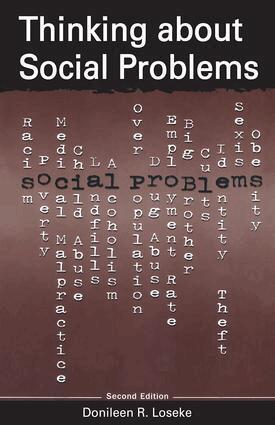
    Thinking About Social Problems

    An Introduction to Constructionist Perspectives

    AvDonileen R. Loseke

    Häftad, Engelska, 2003

    Del i serien Social Problems and Social Issues

    689 kr

    Beställningsvara. Skickas inom 10-15 vardagar. Fri frakt över 249 kr.

    Fler format och utgåvor

    Inbunden

    2 425 kr

    E-bok

    908 kr

    E-bok

    906 kr

    Beskrivning

    Like the first edition of this distinctive and widely adopted textbook, the new second edition brings into the classroom an overview of how images of social problems can shape not only public policy and social services, but also the ways in which we make sense of ourselves and others. It introduces two primary changes from the first edition. First, this edition devotes some attention to the ”new social movements” that emphasize social change through identity transformation rather than through structural change. Second, it also looks more closely at the importance of emotions in constructing public consciousness of social problems. Although Thinking About Social Problems can be used as a stand-alone short text and a corrective on received notions of studying the objective indicators of one problem a week, Donileen Loseke and Joel Best have provided an accompanying reader, Social Problems: Constructionist Readings, which can be used by those who wish to teach the course with reference to empirical examples of social problems examined from constructionist perspectives. Finally, an instructor’s manual on a CD-ROM will be available for instructors who adopt the new edition.

    Produktinformation

    • Utgivningsdatum:2003-03-27
    • Mått:152 x 229 x 15 mm
    • Vikt:323 g
    • Format:Häftad
    • Språk:Engelska
    • Serie:Social Problems and Social Issues
    • Antal sidor:250
    • Upplaga:2
    • Förlag:Taylor & Francis Inc
    • ISBN:9780202306841

    Utforska kategorier

    • Antropologi inom Samhälle och politik
    • Socialpsykologi och gruppsykologi inom Psykologi och pedagogik
    • Sociala och etiska frågor inom Samhälle och politik

    Mer om författaren

    Donileen R. Loseke, University of South Florida.

    Innehållsförteckning

    • Part I: Issues in Studying Social Problems 1 Examining Social Problems 2 Claims-Makers and Audience Part II: Constructing Packages of Claims 3 Constructing Conditions 4 Constructing People 5 Constructing Solution Part III: From Social Constructions to Social Actions 6 Social Problems and Everyday Life 7 Social Problems and Troubled People 8 Evaluating Constructionist Perspectives on Social Problems