• Fri frakt över 249 kr
  • •
  • Snabba leveranser
  • •
  • Billiga böcker
Kundservice

Du är på sajten för privatpersoner.

Företag, bibliotek eller offentlig verksamhet?

Du handlar på classic.bokus.com, där alla dina funktioner finns intakta.
Till classic.bokus.com
Bokus logotyp. Gå till startsidan.
  • Erbjudanden
  • Nyheter
  • Student
  • Topplistor
  • Barn & ungdom
  • Bokus Play
  • E-böcker
  • Pocketböcker
  • Spel & pussel

10% studentrabatt med kod TERM26

Sidfot

Mina sidor

    Hjälp

    • Kundservice
    • Vanliga frågor och svar
    • Frakt och leverans
    • Retur vid ångerrätt
    • Reklamera vara
    • Betalning
    • Köpvillkor
    • Allmänna villkor
    • Information om webbplatsens tillgänglighet

    Om Bokus

    • Om oss
    • Pressrum
    • För studenter
    • För företag
    • För bibliotek och offentlig verksamhet
    • För leverantörer
    • Hållbarhet

    Populärt

    • Aktuella erbjudanden
    • Presentkort
    • Studentlitteratur
    • Nya böcker
    • Topplistor
    • Signerade böcker
    • Engelska böcker

    Inspiration

    • Boktips
    • BookTok
    • Populära bokserier
    • Barnbokskaraktärer
    • Populära författare
    Logotyp för Bokus
    Följ oss på Facebook (extern länk)Följ oss på Instagram (extern länk)Följ oss på YouTube (extern länk)Följ oss på TikTok (extern länk)
    bokus @ CookiesAnpassa cookiesIntegritetspolicyKöpvillkor
    Till Citymail hemsida (extern länk)Till Budbee hemsida (extern länk)Till Postnord hemsida (extern länk)Till Schenker hemsida (extern länk)Till Early Bird hemsida (extern länk)Till Walleys hemsida (extern länk)
    1. Samhälle och politik
    2. Sociologi och antropologi
    3. Sociologi

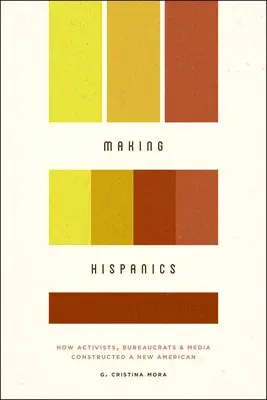
    Making Hispanics – How Activists, Bureaucrats, and Media Constructed a New American

    AvG Cristina Mora

    Häftad, Engelska, 2014

    276 kr

    Beställningsvara. Skickas inom 5-8 vardagar. Fri frakt över 249 kr.

    Beskrivning

    How did Puerto Ricans, Mexicans, and Cubans become known as "Hispanics" and "Latinos" in the United States? How did several distinct cultures and nationalities become portrayed as one? Cristina Mora answers both these questions and details the scope of this phenomenon in Making Hispanics. She uses an organizational lens and traces how activists, bureaucrats, and media executives in the 1970s and '80s created a new identity category-and by doing so, permanently changed the racial and political landscape of the nation. Some argue that these cultures are fundamentally similar and that the Spanish language is a natural basis for a unified Hispanic identity. But Mora shows very clearly that the idea of ethnic grouping was historically constructed and institutionalized in the United States. During the 1960 census, reports classified Latin American immigrants as "white," grouping them with European Americans. Not only was this decision controversial, but also Latino activists claimed that this classification hindered their ability to portray their constituents as under-represented minorities. Therefore, they called for a separate classification: Hispanic.Once these populations could be quantified, businesses saw opportunities and the media responded. Spanish-language television began to expand its reach to serve the now large, and newly unified, Hispanic community with news and entertainment programming. Through archival research, oral histories, and interviews, Mora reveals the broad, national-level process that led to the emergence of Hispanicity in America.

    Produktinformation

    • Utgivningsdatum:2014-03-07
    • Mått:151 x 228 x 15 mm
    • Vikt:378 g
    • Format:Häftad
    • Språk:Engelska
    • Antal sidor:232
    • Förlag:The University of Chicago Press
    • ISBN:9780226033839

    Utforska kategorier

    • Sociologi inom Samhälle och politik
    • Amerikas historia inom Historia och arkeologi
    • Etnicitet inom Samhälle och politik

    Mer om författaren

    G. Cristina Mora is assistant professor of sociology at the University of California, Berkeley.

    Recensioner i media

    "Mora has written an excellent and scholarly contribution to our understanding of the origins of the concept of 'Hispanic' and 'Latino.' It is a nuanced study that eschews political correctness, whether of the Left or Right, and instead documents the politics of ethnic labeling and identity." (Mario T. Garcia, University of California, Santa Barbara)"