• Fri frakt över 249 kr
  • •
  • Snabba leveranser
  • •
  • Billiga böcker
Kundservice

Du är på sajten för privatpersoner.

Företag, bibliotek eller offentlig verksamhet?

Du handlar på classic.bokus.com, där alla dina funktioner finns intakta.
Till classic.bokus.com
Bokus logotyp. Gå till startsidan.
  • Erbjudanden
  • Nyheter
  • Student
  • Topplistor
  • Barn & ungdom
  • Bokus Play
  • E-böcker
  • Pocketböcker
  • Spel & pussel

10% rabatt på allt med kod NYSTART10 →

Sidfot

Mina sidor

    Hjälp

    • Kundservice
    • Vanliga frågor och svar
    • Frakt och leverans
    • Retur vid ångerrätt
    • Reklamera vara
    • Betalning
    • Köpvillkor
    • Allmänna villkor
    • Information om webbplatsens tillgänglighet

    Om Bokus

    • Om oss
    • Pressrum
    • För studenter
    • För företag
    • För bibliotek och offentlig verksamhet
    • För leverantörer
    • Hållbarhet

    Populärt

    • Aktuella erbjudanden
    • Presentkort
    • Studentlitteratur
    • Nya böcker
    • Topplistor
    • Signerade böcker
    • Engelska böcker

    Inspiration

    • Boktips
    • BookTok
    • Populära bokserier
    • Barnbokskaraktärer
    • Populära författare
    Logotyp för Bokus
    Följ oss på Facebook (extern länk)Följ oss på Instagram (extern länk)Följ oss på YouTube (extern länk)Följ oss på TikTok (extern länk)
    bokus @ CookiesAnpassa cookiesIntegritetspolicyKöpvillkor
    Till Citymail hemsida (extern länk)Till Budbee hemsida (extern länk)Till Postnord hemsida (extern länk)Till Schenker hemsida (extern länk)Till Early Bird hemsida (extern länk)Till Walleys hemsida (extern länk)
    1. Medicin
    2. Klinisk medicin och internmedicin
    3. Sjukdomar och rubbningar
    4. Infektionssjukdomar och smittsamma sjukdomar

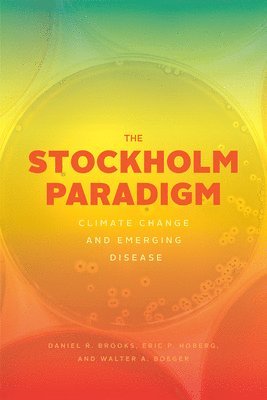
    Stockholm Paradigm

    Climate Change and Emerging Disease

    AvDaniel R. Brooks,Eric P. Hoberg

    Inbunden, Engelska, 2019

    1 106 kr

    Tillfälligt slut

    Fler format och utgåvor

    Häftad

    472 kr

    Beskrivning

    The contemporary crisis of emerging disease has been a century and a half in the making. Human, veterinary, and crop health practitioners convinced themselves that disease could be controlled by medicating the sick, vaccinating those at risk, and eradicating the parts of the biosphere responsible for disease transmission. Evolutionary biologists assured themselves that coevolution between pathogens and hosts provided a firewall against disease emergence in new hosts. Most climate scientists made no connection between climate changes and disease. None of these traditional perspectives anticipated the onslaught of emerging infectious diseases confronting humanity today.As this book reveals, a new understanding of the evolution of pathogen-host systems, called the Stockholm Paradigm, explains what is happening. The planet is a minefield of pathogens with preexisting capacities to infect susceptible but unexposed hosts, needing only the opportunity for contact. Climate change has always been the major catalyst for such new opportunities, because it disrupts local ecosystem structure and allows pathogens and hosts to move. Once pathogens expand to new hosts, novel variants may emerge, each with new infection capacities. Mathematical models and real-world examples uniformly support these ideas. Emerging disease is thus one of the greatest climate change-related threats confronting humanity.While time is short, the danger is great, and we are largely unprepared, The Stockholm Paradigm offers hope for managing the crisis. By using the DAMA (document, assess, monitor, act) protocol, we can "anticipate to mitigate" emerging disease, buying time and saving money while we search for more effective ways to cope with this challenge.

    Produktinformation

    • Utgivningsdatum:2019-07-19
    • Mått:152 x 229 x undefined mm
    • Format:Inbunden
    • Språk:Engelska
    • Förlag:The University of Chicago Press
    • ISBN:9780226632308

    Utforska kategorier

    • Infektionssjukdomar och smittsamma sjukdomar inom Medicin
    • Biovetenskap inom Naturvetenskap och teknik
    • Biologi inom Naturvetenskap och teknik

    Mer om författaren

    Daniel R. Brooks is a senior research associate of the Harold W. Manter Laboratory of Parasitology at the University of Nebraska State Museum. Among his many books, he is coauthor of Evolution as Entropy; Phylogeny, Ecology, and Behavior; and The Nature of Diversity, all published by the University of Chicago Press. Eric P. Hoberg is a field biologist, biogeographer, and parasitologist with appointments in the Museum of Southwestern Biology, University of New Mexico, and in the School of Veterinary Medicine, University of Wisconsin-Madison. Walter A. Boeger is full professor and coordinator in the Laboratory of Evolutionary Parasitology at the Universidade Federal do Paran in Curitiba, Brazil, a senior research fellow of the Harold W. Manter Laboratory at University of Nebraska, and an investigator with the Conselho Nacional de Desenvolvimento Cient fico e Tecnol gico (CNPq), Brazil.

    Recensioner i media

    "The authors make a passionate case for the link between climate change and emerging infectious diseases. These are two of the biggest threats facing humanity and in combination the risks are escalated even further. Raising awareness of this combined threat is an original, timely, and vital contribution. I am not aware of another book on this topic that comes close to this in terms of the breadth and depth of its ambition."--Ian Goldin, Professor of Globalisation and Development, University of Oxford "The Stockholm Paradigm provides a new perspective on how we should think about (and combat) emerging pathogens. The authors, all highly respected parasitologists, are well qualified to provide the historical context, broad synthesis, and contemporary urgency required for a shift in thinking, essentially away from reactive, for profit programs. A game changer for parasitology and public health efforts focused on emerging infectious diseases."--Joseph A. Cook, Professor of Biology, Curator of the Division of Mammals at the Museum of Southwestern Biology, University of New Mexico