• Fri frakt över 249 kr
  • •
  • Snabba leveranser
  • •
  • Billiga böcker
Kundservice

Du är på sajten för privatpersoner.

Företag, bibliotek eller offentlig verksamhet?

Du handlar på classic.bokus.com, där alla dina funktioner finns intakta.
Till classic.bokus.com
Bokus logotyp. Gå till startsidan.
  • Erbjudanden
  • Nyheter
  • Student
  • Topplistor
  • Barn & ungdom
  • Bokus Play
  • E-böcker
  • Pocketböcker
  • Spel & pussel

10% rabatt på allt med kod: NYSTART10 →

Sidfot

Mina sidor

    Hjälp

    • Kundservice
    • Vanliga frågor och svar
    • Frakt och leverans
    • Retur vid ångerrätt
    • Reklamera vara
    • Betalning
    • Köpvillkor
    • Allmänna villkor
    • Information om webbplatsens tillgänglighet

    Om Bokus

    • Om oss
    • Pressrum
    • För studenter
    • För företag
    • För bibliotek och offentlig verksamhet
    • För leverantörer
    • Hållbarhet

    Populärt

    • Aktuella erbjudanden
    • Presentkort
    • Studentlitteratur
    • Nya böcker
    • Topplistor
    • Signerade böcker
    • Engelska böcker

    Inspiration

    • Boktips
    • BookTok
    • Populära bokserier
    • Barnbokskaraktärer
    • Populära författare
    Logotyp för Bokus
    Följ oss på Facebook (extern länk)Följ oss på Instagram (extern länk)Följ oss på YouTube (extern länk)Följ oss på TikTok (extern länk)
    bokus @ CookiesAnpassa cookiesIntegritetspolicyKöpvillkor
    Till Citymail hemsida (extern länk)Till Budbee hemsida (extern länk)Till Postnord hemsida (extern länk)Till Schenker hemsida (extern länk)Till Early Bird hemsida (extern länk)Till Walleys hemsida (extern länk)
    1. Samhälle och politik
    2. Samhälle och kultur
    3. Kultur och medier
    4. Referensverk och tvärvetenskap

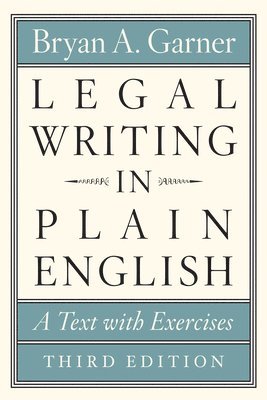
    Legal Writing in Plain English, Third Edition

    A Text with Exercises

    AvBryan A. Garner

    Häftad, Engelska, 2023

    Del i serien Chicago Guides to Writing, Editing, and Publishing

    248 kr

    Beställningsvara. Skickas inom 5-8 vardagar. Fri frakt över 249 kr.

    Beskrivning

    The leading guide to clear writing—and clear thinking—in the legal profession for more than two decades, now newly updated.  Admirably clear, concise, down-to-earth, and powerful—all too often, legal writing embodies none of these qualities. Its reputation for obscurity and needless legalese is widespread. Since 2001, Bryan A. Garner’s Legal Writing in Plain English has helped address this problem by providing lawyers, judges, paralegals, law students, and legal scholars with sound advice and practical tools for improving their written work. Now the leading guide to clear writing in the field, this indispensable volume encourages legal writers to challenge conventions and offers valuable insights into the writing process: how to organize ideas, create and refine prose, and improve editing skills.Accessible and witty, Legal Writing in Plain English draws on real-life writing samples that Garner has gathered through decades of teaching experience. Trenchant advice covers all types of legal materials, from analytical and persuasive writing to legal drafting, and the book’s principles are reinforced by sets of basic, intermediate, and advanced exercises in each section.For this third edition, Garner has retained the structure of the previous versions, with updates and new material throughout. There are new sections on making your writing vivid and concrete and on using graphics to enhance your argument. The coverage and examples of key topics such as achieving parallelism, avoiding legalese, writing effective openers and summaries, and weaving quotations into your text have also been expanded. And the sample legal documents and exercises have been updated, while newly added checklists provide quick summaries of each section.  Altogether, this new edition will be the most useful yet for legal professionals and students seeking to improve their prose.

    Produktinformation

    • Utgivningsdatum:2023-09-06
    • Mått:165 x 235 x 25 mm
    • Vikt:567 g
    • Format:Häftad
    • Språk:Engelska
    • Serie:Chicago Guides to Writing, Editing, and Publishing
    • Antal sidor:336
    • Upplaga:3
    • Förlag:The University of Chicago Press
    • ISBN:9780226816548

    Utforska kategorier

    • Referensverk och tvärvetenskap inom Samhälle och politik
    • Juridisk kompetens och praktik inom Juridik

    Mer om författaren

    Bryan A. Garner is president of LawProse, Inc., and Distinguished Research Professor of Law at Southern Methodist University. He is the author of the “Grammar and Usage” chapter of The Chicago Manual of Style and editor-in-chief of Black’s Law Dictionary. Garner is also the author of several best-selling books, including Garner’s Modern English Usage and, with Justice Antonin Scalia, Reading Law: The Interpretation of Legal Texts and Making Your Case: The Art of Persuading Judges.

    Innehållsförteckning

    • PrefaceIntroductionPart One: Principles for All Legal Writing1. Framing Your Thoughts§ 1. Have something to say, and think it through. Approach your task with a fervent desire to get your message across.§ 2. Carry out your writing projects in four steps: think and research; plan and organize; write; revise.§ 3. Order your material in a logical sequence. Present facts chronologically. For other material, make the order (a) deductive, (b) comparative, or (c) spatial. Keep related material together.§ 4. Use informative headings to mark sections and, if helpful, subsections.2. Phrasing Your Sentences§ 5. Exclude unnecessary words.§ 6. Keep your average sentence length to about 20 words.§ 7. Keep the subject, the verb, and the object together—toward the beginning of the sentence.§ 8. Use parallel phrasing for parallel ideas: don’t pair unlike grammatical forms.§ 9. Use strong, precise verbs. Minimize is, are, was, and were—especially when they are part of a passive-voice construction.§ 10. Avoid multiple negatives.§ 11. End sentences emphatically.3. Choosing Your Words§ 12. Use plain English, not legalese.§ 13. Be wary of pretension, officialese, and stiff formulas.§ 14. Simplify wordy phrases—especially those containing of.§ 15. Avoid zombie nouns—especially -ion words that you can turn into verbs.§ 16. Avoid doublets and triplets.§ 17. Refer to people and companies by name. Never use corresponding terms ending in -or and -ee.§ 18. Use shorthand names only when you must. Shun unfamiliar acronyms.§ 19. Make it snappy, vivid, and interesting.§ 20. Be a companionable voice of reason. Make everything you write speakable.Part Two: Principles Mainly for Analytical and Persuasive Writing§ 21. Plan all three parts: the beginning, the middle, and the end.§ 22. For the all-important opener, use the deep issue to state the problem clearly.§ 23. Summarize concretely and effectively. But don’t overparticularize with dates and similar unimportant details.§ 24. Make your paragraphs cohesive. Introduce each one with a topic sentence.§ 25. Link your paragraphs explicitly.§ 26. Vary the length of your paragraphs, but keep them generally short.§ 27. Provide textual signposts along the way.§ 28. Unclutter the text by footnoting citations. Keep the footnotes free of sentences.§ 29. Weave quotations deftly into your prose. “Quotation sandwiches” are hard to skip.§ 30. Be forthright in dealing with counterarguments.Part Three: Principles Mainly for Legal Drafting§ 31. Draft for an ordinary reader, not for a mythical judge who might someday review the document.§ 32. Organize provisions in descending order of importance. Use a good numbering system and abundant headings to make things easy to find.§ 33. Minimize definitions and cross-references. If you have more than a few definitions, put them in a schedule at the end, not at the beginning.§ 34. Break down enumerations into parallel provisions. Put every list of subparts at the end of the sentence—never at the beginning or in the middle.§ 35. Replace every shall.§ 36. Don’t use provisos.§ 37. Replace and/or wherever it appears.§ 38. Prefer the singular over the plural.§ 39. Use numerals, not words, to denote amounts. Avoid word–numeral doublets.§ 40. If you don’t understand a form provision—or why it should be included in your document—try diligently to gain that understanding. If you still can’t understand it, cut it.Part Four: Principles for Document Design§ 41. Make sensible choices about typography: use a readable font and type size, don’t underline, minimize all-caps and initial caps, and put one space between sentences.§ 42. Create ample white space—and use it meaningfully.§ 43. Highlight ideas with attention-getters such as bullets.§ 44. Use graphics whenever they can enhance your message.§ 45. For a long document, make a table of contents.Part Five: Methods for Continued Improvement§ 46. Embrace constructive criticism.§ 47. Edit your work rigorously and systematically.§ 48. Seek out reliable answers to questions of grammar and usage.§ 49. Habitually gauge your own readerly likes and dislikes, as well as those of other readers.§ 50. Remember that good writing makes the reader’s job easy; bad writing makes it hard.Appendix A: A Restatement of PunctuationAppendix B: Four Model Documents1. Research Memos2. Motions3. Appellate Briefs4. ContractsKey to Basic ExercisesBibliographyIndex